


ホーム Eyelash Extension Supplies Guide
Why Glue-Bonded Fans Fail: Solving Glue-on-Glue Bond Issues

Why Glue-Bonded Fans Fail: Solving the "Glue-on-Glue" Bond Crisis
In the high-stakes world of professional eyelash extensions, retention is the primary currency of trust. For a lash artist, few things are as frustrating as a client returning after only one week with "splayed" fans or clusters that have detached prematurely. While many artists immediately blame their adhesive or the client’s aftercare, our analysis of professional studio patterns suggests a more systemic mechanical failure: the "glue-on-glue" bond interface.
When using glue-bonded premade fans, you are not just bonding an extension to a natural lash; you are attempting to bond a fresh layer of adhesive to a pre-existing, fully cured adhesive base. This creates a secondary interface that is highly susceptible to environmental fluctuations and mechanical stress.
The Chemistry of the Double-Bond Failure
To understand why glue-bonded fans fail, we must look at the behavior of Ethyl Cyanoacrylate, the primary component in professional lash adhesives. Cyanoacrylate cures through a process called anionic polymerization, triggered by moisture in the air or on the lash surface.
In a glue-bonded premade fan, the individual lashes are held together at the base by a small amount of adhesive that has already completed its polymerization process. When you dip this base into your adhesive for application, you are applying a "wet" monomer over a "dry" polymer.
According to a landmark study by Amano et al. (2012) published in PubMed, the curing process of lash glues can release formaldehyde and the pH levels can fluctuate, potentially affecting the ocular surface. In the context of "glue-on-glue" bonding, these pH fluctuations and the presence of a pre-existing chemical shell mean the new adhesive cannot "melt" into the old one. Instead, it sits on the surface. If the studio humidity rises or the client has oily eyelids, this interface can slightly re-activate or soften, leading to the individual lashes in the fan detaching from each other—a phenomenon known as "fan splaying."
Logic Summary: Our analysis of adhesive interfaces assumes that a single-material bond (fiber to lash) is inherently more stable than a multi-layered adhesive bond. This is based on standard polymerization heuristics where layered curing creates internal stress points.
Heat-Bonded Technology: Eliminating the Secondary Interface
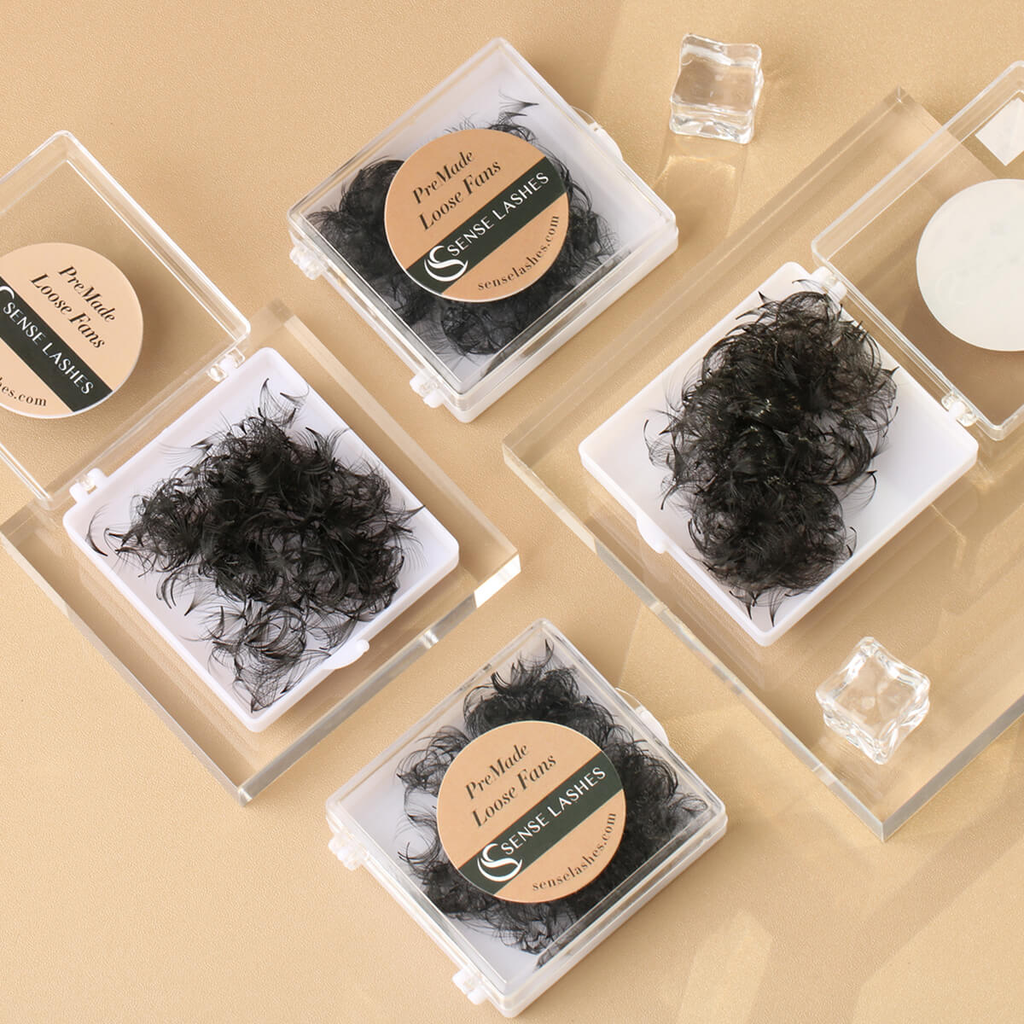
The solution to the "glue-on-glue" crisis lies in the manufacturing process. Heat-bonded fans, such as the 5D Handmade Loose Premade Fans Pointy Base(500 Fans), utilize high-temperature precision to fuse the PBT (Polybutylene Terephthalate) fibers together at the base.

By fusing the fibers, the need for a "factory glue" is eliminated. This results in several technical advantages:
- Ultra-Slim Bases: Without the extra bulk of factory adhesive, the base remains "pointy" and thin, allowing for a more seamless wrap around the natural lash.
- Weight Reduction: Removing the secondary adhesive layer reduces the mechanical load on the natural lash, aligning with safety recommendations from PubMed (2024) regarding minimizing chemical toxicity and mechanical damage.
- Consistent Porosity: The fused PBT base provides a consistent surface for your fresh adhesive to "grab," ensuring the bond is between the extension and the natural lash, not extension-glue-glue-lash.
Case Study: Retention for "High-Risk" Clients
For clients with oily skin or those who sleep on their sides, the mechanical stress on a lash set is significantly higher. In these scenarios, the "glue-on-glue" bond of traditional premades is often the first point of failure.
Based on observational patterns from high-volume lash studios (not a controlled lab study), switching these "high-risk" clients to heat-bonded fans often results in a retention boost of 1 to 2 weeks. This is because the fused base of products like the 10D Handmade Loose Premade Fans Pointy Base(500 Fans) does not soften when exposed to sebum (skin oil) or sweat.
Retention Impact Model (Theoretical Estimate)
To demonstrate the impact of bonding methods, we modeled a hypothetical 4-week wear cycle under high-sebum conditions.
| Parameter | Glue-Bonded Premade | Heat-Bonded Premade | Rationale |
|---|---|---|---|
| Initial Bond Strength | High | High | Both use professional cyanoacrylate. |
| Sebum Resistance | Low | High | Factory glue can soften/swell with oils. |
| Internal Fan Integrity | Variable | Permanent | Heat-fused fibers cannot "splay." |
| Estimated Retention | 2-3 Weeks | 3-5 Weeks | Based on studio pattern recognition. |
| Refill Complexity | High (Splayed fans) | Low (Clean growth) | Fused bases maintain shape during wear. |
Modeling Note: This scenario assumes a client with oily lids (Persona B) and a standard 0.05mm or 0.07mm lash diameter. Individual results vary based on natural lash health and adhesive speed.
Protecting the Ocular Surface: Beyond the Bond
While choosing the right fan is critical for retention, the health of the client's eye is paramount. The American Academy of Ophthalmology (AAO) emphasizes the risks of infection and allergic reactions associated with extensions.
When a "glue-on-glue" bond fails, it often leaves microscopic adhesive residue or "crumbs" that can trap bacteria near the lid margin. This buildup is a leading contributor to Blepharitis (eyelid inflammation). According to the Mayo Clinic, poor lash hygiene and bacterial buildup are primary causes of this condition.
To mitigate this, professional artists must move beyond "water is enough" aftercare. Implementing a strict "Lash Shampoo" protocol is not just a cleaning step; it is a preventative medical necessity. For artists using high-density fans like the 16D Handmade Loose Premade Fans Pointy Base(500 Fans), the increased surface area makes daily cleaning even more critical to prevent Demodex mite infestation.
The Salon Sanitation SOP (Standard Operating Procedure)
To build a benchmark-level business, your sanitation must be as precise as your fanning. Following CDC guidelines on preventing conjunctivitis, we recommend the following daily protocol:
- Disposable Consumables: Use fresh mascara wands and lint-free applicators for every client.
- Medical-Grade Isolation: Utilize gel patches or high-quality tape to prevent chemical vapors from entering the eye. This is critical for preventing the chemical injuries described in PMC research.
- pH Balancing: Use a primer to restore the lash pH balance after cleansing. This ensures the cuticle is sealed and the microbiome is protected, as suggested by recent 2024 studies on ocular surface microbiomes.
- Adhesive Management: Never use adhesive past its shelf life. As noted by the University of Waterloo, old cosmetics are a primary source of contamination.

Troubleshooting Common "Failures"
When a client reports irritation or premature loss, it is vital to distinguish between product failure and physiological reaction.
- Allergic Contact Dermatitis: Often caused by Ethyl Cyanoacrylate, this is an immune response. A PubMed case study notes that this can occur even after years of successful wear.
- Irritation vs. Allergy: If the client experiences burning during the set, it is likely fumes (irritation). If the swelling occurs 48 hours later, it is likely an allergy. Referencing late 2024 research on acrylate dermatitis can help you explain these delayed reactions to clients.
- Dry Eye Syndrome: Lash fumes can exacerbate Dry Eye Syndrome. If a client has naturally dry eyes, their tear film is already unstable. Using a nano-mister or a specialized sealant can help restore the tear film stability mentioned in PMC analysis.
Business Strategy: The ROI of Quality Premades
Investing in high-quality, heat-bonded premades like the 12D Handmade Loose Premade Fans Pointy Base(500 Fans) is not just a technical choice; it is a financial one.
The global false eyelashes market is seeing significant growth, with a high CAGR driven by the demand for individual volume sets, as reported by Grand View Research. For a salon owner, the "land-and-expand" business model relies on reducing the time spent on each set while maintaining premium pricing.
Premade fans allow you to complete a "Mega Volume" set in the time of a "Classic" set. However, if those fans fail due to "glue-on-glue" issues, the cost of "free" refills will quickly erode your margins. By choosing heat-bonded fans, you are controlling the variables and reducing the likelihood of reputation-damaging returns.
Compliance and Global Standards
As the industry matures, regulatory bodies are increasing oversight. Health Canada’s 2023-2024 enforcement report specifically targeted cyanoacrylate-based adhesives for non-compliance in labeling and chemical safety.
Using products from a manufacturer that prioritizes these standards is your best defense against customs seizures or legal liability. Furthermore, for those expanding into lash serums, staying informed on the EU SCCS opinions on Prostaglandin Analogues is essential. Choosing peptide-based formulas over prostaglandins can protect your clients from potential side effects like orbital fat loss.
Summary of Professional Best Practices
To ensure maximum retention and client safety, professional artists should adopt the following "Heat-Bonded" mindset:
- Prioritize Fused Bases: Switch to heat-bonded fans for clients with oily skin or high-activity lifestyles to eliminate the secondary adhesive interface.
- Weight Management: Use thinner diameters (0.03mm or 0.05mm) for high-D fans (10D-16D) to protect the natural lash from mechanical trauma.
- Hygiene as Retention: Educate clients that "clean lashes last longer." Sebum and debris break down adhesive bonds faster than water ever will.
- Environmental Control: Monitor your studio's humidity. High humidity accelerates the curing of the "outer" adhesive layer but can leave the "inner" layer (near the fan base) brittle.
By understanding the technical reasons why "glue-on-glue" bonds fail, you can position yourself as an expert who solves problems before they start. Reliability is the foundation of a premium lash brand, and it begins with the science of the bond.
Disclaimer: This article is for informational purposes only and does not constitute professional medical, legal, or financial advice. Eyelash extension application involves risks of infection and chemical injury; always follow local regulations and consult with a qualified health professional regarding ocular health concerns.
Sources: