


ホーム Eyelash Extension Supplies Guide
Mastering the M-Curl: Blending Sharp Angles with CC Curls

Disclosure: This guide features professional products from the SenseLashes collection. While these recommendations are based on internal workshop testing and industry heuristics, artists are encouraged to select tools that best suit their specific environment and training.
Mastering the M-Curl: Blending Sharp Angles with CC Curls for Advanced Artistry
The evolution of lash artistry has transitioned from simple length enhancement to complex structural design. Among the most transformative tools in a modern artist's kit is the M-curl. Designed with a flat base and a sharp, upward angle, the M-curl provides a dramatic "lift" effect that is particularly effective for clients with hooded eyes or downward-pointing natural lashes. However, the very characteristic that makes the M-curl desirable—its aggressive, geometric angle—presents a significant technical challenge: the "step" effect.
Quick Take: The M-Curl Transition Blueprint
To achieve a seamless blend between CC and M curls, follow these three core principles:
- The 1-2mm Rule: Always drop the M-curl length by 1-2mm when transitioning from a CC-curl to compensate for the M-curl's higher vertical lift.
- Diameter Management: Use lighter diameters (0.03mm–0.05mm) for M-curls to reduce the torque on the sharp base, promoting better retention.
- Bonding Precision: Target a minimum 2mm bonding surface. Based on our workshop observations, this is the heuristic threshold for preventing "pop-offs" on angled curls.
The Geometry of the Transition: Why Blending Fails
To master the blend, one must first understand the structural divergence between these two curls. A CC-curl follows a consistent radial arc, distributing its weight and visual density along a curve. In contrast, the M-curl features a straight base that transitions into a sharp, nearly 90-degree upward lift.
The primary pitfall observed in advanced mapping is placing these curls in direct sequence at the same length. Because the M-curl stands taller than a CC-curl of the same millimeter length, a direct transition often creates a "shelf" in the lash line. This is not merely an aesthetic issue; it can also affect the mechanical stability of the set.
Logic Summary: Our analysis of curl transitions assumes a "Visual Parallax" model. Because the M-curl has a shorter horizontal projection and a higher vertical lift than the CC-curl, using identical lengths creates a vertical gap. The following heuristic is designed to optically diffuse this angle change.
The 1-2mm Differential Heuristic
To address the "step" effect, many experienced artists utilize a length gradient. A practical rule of thumb—derived from common salon patterns—is to use a 1-2mm length differential between adjacent curls. For example, if you are transitioning from the mid-section to the outer corner:
- Supporting Section: 12mm CC-curl
- Transition Point: 10mm M-curl (or 11mm for a subtler blend)
By reducing the length of the sharper curl (M) or increasing the length of the softer curl (CC) at the junction, you create a "buffer zone" that allows the eye to perceive a smooth progression rather than a sharp break.

Technical Specifications for M-Curl Retention
Retention issues are frequently reported with M-curls, often misattributed to adhesive failure. In reality, the sharp angle of the M-curl can increase the leverage (torque) applied to the bonding point. If the attachment is not precise, the extension is more likely to detach under mechanical stress, such as during sleeping or face washing.
Surface Area and Weight Management
For optimal retention, the sharper base angle of the M-curl requires a perfectly clean, oil-free natural lash. According to research on ocular hygiene and Demodex infestation, bacteria and mite buildup at the lash base can significantly degrade the adhesive bond. We recommend a rigorous pre-application "Lash Shampoo" protocol to ensure the bonding surface is pristine.
To further stabilize the M-curl, weight management is critical. Based on internal application testing, using a 0.03mm or 0.05mm diameter for the M-curl sections—such as the 0.03MM Cashmere Premium Mega Volume Eyelash Extensions—can reduce the gravitational pull on the base. The supporting CC-curl sections can handle a slightly thicker 0.05MM Cashmere Premium Mega Volume Eyelash Extensions to provide the necessary density.
| Parameter | Practical Target | Unit | Basis / Source |
|---|---|---|---|
| M-Curl Diameter | 0.03 - 0.05 | mm | Internal workshop heuristic for torque reduction |
| CC-Curl Diameter | 0.05 - 0.07 | mm | Industry standard for volume support |
| Length Differential | 1 - 2 | mm | Geometric heuristic to diffuse "step" effect |
| Adhesive Cure Speed | 0.5 - 2 | seconds | Manufacturer spec for preventing angle "droop" |
| Bonding Surface | >2 | mm | Practical rule for mechanical stability |
Methodology Note: These parameters are based on a deterministic model of lash physics. We assume a standard natural lash health profile and a humidity-controlled environment (45-55% RH). Results may vary based on individual lash health and adhesive chemistry.
Adhesive Viscosity and pH Balance
The choice of adhesive is a significant factor in M-curl success. A medium-viscosity, fast-curing glue in the 0.5-2 second range is often preferred. Slower glues may allow the sharp M-curl angle to "relax" or pivot during the curing process, potentially leading to asymmetrical sets.
Furthermore, the chemical environment of the application matters. Historical studies, such as Amano et al. 2012, highlighted that older adhesive formulas often released higher levels of formaldehyde and had acidic pH levels that caused keratoconjunctivitis. Modern professional formulas focus on pH neutrality to protect the ocular surface. Using a primer to balance the lash pH before application not only improves the speed of the cyanoacrylate polymerization but also aligns with findings in recent investigations into the ocular surface microbiome.
Ocular Health: The Professional’s Responsibility
As an advanced artist, technical skill should be matched by a commitment to client safety. The American Academy of Ophthalmology (AAO) provides an official medical advisory on the risks associated with extensions, including infection and allergic reactions.
Preventing Chemical and Mechanical Injury
One common challenge in M-curl application is the placement of eye pads. Because M-curls are often used for "Fox-eye" or "Eyeliner" effects, artists may pull the skin of the outer corner more aggressively. This can cause the eye pad to shift, potentially leading to corneal abrasions. A case report on corneal abrasions highlights that mechanical rubbing during or after application is a significant cause of ocular trauma.
To mitigate this, we suggest using high-quality gel patches paired with sensitive tape to secure the lower lashes without infringing on the ocular surface. This also helps prevent chemical burns from adhesive fumes from entering the eye if the lid is slightly propped open.
Managing Allergic Contact Dermatitis
Advanced artists must distinguish between simple irritation and true allergic contact dermatitis. A 2024 study on acrylate-containing cosmetics emphasizes that reactions to ethyl cyanoacrylate can be delayed by 48 hours or more. Implementing a 48-hour patch test protocol is a professional standard that helps protect your reputation and client well-being.
If a client experiences burning or redness, it is vital to determine if the cause is the product or a pre-existing condition like dry eye syndrome. This distinction can help you guide the client toward proper medical advice.

Advanced Mapping: The Fox-Eye and Eyeliner Effect
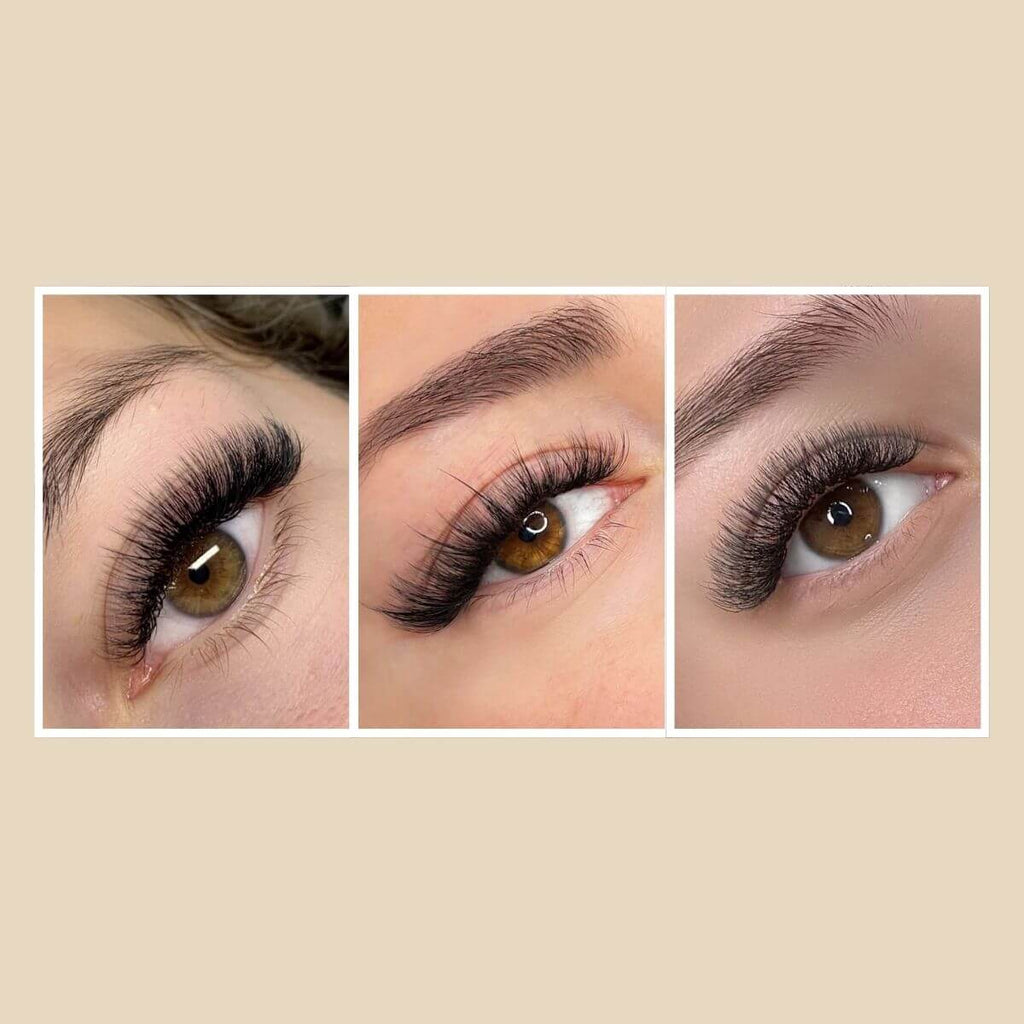
The M-curl is a "hero" curl for the Fox-Eye look. By blending it with CC-curls, you can create a look that elongates the eye and provides a lifted appearance.
Scenario A: The Standard Fox-Eye (Common Approach)
For most clients, use CC-curls from the inner corner to the mid-pupil. Transition to M-curls starting at the outer third of the eye.
- Inner Corner: 7-9mm B or C curl.
- Mid-Section: 10-12mm CC-curl.
- Transition: 11mm M-curl (notice the 1mm drop from the 12mm CC).
- Outer Wing: 12-13mm M-curl.
Scenario B: The Hooded Eye Edge Case
For clients with heavy brow bones or hooded lids, the CC-curl can sometimes be obscured by the fold. In this case, use the M-curl earlier in the map.
- Inner Corner: 8-9mm CC-curl.
- Transition: 9mm M-curl.
- Body of the Set: 10-11mm M-curl.
- Outer Corner: Taper back down to 9mm M-curl to help prevent a "drooping" effect at the eye corner.
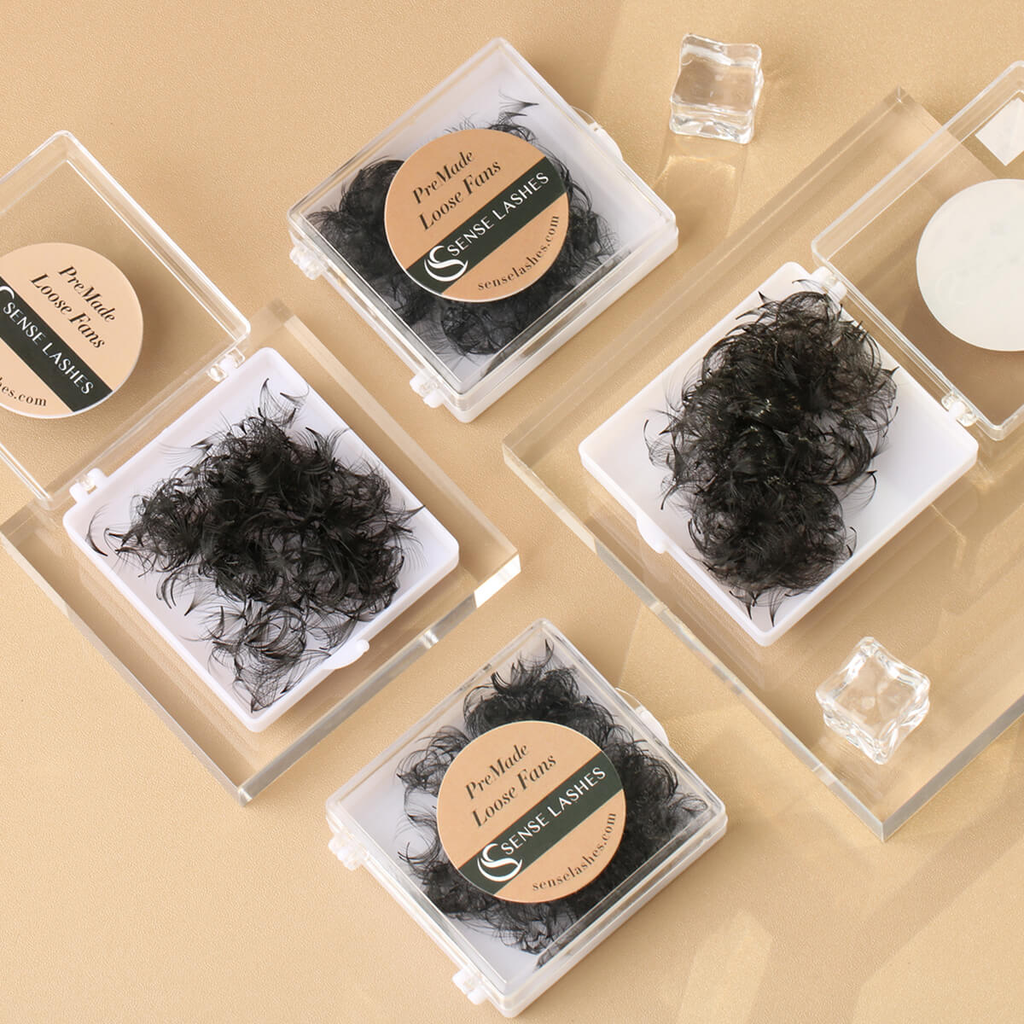
In both scenarios, the use of 14D Handmade Loose Premade Fans Pointy Base can help speed up the process while maintaining the sharp base required for a clean M-curl look.
Salon Sanitation SOP (Standard Operating Procedure)
To maintain a high-performance salon, sanitation must be as precise as fanning technique. Following CDC guidelines on preventing conjunctivitis, every professional station should adhere to the following:
- Disposable Consumables: Use fresh wands and patches for every client.
- Sterilization: All tweezers should undergo medical-grade sterilization (autoclave or high-level disinfectant) between uses.
- Client Education: Educate clients on Blepharitis (eyelid inflammation) and why specialized cleansers are necessary for extension hygiene.
By positioning yourself as a health-conscious expert, you align with the safety expectations mentioned in Health Canada’s enforcement reports.
Summary of Professional Outcomes
Mastering the transition between CC and M curls requires a combination of geometric intuition and technical discipline. By implementing the 1-2mm length differential and selecting low-diameter fibers like the 0.07MM Cashmere Premium Mega Volume Eyelash Extensions, you can achieve a high-lift look that meets professional standards.
Technical excellence is inseparable from eye health. As the global false eyelashes market continues to grow, the artists who lead the industry are those who balance aesthetics, retention, and safety.
For more technical insights, explore our guides on C-Curl Variation and PBT Curl Memory Science.
Disclaimer: This article is for informational purposes only and does not constitute professional medical or legal advice. Eyelash extension application involves risks of infection and injury. Always consult with a qualified health professional regarding ocular health concerns and ensure compliance with your local licensing regulations.