


ホーム Eyelash Extension Supplies Guide
Calculating Lash Load: The Hidden Weight of Glue-Bonded Fans

Understanding Lash Load: The Technical Reality of Adhesive Mass
In the pursuit of high-impact volume, professional lash artists often focus on two primary variables: lash diameter and the number of fibers in a fan (the "D" count). However, a critical third variable frequently goes uncalculated: the mass of the adhesive bond itself. As the industry moves toward more complex mega-volume sets, understanding "Lash Load"—the total weight exerted on a natural lash—is no longer optional. It is a fundamental requirement for maintaining long-term lash health and client safety.
When we evaluate the difference between glue-bonded and heat-bonded fans, we aren't just comparing application speed. We are comparing the mechanical stress placed on the hair follicle. Recent observations within professional communities and technical assessments of premade fans suggest that the method of fan construction significantly alters the total weight profile.

The Manufacturing Divide: Heat-Bonded vs. Glue-Bonded
To manage lash load effectively, an artist must understand how these fans are created at the factory level.
Glue-Bonded Fans
Glue-bonded premade fans are held together at the base by a small amount of adhesive during the manufacturing process. While this ensures the fan remains intact during shipping and pickup, it introduces a "double-bonding" scenario. When the artist dips this fan into their own adhesive—such as the 0.5-1 Second Diamond Eyelash Extension Glue—they are adding a second layer of cyanoacrylate to a base that already contains cured adhesive.
Heat-Bonded Fans
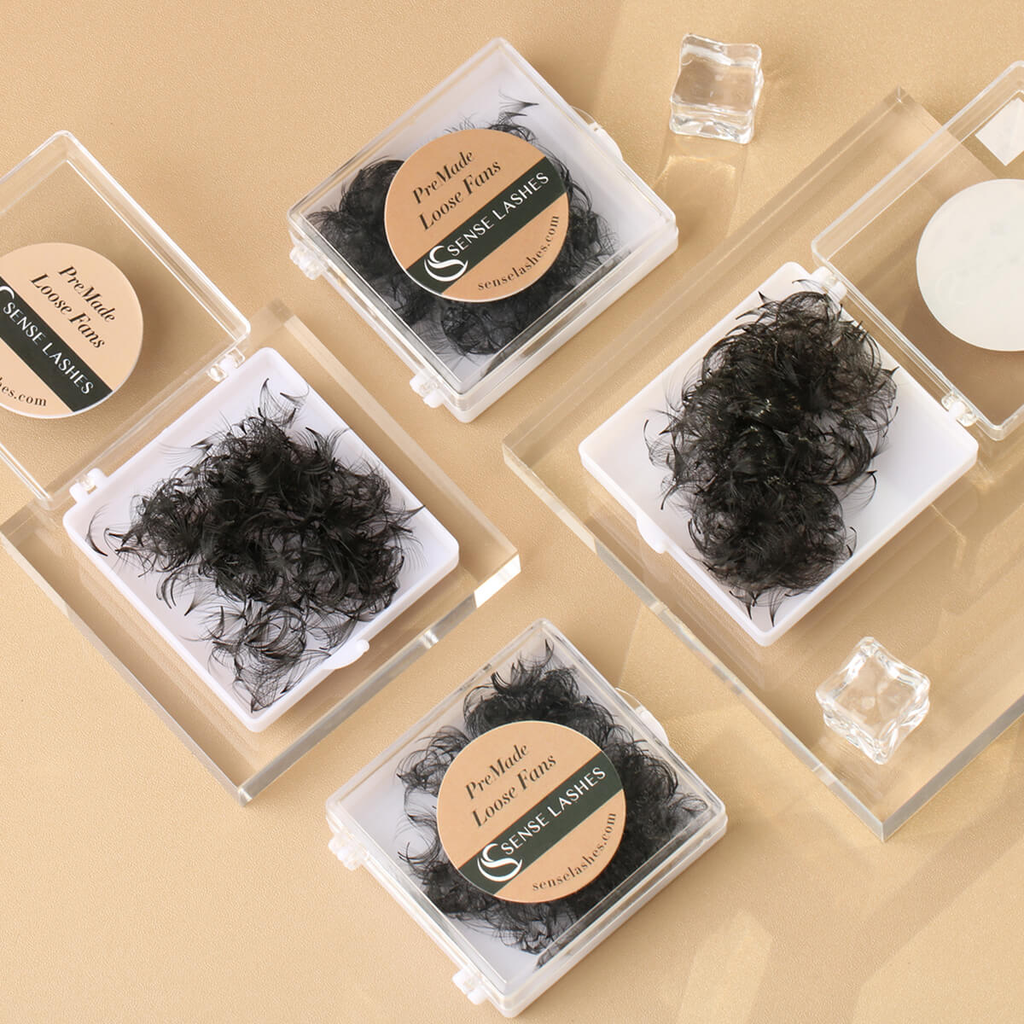
In contrast, heat-bonded fans, such as the 12D Handmade Loose Premade Fans Pointy Base(500 Fans), use a thermal process to fuse the bases of the PBT (Polybutylene Terephthalate) fibers together. This creates a "pointy base" that is virtually indistinguishable from a hand-made fan. Because there is no factory-applied adhesive, the only weight added to the natural lash is the fiber mass and the single layer of adhesive applied by the artist.
Logic Summary: Our analysis of lash load assumes that heat-bonded fans represent the "baseline" weight of the fibers, whereas glue-bonded fans include a pre-existing mass of cured cyanoacrylate. This modeling is based on common industry heuristics regarding manufacturing processes.
Quantifying the Adhesive Mass: Why 15-25% Matters
Experienced lash artists have observed that the weight of the adhesive bond is often the "hidden" factor in premature shedding. In practice, a glue-bonded 10D fan can add 15-25% more total weight to the natural lash compared to an identical heat-bonded fan. This extra mass primarily resides in the "adhesive blob" at the base.
While 20% may seem negligible in a single fan, the cumulative effect across a full set of 80 to 120 lashes is substantial. This extra mass is a primary contributor to "lash fatigue," a condition where clients report tenderness or increased shedding after 2-3 weeks, even when isolation is perfect.
The 50% Heuristic for Lash Health
To protect the natural lash, a reliable professional heuristic is to aim for a total extension weight (lash + bond) that does not exceed 50% of the estimated weight of a healthy, mature natural lash.
| Parameter | Value / Range | Rationale |
|---|---|---|
| Max Total Load | < 50% of natural lash mass | Prevents traction on the follicle |
| Adhesive Weight (Glue-Bonded) | +15-25% over fiber weight | Cumulative mass of double-bonding |
| Fiber Diameter (Mega Volume) | 0.03mm to 0.05mm | Reduces base mass for high D-counts |
| Safety Margin | 10-15% reduction for fine lashes | Critical for Asian or mature lash profiles |
For clients with fine or sparse lashes, this ratio becomes even more restrictive. Switching to ultra-lightweight options like 30D Handmade Loose Premade Fans Pointy Base(500 Fans) or even 40D Handmade Loose Premade Fans Pointy Base(500 Fans) allows for high-density looks while keeping the base weight manageable through heat-bonding technology.

Clinical Implications of Excessive Weight
Overloading the natural lash isn't just an aesthetic concern; it has documented physiological consequences. According to the American Academy of Ophthalmology (AAO), risks associated with eyelash extensions include traction alopecia—permanent hair loss caused by excessive tension on the hair follicle.
Mechanical Stress and Ocular Surface Changes
A study published in PMC (Ocular Surface Changes) highlights how extensions can affect tear film stability. When a lash is overloaded, it may droop or tilt, causing the extensions to interfere with the natural blink mechanism. This mechanical interference can lead to meibomian gland dysfunction, as the glands are not properly "milked" during a full blink, potentially resulting in dry eye syndrome.
The "Ugly Truth" of Bacteria Buildup
Excessive adhesive mass doesn't just add weight; it creates surface area. Bulky glue bonds are prone to trapping sebum, dead skin cells, and cosmetic residue. This creates an ideal environment for Demodex mites and bacteria. Research on Demodex mite infestation emphasizes that ocular hygiene is non-negotiable. For the professional, this means that a cleaner, slimmer base—like those found in heat-bonded fans—is inherently easier for the client to keep clean, reducing the risk of Blepharitis.
Troubleshooting Failure Modes: The "Hinge Point" Effect
Beyond the health risks, excessive weight at the base changes the physics of the extension's movement. A common failure mode observed with bulkier glue bonds is the creation of a "hinge point."
Because the glue-bonded base is rigid and thick, it does not flex with the natural lash. When a client sleeps or rubs their eyes, the extension acts as a lever. The rigid base creates a point of high stress where the extension meets the natural lash. This often leads to the extension "twisting" or catching, which can cause the natural lash to snap or be pulled out prematurely (traction).
Heat-bonded fans, by contrast, offer a more seamless transition from the natural lash to the extension. The slimmer base allows the bond to be more flexible, which improves retention by an estimated 10-15% in real-world scenarios by reducing the mechanical leverage that causes lifting.
The Chemistry of Allergic Reactions vs. Irritation
As a risk manager for your clients, it is vital to distinguish between chemical irritation and true allergic contact dermatitis. A PubMed study on Ethyl Cyanoacrylate notes that allergic reactions are often immune-mediated and can develop over time.
However, many "reactions" are actually irritations caused by the off-gassing of formaldehyde, a byproduct of cyanoacrylate curing. Historical data, such as the Amano et al. 2012 study, pointed out that older adhesive formulas were often acidic and released significant formaldehyde. Modern, high-performance adhesives like the 0.5-1 Second Diamond Eyelash Extension Glue are engineered to be pH-balanced and low-fume, but the volume of glue used still matters. More glue equals more fumes. By using heat-bonded fans, you reduce the total volume of cyanoacrylate required per eye, thereby lowering the cumulative exposure to fumes.
Professional Risk Management: Sanitation and Consent
To operate a truly authoritative lash business, your technical skill must be matched by your administrative protocols.
Salon Sanitation SOPs
Following CDC guidelines on preventing conjunctivitis is the baseline. This includes the use of disposable consumables and medical-grade sterilization for tweezers. When you explain these protocols to your clients, you are not just "cleaning"; you are performing clinical risk management.
Client Safety Consent
Using resources like the AAO advisory, professionals should implement a comprehensive "Client Safety Consent Form." This form should explicitly mention the risks of overloading and the importance of following aftercare to prevent conditions like blepharitis. This transparency bridges the "compliance signaling gap," positioning you as an expert who prioritizes health over a "more is better" mentality.

Strategic Implementation for Salon Longevity
For the salon owner, the decision between glue-bonded and heat-bonded fans is a business strategy. While glue-bonded fans might be cheaper to procure, the long-term cost of damaged natural lashes, poor retention, and client dissatisfaction is much higher.
Case Study: Fine Lash Profiles
In many cases, particularly with Asian or mature clients, the natural lashes are shorter and have a finer diameter. Applying a traditional 0.15mm classic lash or a heavy glue-bonded volume fan can cause the lash to droop instantly.
- The Solution: Use 0.03mm heat-bonded fans.
- The Result: The reduced mass allows the natural lash to remain in its natural upward orientation, providing a better aesthetic result and preserving the follicle's integrity.
Modeling Note: The "Grow-Out" Factor
We must also consider the "Grow-out discomfort." As a natural lash grows, the extension moves further from the eyelid. A heavy, glue-bonded fan will begin to lean or "flop" much sooner than a lightweight heat-bonded fan. This leaning causes the base of the extension to poke the eyelid or twist the natural lash, leading to the client picking at their lashes—the number one cause of mechanical damage.
Summary of Professional Recommendations
- Prioritize Heat-Bonding: For any set above 6D, utilize heat-bonded fans to eliminate the "double-adhesive" weight penalty.
- Calculate the Load: Adhere to the 50% heuristic. If the natural lash is fine, decrease the D-count or use a smaller diameter (0.03mm).
- Optimize Adhesive Use: Use a high-viscosity, fast-curing adhesive like 0.5-1 Second Diamond Eyelash Extension Glue to ensure a thin, clean bond without excess "blobbing."
- Educate the Client: Shift the conversation from "how many lashes" to "how much weight." Explain that fiber quality matters more than quantity for the health of their eyes.
- Monitor Ocular Health: Regularly check for signs of meibomian gland blockage or redness at the lash line, and refer to a medical professional if symptoms of Blepharitis persist.
By mastering the calculation of lash load, you move from being a technician to a specialized lash health consultant. This expertise is what builds a loyal, long-term client base and a reputation for excellence in the competitive beauty industry.
Disclaimer: This article is for informational purposes only and does not constitute professional medical, legal, or financial advice. The techniques and heuristics described are based on industry standards and scenario modeling. Always consult with a qualified health professional regarding eye health concerns and adhere to local regulations regarding cosmetic applications.
Sources
- American Academy of Ophthalmology (AAO) - Eyelash Extension Safety
- Centers for Disease Control (CDC) - Conjunctivitis Prevention
- Mayo Clinic - Blepharitis Symptoms & Causes
- PubMed - Allergic Contact Dermatitis from Cyanoacrylate
- PMC - Ocular Surface Changes and Eyelash Extensions
- PubMed - Formaldehyde and pH in Eyelash Adhesives (Amano et al.)