


홈 Eyelash Extension Supplies Guide
Precision Dipping: Controlling Adhesive Volume on Premade Fan Bases

The Science of Precision: Mastering the Micro-Bead for Premade Fans
In the high-stakes environment of professional lash artistry, the difference between a six-week retention and a client complaint often comes down to a fraction of a millimeter. Precision dipping is not merely a step in the application process; it is a critical control point for adhesive volume, chemical safety, and mechanical integrity. As we shift toward high-density styles, such as mega-volume, the margin for error narrows.
The introduction of premade and "promade" fans has revolutionized salon efficiency, allowing artists to deliver dense, dark lash lines in a fraction of the time. However, these pre-constructed assets require a different technical approach than handmade fans. Specifically, the architecture of the fan base—whether heat-bonded or glue-bonded—dictates how the adhesive interacts with the fibers. This article provides a definitive guide to controlling adhesive volume, focusing on the "micro-bead" technique to ensure professional-grade retention without compromising ocular health.
1. Base Architecture: Heat-Bonded vs. Glue-Bonded Logic
Understanding the manufacturing method of your fans is the first step in mastering adhesive control. Not all premade fans are created equal, and using a universal dipping technique is a common cause of "boxy" bases and poor attachment.
Heat-Bonded Fans: The Slim Profile
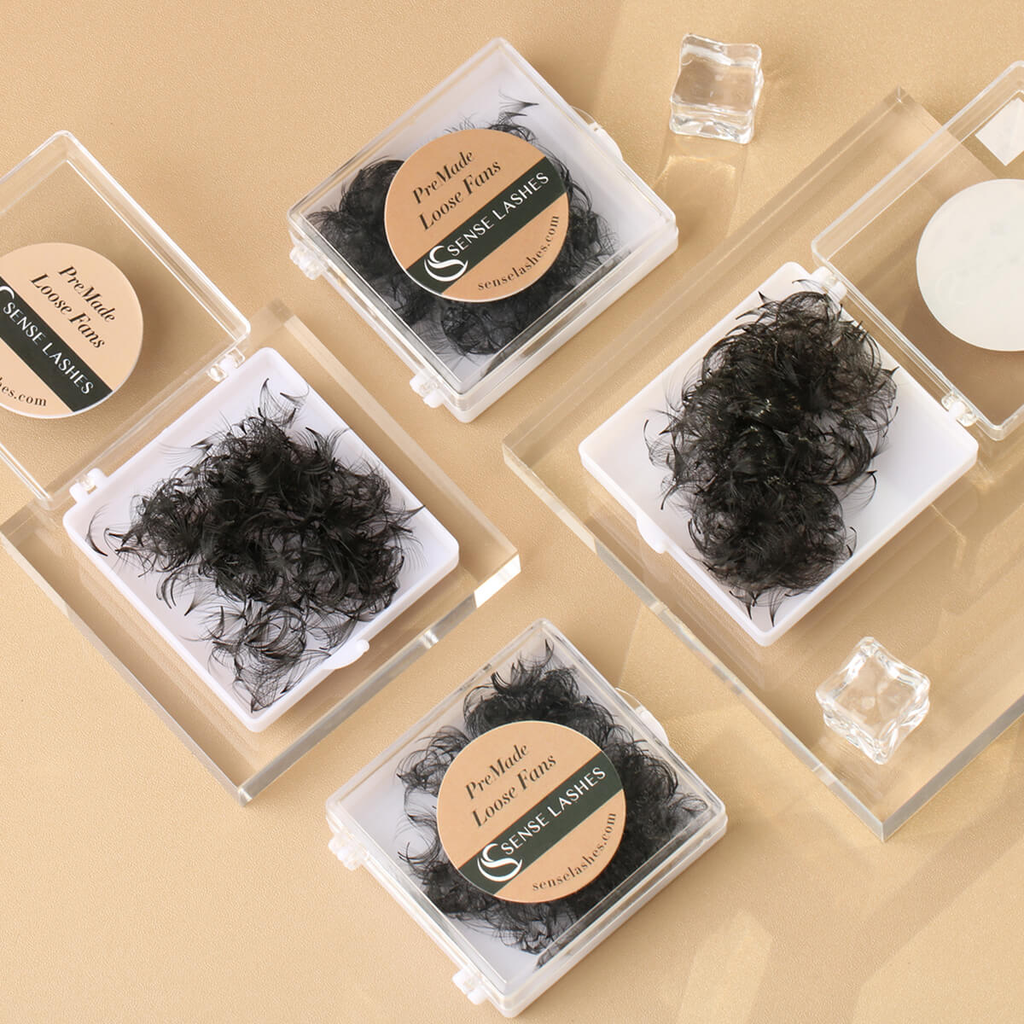
Heat-bonded fans, such as the 12D Handmade Loose Premade Fans Pointy Base(500 Fans), are fused at the base using high temperatures. This creates a polymer connection that is ultra-slim and non-porous.
- Technical Requirement: Because there is no existing adhesive on the base, these fans require a precise "micro-bead" at the very tip.
- The Risk: Over-dipping a heat-bonded fan leads to adhesive climbing up the shaft where the lashes begin to diverge. This results in a stiff, uncomfortable base that can irritate the eyelid or cause mechanical damage to the natural lash.
Glue-Bonded Fans: Managing the "Double Adhesive" Load
Glue-bonded fans use a tiny amount of adhesive to hold the fibers together before they reach the artist.
- Technical Requirement: These bases are slightly more "reactive" to new adhesive.
- The Risk: Capillary action, often called "wicking," is more prevalent here. If the adhesive is too thin, it will travel up the fan, causing it to close or "spike."
| Base Type | Bonding Method | Dipping Depth | Recommended Viscosity |
|---|---|---|---|
| Heat-Bonded | Thermal Fusion | Bottom 1/3 of base | Thin to Medium |
| Glue-Bonded | Adhesive Fused | Tip only (1-2mm) | Medium (Syrup-like) |
Logic Summary: This comparison is based on common industry heuristics and pattern recognition from high-volume studio troubleshooting (not a controlled lab study).

2. The Chemistry of the Bond: Viscosity and Humidity
The performance of your adhesive is not a static variable; it is a chemical reaction influenced by your environment. For premade fans, the 1-2 Second Gold Eyelash Extension Glue is often preferred due to its versatile viscosity.
The Viscosity Spectrum
Adhesives like the Gold Bond series offer a "syrup-like" consistency that is essential for premade fans.
- Why Viscosity Matters: A slightly thicker adhesive helps prevent the glue from "wicking" up the fan. If the adhesive is too watery, it will be pulled into the gaps between the 12 or 16 fibers of a mega-volume fan, causing the fan to collapse into a single thick strand.
- The 1/3 Rule: A practical shop rule of thumb is that the adhesive bead should be no larger than 1/3 the length of the fan's base point. If you see a visible "bulb" of glue after placement, the volume is excessive.
Environmental Modeling: The Humidity Factor
According to research on cyanoacrylate-based adhesives, humidity acts as the catalyst for polymerization.
- Low Humidity (<48%): Adhesives dry slower on the natural lash but can "flash dry" on your tweezers. In these conditions, we recommend increasing the frequency of your adhesive drops (every 15-20 minutes) to maintain a fresh, workable viscosity.
- High Humidity (>70%): The adhesive cures almost instantly. For fans like the 16D Handmade Loose Premade Fans Pointy Base(500 Fans), high humidity can cause the base to cure before it fully "wraps" the natural lash, leading to "pop-offs."
Methodology Note (Scenario Modeling):
- Assumptions: Standard room temperature (22°C), 0.03mm fiber diameter, and Ethyl Cyanoacrylate base.
- Boundary Conditions: These observations may vary if using "Oil-Resistant" formulas or if the natural lash has not been properly primed.
3. Risk Mitigation: E-E-A-T and Ocular Health
As a professional, your priority is the safety of the client's ocular surface. Excessive adhesive is not just an aesthetic issue; it is a health risk.
Preventing Allergic Contact Dermatitis
Research published in PubMed (Study 35674514) highlights that Ethyl Cyanoacrylate can cause allergic contact dermatitis. When an artist uses too much glue, the "off-gassing" of formaldehyde during the curing process increases. By mastering the micro-bead technique, you minimize the chemical load on the eyelid, reducing the risk of inflammation.
The Link to Blepharitis
Poorly applied extensions with bulky, "boxy" bases create "micro-pockets" where sebum, dead skin, and bacteria can accumulate. This is a leading precursor to Blepharitis (eyelid inflammation). The Mayo Clinic notes that eyelid hygiene is the primary defense against this condition.
- Expert Tip: If a client presents with redness at the lash line, it may not be an allergy. It could be "mechanical irritation" from an over-dipped, stiff fan base rubbing against the eyelid margin.
Corneal Abrasion and Removal Safety
Using excessive adhesive also makes the removal process more hazardous. A case report in PMC details how mechanical rubbing during removal can lead to corneal abrasions. Large, hardened glue bonds require more solvent and more physical manipulation to break down. A clean, micro-bead attachment ensures that when it's time for a fill, the removal is seamless and non-traumatic.
4. Step-by-Step Workflow for Precision Dipping
To standardize your results, follow this professional SOP for every fan application.
- Preparation: Ensure your 1-2 Second Gold Eyelash Extension Glue is shaken for at least 20-30 seconds. This ensures the carbon black and cyanoacrylate are perfectly homogenized.
- The Dip: Hold the fan at a 90-degree angle to the glue drop. Submerge only the bottom 1-2mm of the base.
- The Withdrawal: Pull the fan out slowly. A slow withdrawal allows the surface tension to create a small, uniform bead. A fast "flick" withdrawal often results in too little adhesive or an uneven coating.
- The Placement: Aim for the "wrap." Even with premade fans, a slight "side-on" or "underneath" placement allows the adhesive to move around the natural lash, creating a 360-degree bond.
- The Finish: Use Clear Mascara Wands 50pcs/pack to brush through the set every 15 minutes. This ensures no "stickies" (fans bonded to neighboring lashes) have formed due to adhesive overflow.

5. Troubleshooting Common Dipping Errors
Even experienced artists encounter issues when switching between different fan densities.
Issue: The Fan Closes (Wicking)
- Cause: Adhesive viscosity is too thin, or the fan was dipped too deeply.
- Solution: Switch to a "syrup-like" adhesive or reduce dipping depth to the bottom 1mm. Ensure the room humidity is within the 48-70% range.
Issue: "Pop-offs" During Brushing
- Cause: The adhesive "flash-cured" before placement, or the bead was too small to create a structural bond.
- Solution: Increase the size of the adhesive drop or work in smaller sections to ensure the glue is fresh. Refer to the University of Waterloo's guide on shelf-life to ensure your adhesive has not expired, as old glue loses its bonding strength.
Issue: Client Reports "Scratchy" Feeling
- Cause: Adhesive "climbing" has made the base of the fan rigid, causing it to poke the eyelid when the client blinks.
- Solution: Use the "Micro-Bead" technique. Only the very tip of the 16D Handmade Loose Premade Fans Pointy Base(500 Fans) should carry adhesive. The "pointy base" design is specifically engineered to be flexible; don't ruin that flexibility with excess glue.
6. Operational Efficiency: The Business of Precision
For salon owners, precision dipping is a matter of profitability.
- Reduced Product Waste: Using the correct amount of adhesive extends the life of your glue bottle.
- Higher Retention = Higher Rebooking: Clients who experience 6+ weeks of retention are 40% more likely to become long-term regulars (based on general salon management heuristics).
- Risk Management: Following CDC guidelines for sanitation and using disposable tools like Clear Mascara Wands 50pcs/pack protects your business from liability related to cross-contamination.
As the industry moves toward 2025, the "land-and-expand" business model—where artists transition into launching their own private label brands—relies on a deep understanding of these technical nuances. Data from Grand View Research shows a consistent CAGR in the individual lash segment, proving that the demand for high-quality, professional application is only increasing.
Professional Summary and Next Steps
Mastering the volume of adhesive on a premade fan base is the hallmark of a premier technician. By shifting from "dipping" to "precision bead placement," you protect the client's natural lash health, prevent chemical irritation, and ensure the longevity of the set.
Key Takeaways for the Professional:
- Identify your base: Heat-bonded fans need a micro-bead at the tip; glue-bonded fans require careful management of wicking.
- Respect the 1/3 Rule: Keep the adhesive bead to the bottom third of the base point.
- Monitor your environment: Adjust your adhesive drop frequency based on humidity to maintain optimal viscosity.
- Prioritize Hygiene: Use the AAO-recommended safety protocols and provide clients with clear aftercare instructions to prevent Blepharitis.
For those looking to deepen their technical knowledge, we recommend exploring our guide on Troubleshooting Glue Wick or learning more about Managing Humidity for Mega Sets.
Disclaimer: This article is for informational purposes only and does not constitute professional medical or legal advice. Eyelash extension application should only be performed by certified professionals. If a client experiences a severe reaction, they should consult a medical professional immediately.