


Accueil Eyelash Extension Supplies Guide
Solving Base Lift: Eliminating Gaps at the Attachment Point

Solving Base Lift: Eliminating Gaps at the Attachment Point
In the high-precision world of mega volume artistry, the difference between a set that lasts six weeks and one that sheds in six days often comes down to a fraction of a millimeter. "Base lift"—the subtle detachment of the extension root from the natural lash—is more than a retention nuisance. It is a mechanical failure that leads to client discomfort (the "poking" sensation), premature shedding, and significant hygiene risks.
For the professional lash artist, achieving a flush, seamless bond is the hallmark of technical mastery. When a fan base lifts, it creates a microscopic shelf that collects sebum, dead skin cells, and cosmetic residue. This accumulation is not merely unsightly; according to the Mayo Clinic, poor eyelid hygiene is a primary driver of Blepharitis, an inflammatory condition that can jeopardize a client's long-term lash health.
In this guide, we will analyze the mechanical causes of base lift, the physics of fan-to-lash compatibility, and the professional protocols required to ensure every attachment is architecturally sound.
The Mechanics of the Flush Bond: Why Bases Lift
Base lift typically occurs during the first 30 seconds of the polymerization process or as a result of a geometric mismatch between the extension and the natural lash. We have identified through pattern recognition in professional lash studios that the most common culprit is a failure to account for the natural lash's growth trajectory.
The Upward-Growth Conflict
A common mistake observed in studios is using a flat-base fan on a natural lash that grows sharply upward. This creates an immediate gap at the apex of the natural lash's curve. Because the flat base requires a horizontal surface area to bond effectively, the upward angle of the natural hair forces the bottom edge of the fan to "kick out."
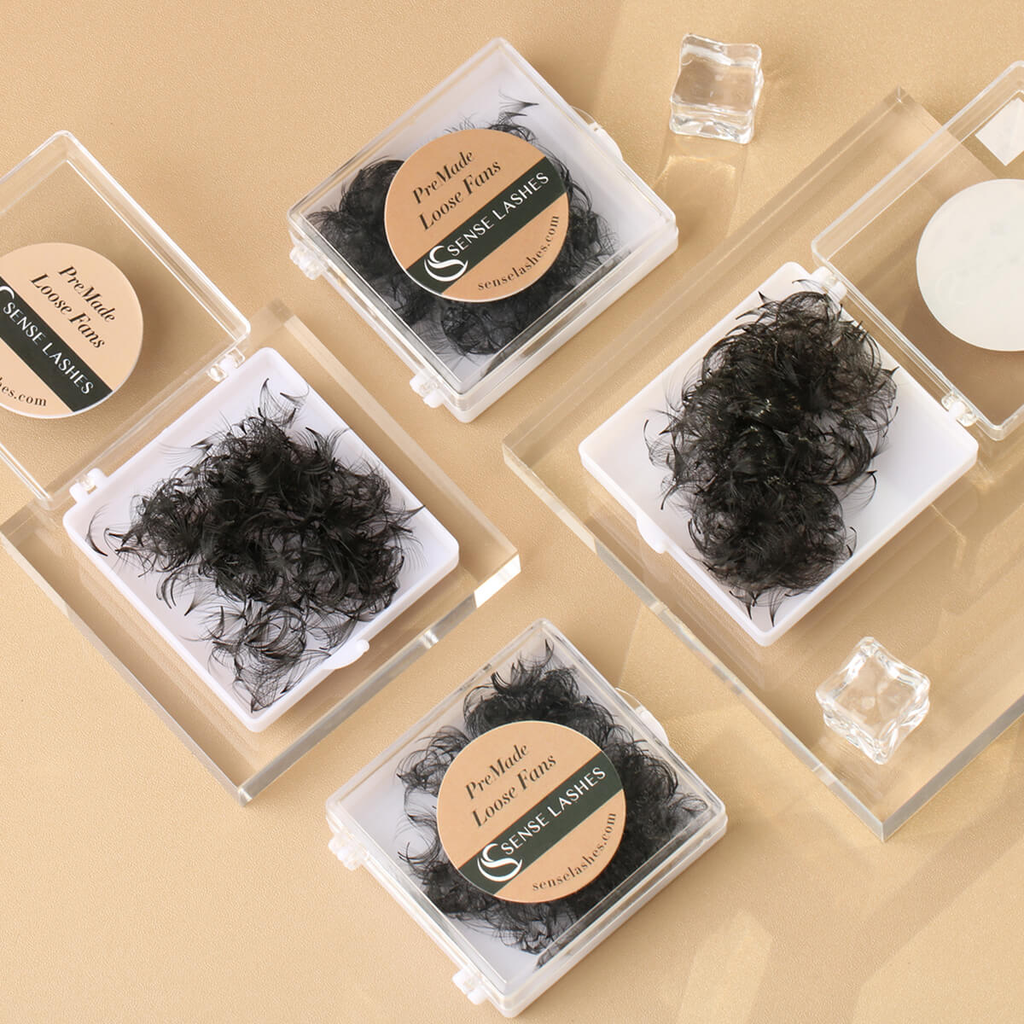
The professional correction is to match a pointy-base fan, such as our 12D Handmade Loose Premade Fans Pointy Base(500 Fans), to "spear" into that upward growth angle. This maximizes the contact line along the vertical axis of the hair shaft rather than relying on a flat horizontal plane.
Methodology Note: This "Growth-to-Base" matching protocol is a shop-tested heuristic developed to reduce mechanical leverage at the root. It assumes a standard PBT fiber weight and a natural lash diameter of 0.07mm–0.10mm.

Adhesive Viscosity and the "Bridge" Effect
Even with perfect fan selection, adhesive chemistry plays a decisive role. Adhesive viscosity—the "thickness" of your glue—determines how well the bond can bridge minor geometric discrepancies.
- High Viscosity (Syrup-like): Can bridge a minor mismatch by filling the microscopic gap between the fan and the lash before it cures.
- Low Viscosity (Thin/Watery): While offering a faster setting time, thin adhesives tend to pull away from the gap due to surface tension, causing the adhesive to crystallize in a "lifting" position.
According to research published in PubMed (Amano et al. 2012), the pH and chemical stability of the adhesive are critical. If an adhesive releases excessive formaldehyde or has an acidic pH, it can cause keratoconjunctivitis or ocular surface irritation, which often leads to the client rubbing their eyes—the #1 external cause of mechanical base lift.
Selection Logic: Pointy vs. Flat Bases
To eliminate gaps, you must select your fan based on the "attachment architecture." At SenseLashes, we focus on heat-bonded pointy bases for mega volume because they offer the most versatile "wrap" potential.
Base Compatibility Matrix
We have modeled the following compatibility scenarios to help artists choose the correct fan for different lash profiles:
| Natural Lash Type | Recommended Fan Base | Rationale |
|---|---|---|
| Upward / Straight | Pointy Base (e.g., 16D Handmade Loose Premade Fans Pointy Base(500 Fans)) | Allows the base to "nestle" into the upward angle without a flat-edge kickback. |
| Downward / Drooping | Flat Base | Provides a broader "shelf" to support the lash, though requires careful L-Curl Integration. |
| Disorganized / Criss-Cross | Pointy Base | Easier to isolate and "spear" into crowded lash lines where lateral space is limited. |
| Healthy / Horizontal | Flat or Pointy | Standard application; focus shifts to Mastering the Wrap. |
The 30-Second Magnification Check
A critical professional insight for ensuring retention is the "30-second inspection." After placing a fan—especially high-dimension fans like the 20D Handmade Loose Premade Fans Pointy Base(500 Fans)—inspect the attachment under at least 5x magnification.
If a shadow is visible between the fan base and the natural lash, the bond will fail prematurely. This requires immediate removal and re-application. A "shadow" indicates that the adhesive has crystallized across a gap rather than creating a fused interface.
Client Safety and Sanitation: The Professional SOP
Base lift isn't just a technical failure; it's a safety hazard. When a base lifts, it creates a "trap" for bacteria. According to the CDC (Centers for Disease Control), preventing the spread of ocular infections like conjunctivitis requires strict hygiene protocols.
Preventing Blepharitis through Precision
As noted by the American Academy of Ophthalmology (AAO), extensions can trap bacteria if not applied or cleaned correctly. We advocate for a "Prevention First" marketing strategy. Instead of selling lash shampoo as a simple cleanser, market it as "Blepharitis Prevention."
If a client experiences burning or redness, use the WebMD Dry Eye Guide to help differentiate between glue fume irritation and underlying dry eye syndrome. This diagnostic approach builds immense trust and reduces unfair product complaints.
The Sanitation Checklist
- Pre-Application Cleansing: Use a professional-grade foam cleanser to remove all oils.
- Priming: Ensure the lash pH is balanced to optimize the cyanoacrylate bond.
- Disposable Consumables: Always use fresh Clear Mascara Wands 50pcs/pack for every client to prevent cross-contamination.
- Post-Application Seal: Use a nano-mister or sealant to cure the adhesive quickly, reducing the time the ocular surface is exposed to fumes, as suggested by PMC research on ocular surface changes.

The Chemistry of Allergic Reactions vs. Irritation
Understanding the difference between a chemical burn, an irritation, and a true allergy is vital for salon owners. A study in PubMed (Dermatitis Study 35674514) highlights that Ethyl Cyanoacrylate can cause allergic contact dermatitis in sensitive individuals.
- Irritation (Fumes): Usually occurs during or immediately after the set. It is often caused by the "shock curing" of adhesive or high humidity.
- Allergy (Immune Response): Often a delayed reaction (48h+). This is why a Patch Test Protocol is essential for new clients.
By using high-purity adhesives and ensuring flush base attachment, you minimize the amount of exposed adhesive surface area, thereby reducing the potential for off-gassing and subsequent irritation.
Business Impact: Why Retention is Your Best Marketing
The global false eyelashes market is seeing a massive CAGR (growth rate), as reported by Grand View Research. For salon owners, the most significant cost is not the product—it is the "re-do" time.
The ROI of Perfect Attachment
Let’s model the financial impact of eliminating base lift:
| Metric | Standard Set (with 10% lift issues) | Optimized Set (SenseLashes Protocol) |
|---|---|---|
| Average Retention | 3.5 Weeks | 5.5 Weeks |
| Annual Appointments per Client | 15 | 10 |
| "Fix-it" Appointments (Unpaid) | 2 per month | 0 |
| Estimated Annual Revenue Gain | Base | +$1,200 per client (via capacity for new bookings) |
Logic Summary: This model assumes a $100 service fee and a 2-hour time slot. By increasing retention, you free up nearly 10 hours of chair time per client annually, allowing you to expand your client base without increasing your working hours.
Furthermore, with increasing global regulations, such as the Health Canada 2023-2024 Compliance Report, using compliant, high-quality supplies like SenseLashes protects your business from inventory seizures and liability.
Technical Troubleshooting: The "Grounded" Perspective
In our experience working with thousands of artists, we often see that the "perfect" fan placement fails because of micro-movements during the drying phase.
The "Friction Point" Discovery: We have observed that when using ultra-lightweight fans like the 20D Pointy Base, the weight of the fan is so low that the surface tension of a large adhesive drop can actually "pull" the fan out of alignment as it cures.
The Fix:
- Dip Depth: Ensure you are dipping only the bottom 1-2mm of the fan base.
- Wick the Excess: Gently wick the excess adhesive on a silicone pad to ensure the base remains "pointy" and doesn't become a "blob."
- The "Hold": Hold the fan in place for 1 extra second after placement to allow the initial bond to stabilize.
Summary of Next Steps for the Professional
To eliminate base lift and elevate your artistry, transition your selection logic from "one-size-fits-all" to a growth-angle-matching system.
- Audit Your Fans: Switch to pointy-base fans for clients with upward or straight natural lashes to ensure a flush contact line.
- Upgrade Your Inspection: Incorporate a 30-second magnification check into every set. If you see a gap, fix it immediately.
- Educate Your Clients: Use the medical risks of poor hygiene (Blepharitis, infection) to sell the importance of aftercare.
- Maintain Compliance: Ensure your adhesives and lashes meet international safety standards to protect your professional reputation.
By mastering the architecture of the attachment point, you provide more than just beautiful lashes—you provide safety, comfort, and the kind of retention that builds a loyal, high-value clientele.
Disclaimer: This article is for informational purposes only and does not constitute professional medical, legal, or financial advice. Always consult with a qualified health professional regarding eye health concerns and refer to local regulations regarding cosmetic compliance.