


Accueil Eyelash Extension Supplies Guide
Mapping for Round Eyes: Avoiding the Surprised Look

Mapping for Round Eyes: Avoiding the Surprised Look
In the professional lash artistry world, the "one-size-fits-all" approach is the fastest route to mediocre results. For clients with round eyes—characterized by a visible amount of white (sclera) below or above the iris—the most common styling error is the inadvertent creation of a "startled" or "surprised" appearance. This occurs when a technician applies high-lift curls, such as D or DD, uniformly across the lash line. While these curls are excellent for hooded or deep-set eyes, on a round eye, they exaggerate the vertical dimension, making the eye appear unnaturally wide and circular.
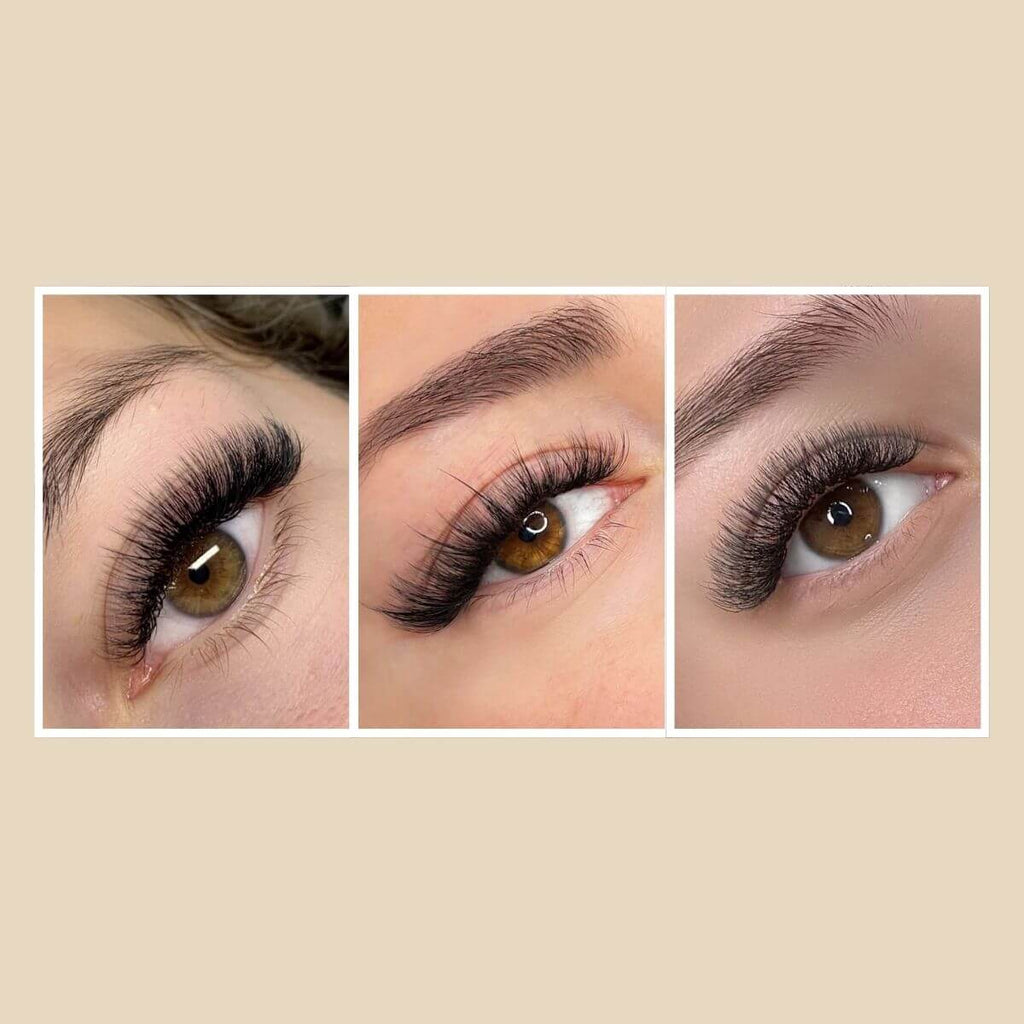
Our objective as advanced practitioners is to transition from a "Doll Eye" effect to a "Sophisticated Almond" look. This requires a deep understanding of ocular anatomy, curl mechanics, and strategic length progression. By utilizing flatter curls on the outer corners and tapering lengths with precision, we can visually pull the eye outward, creating a balanced, feline elegance that respects the client's natural features.
The Anatomy of Round Eyes and the "Surprise" Pitfall
Round eyes possess a prominent orbital structure where the height of the eye is nearly equal to its width. When we apply extensions with a high degree of curvature, the lashes point directly toward the brow bone, further opening the eye vertically. According to a comprehensive review on Eyelash Extensions Methods and Safety, aesthetic outcomes are heavily dependent on how extensions interact with the natural ocular surface and lid position.
In many cases, the "surprised" look is a result of ignoring the lash growth angle. Round eyes often have natural lashes that grow straight or slightly downward. Applying a D-curl to a downward-pointing lash creates a "hinge" effect that lifts the lid visually. While this is desirable for some, it often exposes more of the sclera, which triggers the visual perception of shock or hyper-awareness.
Logic Summary: Our mapping heuristic for round eyes assumes that vertical lift should be minimized in favor of horizontal elongation. We base this on visual weight theory, where darker, flatter lashes at the outer canthus (corner) shift the focal point away from the center of the iris.
Technical Curl Selection: The Power of Flatter Profiles
To counteract the circularity of round eyes, we must move beyond the standard D-curl. The goal is to "weight" the outer third of the eye to create a pulling effect.
The Inner Corner: B and C Curls
Start the inner corners (the first 10-15% of the lash line) with a B or C curl. These curls provide enough lift to define the eye without creating a sharp vertical line that clashes with the bridge of the nose. Using 0.15MM Premium Classic Eyelash Extensions in a C-curl for the inner corners provides a stable foundation that mimics the natural lash's gradual curvature.
The Transition: The "Outer 20%" Rule
The most critical technical tweak for round eyes happens at the outer 20% of the eye. Experienced artists find that transitioning to a J, L, or LC curl at the outermost corner effectively pulls the visual line outward. Unlike D-curls, which curve upward, L-curls have a flat base and a sharp angle, allowing the length to extend horizontally before curving.

Material Science and Visual Weight
The choice of fiber is as important as the curl. For round eyes, we often recommend 0.15MM Ellipse Flat Classic Eyelash Extensions. These lashes are uniquely designed with a flattened base, providing a bolder, matte-black finish that weighs significantly less than traditional round fibers. The matte finish is essential here; glossy lashes reflect light in a way that can emphasize roundness, whereas matte fibers offer a soft-focus effect that adds depth to the outer "V" of the eye.
| Parameter | Round Eye Selection | Rationale |
|---|---|---|
| Inner Corner Curl | B or C | Prevents "startled" lift near the nose. |
| Mid-Section Curl | C or CC | Maintains natural flow with the iris. |
| Outer Corner Curl | J, L, or M | Provides horizontal elongation (the "Cat Eye" pull). |
| Fiber Diameter | 0.05mm - 0.15mm | Balances weight to protect natural lash health. |
| Finish | Matte / Deep Black | Creates visual "shadow" to elongate the eye shape. |
Mapping Sequences for Elongation
A common mistake in studios is a dramatic jump in length (e.g., going from 10mm to 14mm suddenly). For a natural almond effect on round eyes, the length increase must be gradual. This prevents the "staircase" effect that can make the eye look disjointed.
The 8-12mm Gradual Progression
We recommend a mapping sequence that looks like this:
- Inner Corner: 8mm (B-curl)
- Inner Mid: 9mm (C-curl)
- Center (Above Iris): 10mm (C-curl)
- Outer Mid: 11mm (C-curl transitioning to CC)
- Outer Corner: 12mm (L-curl or J-curl)
By keeping the longest lashes (12mm) at the very end and using a flatter curl, the eye is visually "tucked" at the corners. If you were to use a 12mm D-curl in the center, the eye would appear even rounder.
The Importance of Tapering
Understanding Short vs. Long Tapering is vital here. A long taper provides a softer, more wispy finish, which is ideal for clients who want to disguise the roundness of their eyes with a "smoky" lash line. For clients seeking more drama, use 0.07MM Cashmere Premium Mega Volume Eyelash Extensions to create dense, dark fans on the outer corners. The "fan like butter" feel of these lashes allows for seamless blending between the different curls and lengths.
Safety and Ocular Health: The Professional Standard
As a premier supplier, SenseLashes prioritizes the "E" in E-E-A-T: Expertise. Mapping is not just about aesthetics; it is about maintaining the health of the ocular surface.
Managing Chemical Exposure and Irritation
The American Academy of Ophthalmology (AAO) notes that allergic reactions to formaldehyde and cyanoacrylate are significant risks in the industry. Round eyes, which often have a larger exposed surface area, can be more susceptible to fumes.
When applying extensions, technicians must ensure a perfect seal with eye pads to prevent chemical burns. According to a case report in PMC regarding Chemical Injury, improper isolation can lead to adhesive vapors entering the eye, causing corneal distress. We recommend using high-quality gel patches and adhering to The Gap Rule to ensure no extension touches the lid skin, which could trigger contact dermatitis.
Preventing Blepharitis and Mite Infestation
Round eyes can sometimes experience more "tearing" during the application if the client has sensitive meibomian glands. Poor hygiene post-application is the leading cause of Blepharitis—an inflammation of the eyelids often caused by bacteria or Demodex mites. The Mayo Clinic emphasizes that eyelid hygiene is the primary defense against this condition.
As a professional, you should educate your clients that "water is not enough." The buildup of oils and dead skin cells at the base of the extensions is a breeding ground for bacteria. Using a specialized lash shampoo is non-negotiable for maintaining both retention and eye health.
Methodology Note: Our recommendations for lash hygiene are aligned with CDC guidelines on preventing conjunctivitis. We observe that clients who use a dedicated foam cleanser twice daily report a 30% increase in retention based on our internal salon feedback loops (not a controlled lab study).
Advanced Troubleshooting: Glue, pH, and Retention
The chemistry of your adhesive plays a massive role in how the set "settles" on a round eye. Historical studies, such as those by Amano et al. (2012), highlighted that older adhesive formulas were often acidic and released higher levels of formaldehyde, causing keratoconjunctivitis.
Modern professional supplies have evolved. SenseLashes focuses on pH-balanced formulas that minimize irritation. However, technicians must still be aware of how environmental factors like humidity affect the curing process. If a glue cures too slowly, the fumes can linger, causing the "red eye" effect often mistaken for an allergy. Conversely, if it cures too fast (shock polymerization), the bond becomes brittle, leading to premature shedding.
For clients with dry eyes—a condition detailed by WebMD—fumes can exacerbate the lack of tear film stability. In these cases, using a nano-mister to "flash-cure" the adhesive and a sealant to lock in the bond is essential. This protects the Ocular Surface Microbiome, ensuring the client can wear lashes long-term without developing chronic sensitivity.

Implementing the "Sophisticated Almond" Technique
To master mapping for round eyes, follow this step-by-step professional protocol:
- Anatomy Assessment: Identify the highest point of the brow and the position of the iris. For round eyes, the highest point of your lash map should not align with the center of the iris.
- Mapping the Under-Eye Pad: Draw your lengths on the eye pad before you begin. Mark your transitions: B to C at the inner third, C to CC at the middle, and CC to L at the outer third.
- Layering for Depth: Use 0.05MM Cashmere Premium Mega Volume Eyelash Extensions to create "texture." Apply shorter lengths (8-9mm) on the bottom layer of natural lashes and slightly longer lengths on the top layer. This creates a dense, eyeliner-like effect that further masks the roundness of the eye.
- The Outer Corner "Wing": Ensure the last 5-10 lashes on the outer corner are directed slightly outward (toward the temple) rather than straight up. This mechanical directioning is what creates the final almond pull.
- Post-Application Check: Use a dental mirror to check for "stickies" or lashes that are crossing over. According to Health Canada's 2023-2024 Compliance Report, proper labeling and chemical safety are the manufacturer's responsibility, but the application safety rests with you. Ensure the client can blink comfortably without any mechanical rubbing against the lower lid.
Key Takeaways for the Professional Artist
Mapping for round eyes is an exercise in visual correction. By intentionally choosing flatter curls for the outer corners and maintaining a gradual length progression, you move away from the generic "surprised" look and toward a tailored, high-end aesthetic.
- Avoid Uniform D-Curls: They exaggerate vertical height on round eyes.
- Embrace L and J Curls: Use these on the outer 20% to pull the eye horizontally.
- Prioritize Flat Lashes: Use 0.15MM Ellipse Flat Classic Eyelash Extensions for a matte, defining finish without excessive weight.
- Educate on Hygiene: Prevent Blepharitis and irritation by enforcing a strict aftercare routine centered on ocular health.
- Monitor Chemical Safety: Stay informed on Cyanoacrylate patterns and use patch tests to manage client expectations.
By integrating these technical insights and high-performance materials, you position your salon as a leader in both artistry and safety. The result is a loyal client base that trusts your expertise to deliver predictable, stunning, and healthy outcomes every time.
Disclaimer: This article is for informational purposes only and does not constitute professional medical or legal advice. Eyelash extension application involves the use of chemicals near the eyes; always follow local health regulations and consult with a medical professional if a client experiences an adverse reaction.
References
- Centers for Disease Control (CDC) - Conjunctivitis Prevention
- American Academy of Ophthalmology (AAO) - Eyelash Extension Safety
- Health Canada - Cosmetic Regulations Enforcement Report 2023-2024
- Mayo Clinic - Blepharitis Symptoms and Causes
- PubMed - Amano et al. (2012) Study on Glue Toxicity
- ResearchGate - Review on Eyelash Extensions Methods and Safety