


Accueil Eyelash Extension Supplies Guide
Safe Weight Limits: Calculating Mega Volume Load for Lashes

Safe Weight Limits: Calculating Mega Volume Load for Lashes
The evolution of lash artistry from classic 1:1 applications to the architectural complexity of Mega Volume has redefined the technical boundaries of the profession. While the aesthetic goal is maximum density and a "blackout" lash line, the mechanical reality is a delicate balancing act between fiber mass and the biological tolerance of the natural lash. For the advanced technician, mastering Mega Volume is not merely about fanning skills; it is about understanding the physics of cumulative load.
Transparency & Evidence Disclosure: This guide is designed for professional lash technicians. It contains links to products sold by this site. The technical parameters provided—such as adhesive mass and weight gain percentages—are derived from internal workshop observations and geometric modeling rather than independent laboratory clinical trials. Where medical conditions are discussed, we cite peer-reviewed or authoritative health organizations. [Evidence Level: Expert Consensus & Geometric Modeling]
The Physics of Ultra-Fine Fibers: 0.03mm vs. 0.05mm
In Mega Volume, we primarily work with diameters of 0.03mm and 0.05mm. To the naked eye, the difference is negligible; however, in terms of volume and mass, the difference is exponential. The cross-sectional area of a fiber determines its weight. Because the area is calculated using the square of the radius ($\pi r^2$), a 0.05mm lash is nearly three times the mass of a 0.03mm lash.
Example Calculation: The "Triple Mass" Rule
To understand why a 20D fan of 0.05mm is often dangerous while a 20D of 0.03mm is manageable, we use the following geometric model:
- Formula: $Area = \pi \times r^2$
- 0.03mm Fiber: Radius = 0.015mm. $Area \approx 0.000706 \text{ mm}^2$
- 0.05mm Fiber: Radius = 0.025mm. $Area \approx 0.001963 \text{ mm}^2$
- Comparison: $0.001963 / 0.000706 = 2.78$.
Conclusion: A single 0.05mm fiber carries approximately 278% the weight of a 0.03mm fiber of the same length. Consequently, [Practical Rule of Thumb] to achieve a similar perceived density without compromising integrity, the D-count for 0.05mm fibers should be limited to roughly half that of 0.03mm fibers on the same natural lash.

Modeling the Cumulative Load
The primary risk factor in Mega Volume is the cumulative load: the fibers, the adhesive base, and environmental factors.
Modeling Note (Internal Estimates): This weight distribution model is a deterministic parameterized analysis based on PBT (Polybutylene Terephthalate) density and common adhesive application volumes observed in our training facility.
Parameter Value/Range Unit Evidence Level Rationale Fiber Diameter 0.03 - 0.05 mm Industry Standard Standard for Mega Volume fibers Fan Density 10 - 20 count [Practical Rule] Range for high-density sets Adhesive Mass 0.08 - 0.12* mg [Internal Estimate] Estimated via volumetric calculation of a 1.5mm bond Natural Lash Stage Anagen/Telogen N/A [Clinical Observation] Variable load-bearing capacity Humidity Baseline 50% % [Manufacturer Data] Standard salon environment *Adhesive mass is calculated based on a cured cyanoacrylate density of ~1.1 g/cm³ and an average bond volume of 0.07–0.1 mm³ per fan.
Calculating Safe Limits for Different Lash Stages
Not every natural lash is a candidate for a 20D fan. A frequent correction made in advanced masterclasses is teaching artists to "fan and then trim" or reduce the D-count based on the specific natural lash's lifecycle stage. [Practical Experience]
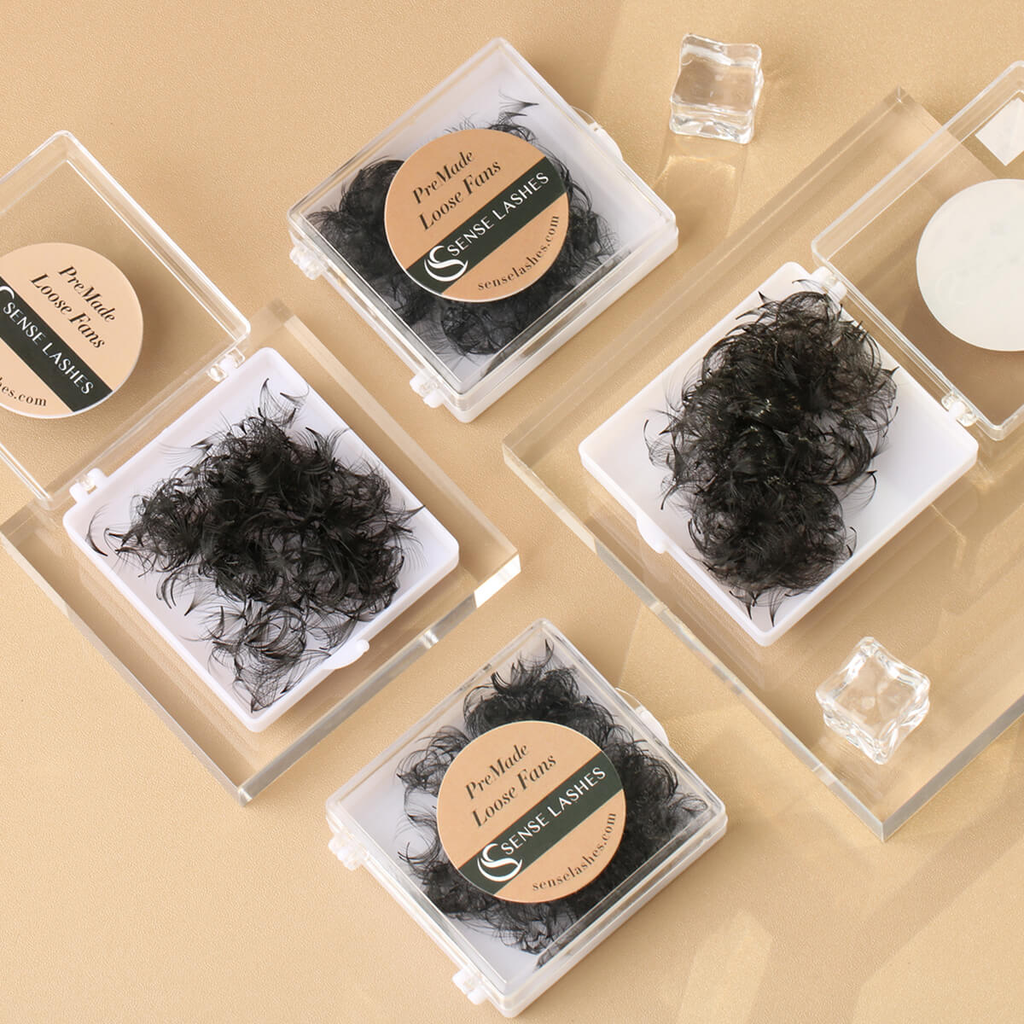
- Anagen (Growth) Lashes: Often referred to as "baby lashes," these are fine and highly susceptible to premature shedding if overloaded. Practitioners consistently observe that these lashes can safely hold a 10D Handmade Loose Premade Fans Pointy Base(500 Fans) in 0.03mm, but will often show stress—visible as slight bending or drooping—with a 12D fan within 14–21 days.
- Catagen (Transition) Lashes: These have reached full length but the follicle is shrinking. They are the most stable for medium-weight fans, such as a 16D Handmade Loose Premade Fans Pointy Base(500 Fans).
- Telogen (Resting) Lashes: These are the strongest but are also closest to naturally shedding. While they can handle a 20D Handmade Loose Premade Fans Pointy Base(500 Fans), the artist must ensure the base is perfectly wrapped to prevent mechanical leverage from pulling the lash out prematurely.
Logic Summary: Our analysis assumes that the mechanical "snap point" of a natural lash is influenced by the length of the extension. A longer extension creates a longer lever arm, increasing the torque on the follicle even if the weight remains constant. [Geometric Modeling]
Environmental Factors: The "Hidden" Weight of Humidity
A critical factor in Mega Volume retention and safety is the impact of ambient humidity on the adhesive bond. Adhesives like the 1-2 Second Gold Eyelash Extension Glue are engineered to cure within a specific humidity range (48-70%).
However, when humidity exceeds 60%, the cyanoacrylate can undergo "shock polymerization." [Internal Observation] indicates this can lead to a slightly denser, more globular bead, potentially adding an estimated 5-10% extra weight to the bond point. This is frequently mistaken for "glue failure" when the fan slips, but it is actually a weight-induced retention issue where the natural lash cannot support the thickened adhesive mass.

Furthermore, according to the American Academy of Ophthalmology (AAO), the chemical composition of adhesives—specifically the presence of formaldehyde as a byproduct—can cause irritation. In Mega Volume, the high fiber count can trap these fumes near the ocular surface, making weight management a safety priority. [Clinical Guideline]
Ocular Health: Why Weight Management is a Medical Necessity
Overloading lashes isn't just an aesthetic mistake; it's a health risk. Heavy extensions can lead to traction alopecia (hair loss due to tension), but they also contribute to immediate ocular issues.
Blepharitis and Hygiene
The Mayo Clinic identifies Blepharitis as a common inflammation of the eyelids. In Mega Volume sets, the density of the fans (especially 16D and 20D) creates a "mesh" that easily traps skin cells and sebum. [Clinical Guideline] If the fans are too heavy, they droop closer to the eyelid margin, exacerbating this buildup.
Preventing Conjunctivitis
Standard sanitation is paramount. The Centers for Disease Control (CDC) emphasizes that preventing the spread of conjunctivitis (pink eye) requires strict hygiene. For the Mega Volume artist, this means ensuring that the high-density fans do not touch the skin, which can cause "chemical wicking" where the adhesive travels onto the conjunctiva. [Clinical Guideline]
Allergic Contact Dermatitis
Recent studies in PubMed (2024) focus on contact dermatitis patterns from acrylates. Because Mega Volume requires more adhesive to secure the larger base of the fan, the risk of a reaction to fumes increases. Using a high-purity adhesive like the 1-2 Second Gold Eyelash Extension Glue helps minimize the "off-gassing" period. [Manufacturer Data / Clinical Study]
The "Fan and Trim" Technique: Professional Troubleshooting
One of the most effective ways to manage weight in real-time is the "Fan and Trim" method. [Practical Experience] If you are using premade fans and encounter a natural lash that is borderline (perhaps transitioning between Anagen and Catagen), do not force a full 20D load.
Experienced educators recommend fanning the lash as usual, then using a precision tweezer to "trim" or pluck one or two fibers from the cluster before application. This customizes the "D-count" to the specific strength of that natural lash, preventing the common pitfall of "uniform loading."
Comparison of Mega Volume Fiber Specifications
| Fan Type | Fiber Diameter | Recommended Natural Lash Stage | Risk Level | Evidence Level |
|---|---|---|---|---|
| 10D Fan | 0.03mm | Anagen (Healthy) / Catagen | Low | [Practical Rule] |
| 10D Fan | 0.05mm | Terminal Catagen / Telogen | Moderate | [Practical Rule] |
| 16D Fan | 0.03mm | Catagen / Telogen | Moderate | [Practical Rule] |
| 20D Fan | 0.03mm | Strong Telogen Only | High | [Practical Rule] |

Advanced Retention: Restoring the Microbiome
Recent research published in PMC (2024) suggests that long-term extension wear can alter the ocular surface microbiome. This is particularly relevant for Mega Volume, where the sheer surface area of the extensions is greater. [Clinical Study]
To mitigate this, the application process must include a thorough priming step to balance pH. According to a study by Amano et al. (2012), the pH of certain adhesives can influence ocular health. Modern professional formulas strive for pH neutrality, ensuring the Gold Bond adhesive creates a "seamless" wrap around the natural lash, distributing the weight 360 degrees rather than just sitting on top.
For more on how fiber characteristics affect your application, see our guide on Fiber Texture and Fan Creation and how to manage Fiber Elasticity.
Strategic Takeaways for the Mega Volume Professional
- Prioritize 0.03mm for 12D+: To maintain long-term lash health, 0.03mm should be the default for any fan exceeding 12 fibers.
- The 50% Rule for 0.05mm: If switching to 0.05mm fibers, reduce your D-count by half to maintain a similar weight profile. [Geometric Modeling]
- Monitor Humidity Levels: Keep your salon between 45-55% humidity to prevent "adhesive weight gain" from shock curing. [Internal Observation]
- Stage-Specific Mapping: Use 10D fans for younger lashes and reserve 16D-20D fans for the strongest, most mature natural lashes.
- Clinical Hygiene: Educate clients on the link between fan density and Blepharitis. A dense set requires more diligent cleaning than a classic set. [Clinical Guideline]
Disclaimer: This article is for informational purposes only and does not constitute professional medical advice. Eyelash extension application involves chemicals and proximity to the eyes; always follow local licensing regulations and consult with an ophthalmologist if a client experiences persistent irritation or infection.