


Accueil Eyelash Extension Supplies Guide
Mega Volume Logic: Why Heat-Bonded Fans Are Essential for 10D+

The Technical Evolution of Mega Volume Artistry
In the professional lash industry, the transition from Volume (3D-6D) to Mega Volume (10D-20D) represents more than just an aesthetic shift; it is a significant engineering challenge. As density increases, the margin for error regarding weight distribution, adhesive management, and ocular health narrows. For the modern lash artist, the choice between heat-bonded and glue-bonded premade fans is no longer a matter of preference—it is a decision that dictates the safety and longevity of the set.
At SenseLashes, we view the manufacturing of lash extensions through the lens of risk reduction and operational reliability. When working with 10D+ densities, the structural integrity of the fan base becomes the primary failure point. This article explores the technical logic behind heat-bonded technology and why it has become the non-negotiable standard for high-density applications.
Manufacturing Science: Heat-Bonded vs. Glue-Bonded Foundations
To understand why heat-bonded fans are essential for mega volume, we must first examine the fundamental differences in their construction.
Heat-Bonded (Thermal/Ultrasonic Fusion)
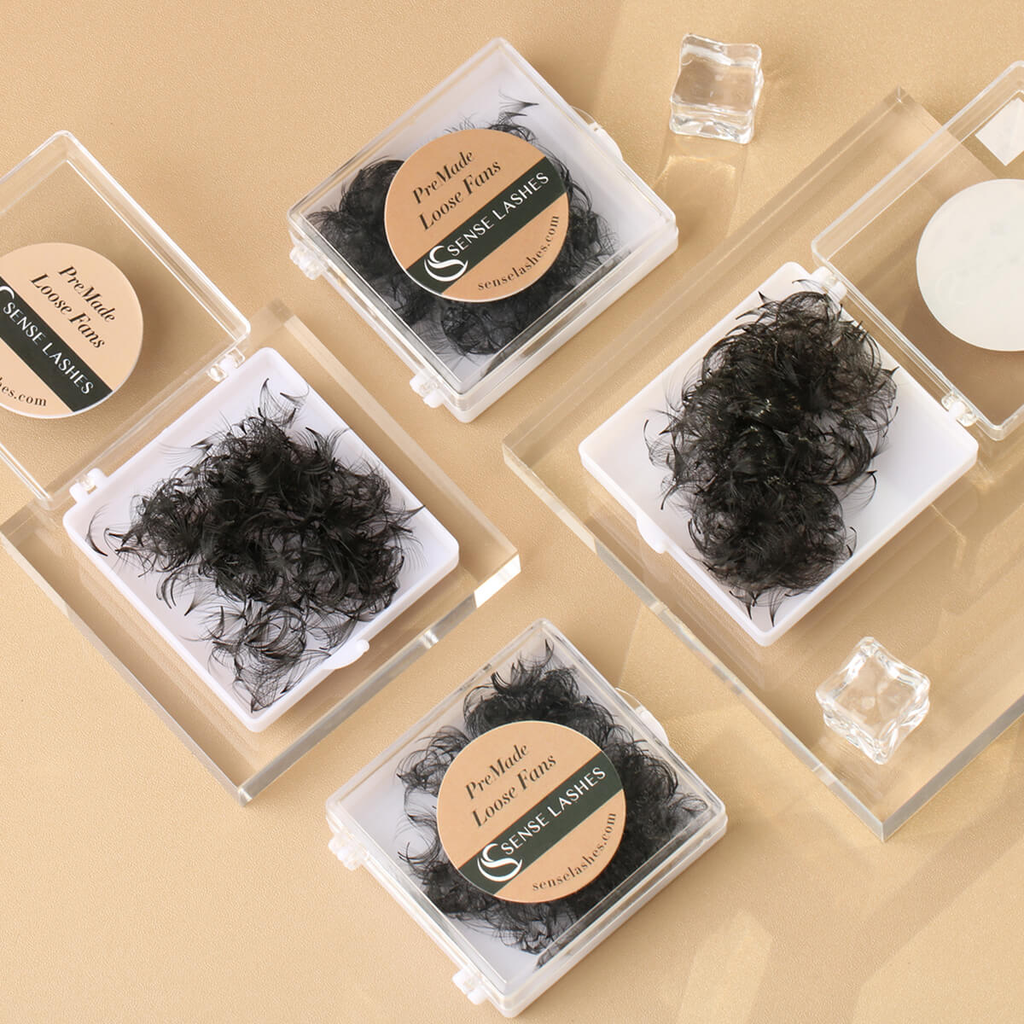
Heat-bonded fans, such as our 12D Handmade Loose Premade Fans Pointy Base(500 Fans), are created by applying precise thermal or ultrasonic energy to the base of the fan. This process fuses the PBT (Polybutylene Terephthalate) fibers together at a molecular level without the introduction of secondary materials.
- Result: A base that is virtually as thin as the sum of the fibers themselves.
- Benefit: Zero added weight and a "pointy" base that facilitates a seamless wrap around the natural lash.
Glue-Bonded (Adhesive-Based Assembly)
Glue-bonded fans use a micro-drop of cyanoacrylate or a similar bonding agent to hold the fan together during manufacturing. While effective for lower densities (2D-5D), this method introduces a "pre-coated" layer of adhesive to the base.
- Result: A thicker, often cylindrical base that is already saturated with a bonding agent.
- Risk: In mega volume sets, this creates a "double-dipping" effect where the artist adds professional-grade adhesive on top of the factory glue, leading to excessive weight and poor bonding geometry.
Logic Summary: The Base-to-Fiber Ratio Our manufacturing analysis assumes that for a 10D fan using 0.03mm fibers, the base diameter must remain under 0.1mm to ensure proper follicular health. Glue-bonded bases frequently exceed this threshold due to the volume of the adhesive "bead" at the root.

Mechanical Integrity and the "Pinch Test"
When creating sets exceeding 12D, the cumulative leverage exerted on the natural lash is substantial. Experienced artists report that glue-bonded fans, especially in higher densities, often have a slightly tacky or uneven base. This texture can pick up excessive adhesive during the dipping process, creating a bulky, unstable bond point.
The Risk of Fan Twisting and Clumping
A bulky base increases the risk of the fan twisting or "clumping" on the natural lash. This is not merely an aesthetic issue; it can lead to mechanical trauma. According to PubMed (38171996), mechanical damage from heavy or improperly balanced extensions is a leading cause of traction alopecia in the lash industry.
The Professional "Pinch Test" Heuristic
A key heuristic for evaluating fan quality is the "pinch test."
- Take a 30D Handmade Loose Premade Fans Pointy Base(500 Fans) with your tweezers.
- Apply pressure to the base.
- Observation: A properly heat-bonded fan will have a consistently slim, dry base that allows for precise pinching without the individual lash strands shifting or separating.
In contrast, glue-bonded bases can feel stiff yet fragile. You may even see tiny, visible glue droplets that compromise the fan's flexibility. For sets as dense as 40D Handmade Loose Premade Fans Pointy Base(500 Fans), base integrity is non-negotiable. A single fan separating mid-application breaks the artist's rhythm and can compromise sterilization protocols if the fan falls onto the client's skin or eye.
Ocular Health: Preventing Blepharitis and Infection
The primary responsibility of a lash professional is the preservation of the client's eye health. High-density sets create more surface area for the accumulation of sebum, debris, and bacteria.
The Blepharitis Argument
Blepharitis is an inflammation of the eyelids often caused by poor lash hygiene and bacteria buildup. According to the Mayo Clinic, maintaining a clean eyelid margin is critical for preventing this condition.
Glue-bonded fans, due to their porous and often uneven base structure, can trap more debris than the ultra-smooth surface of a heat-bonded base. This makes "Lash Shampoo" not just a cleaning product, but a medical necessity for "Blepharitis Prevention." We highly recommend educating clients on Deep Cleaning Mega Bases to prevent sebum-induced fan closure and bacterial colonization.
Protecting the Ocular Surface Microbiome
Recent 2024 investigations into Ocular Surface Disease (PMC 11397841) suggest that long-term extension wear can alter the ocular surface microbiome and tear stability. Heat-bonded fans, being lighter and less chemically complex (due to the absence of factory glue), minimize the disruption to the tear film.

Chemistry, Compliance, and Allergic Reactions
Understanding the chemistry of your supplies is what separates a technician from an expert. Most lash adhesives are based on Ethyl Cyanoacrylate.
The Chemistry of Allergic Reactions
A study on Allergic Contact Dermatitis (PubMed 35674514) highlights that reactions are often an immune response to acrylates. When using glue-bonded fans, you are essentially doubling the chemical exposure—once from the factory bond and once from your professional adhesive.
Furthermore, the American Academy of Ophthalmology (AAO) warns of risks associated with formaldehyde, a byproduct of cyanoacrylate degradation. Heat-bonded fans eliminate the risk of "old" factory glue degrading on the lash and releasing irritants.
Import Compliance and Safety Signaling
For salon owners, inventory safety is a business risk. Health Canada's 2023-2024 Report on cyanoacrylate compliance underscores the importance of sourcing from manufacturers who prioritize chemical safety. By choosing heat-bonded fans, you reduce the complexity of the chemical "cocktail" on your client's eyes, aligning with global safety standards.
Troubleshooting Mega Volume Challenges
Mega volume application comes with unique technical "gotchas" that can frustrate even seasoned artists.
1. The Glue Wick Phenomenon
When a fan has too much surface area at the base (typical of glue-bonded fans), the adhesive can "wick" up the fibers, causing the fan to close instantly upon application. We address this in our guide on Why Mega Fans Close on Application. Heat-bonded pointy bases provide a controlled "dip zone," preventing this issue.
2. Diameter Selection: 0.03mm vs. 0.05mm
For 10D+ sets, the weight of the fiber is critical. We recommend 0.03mm for anything above 12D to ensure the natural lash can support the weight without drooping. You can read more about Choosing Diameters for 15D+ Fans to optimize your sets.
3. Maintaining Symmetry
Consistency is the hallmark of a master. Using 8D Handmade Loose Premade Fans Pointy Base(500 Fans) allows for uniform spacing and weight. For higher densities, maintaining Symmetry Standards requires a fan that doesn't "shift" during the curing process—a common failure of glue-bonded bases.
Modeling the Impact: Mega Volume Weight & Safety
To demonstrate the importance of base slimness, we have modeled the hypothetical weight distribution of a 15D fan set.
Method & Assumptions:
- Modeling Type: Deterministic parameterized model based on PBT density and adhesive volume heuristics.
- Assumptions: Natural lash can support ~0.15mg of weight; standard 0.03mm PBT fiber weight used.
| Parameter | Heat-Bonded (0.03mm) | Glue-Bonded (0.03mm) | Unit | Rationale |
|---|---|---|---|---|
| Fiber Weight (15D) | ~0.06 | ~0.06 | mg | Constant PBT mass |
| Factory Glue Weight | 0 | ~0.02 - 0.04 | mg | Estimated adhesive bead |
| Artist Adhesive Load | ~0.02 | ~0.04 | mg | Glue-bonded bases pick up more |
| Total Weight | ~0.08 | ~0.12 - 0.14 | mg | 40-75% increase in load |
| Base Diameter | <0.1 | >0.15 | mm | Impact on wrap/attachment |
Boundary Conditions: This model may vary based on the specific brand of PBT and the artist's dipping technique. However, the structural trend remains consistent: glue-bonded fans significantly increase the mechanical load on the natural lash.

Operational Reliability and Salon ROI
Beyond safety, the choice of heat-bonded fans is a business decision. In a high-traffic salon, time is the most valuable asset.
Speed and Efficiency
Loose premade fans, like our 12D and 8D collections, are designed to accelerate the application of mega volume sets. By eliminating the need for hand-making fans, an artist can reduce a 4-hour mega volume appointment to 2 hours. This effectively doubles the revenue potential per chair.
Reducing Returns and Complaints
Client dissatisfaction in mega volume is usually tied to two things: poor retention or irritation. As WebMD notes, ocular discomfort can often be exacerbated by fumes or mechanical irritation. By using heat-bonded fans with a Mastered Wrap Technique, you ensure maximum retention with minimum irritation, reducing the rate of unpaid "fix-it" appointments.
The 2025 Market Opportunity
According to Grand View Research, the global lash market continues to grow, with a significant shift toward individual and volume extensions. For aspiring entrepreneurs, building a private label brand with high-quality heat-bonded fans is a "land-and-expand" strategy. It positions your brand as a premium, safety-conscious alternative in a crowded market.
Summary of Professional Selection Criteria
When selecting fans for 10D+ sets, use the following checklist to ensure professional outcomes:
- Bond Type: Prioritize heat-bonded (ultrasonic) fusion to minimize weight.
- Base Shape: Look for a "pointy" or "slim" base to facilitate the wrap around the natural lash.
- Fiber Quality: Ensure the use of high-quality PBT that maintains Synthetic Fiber Elasticity.
- Sanitation: Ensure the packaging supports sterilization protocols, as recommended by the CDC.
By adhering to these technical standards, lash artists can deliver the dramatic impact of mega volume without compromising the long-term health of their clients' eyes.
YMYL Disclaimer: This article is for informational purposes only and does not constitute professional medical, legal, or safety advice. Eyelash extension application involves risks, including infection and allergic reaction. Always consult with a licensed healthcare professional regarding eye health concerns and follow local regulatory guidelines for professional practice.
References
- Centers for Disease Control and Prevention (CDC) - Conjunctivitis Prevention
- Mayo Clinic - Blepharitis Symptoms and Causes
- American Academy of Ophthalmology (AAO) - Eyelash Extension Safety
- Health Canada - Cosmetic Regulations Enforcement Summary
- PubMed - Mechanical and Chemical Damage from Eyelash Extensions (38171996)
- PMC - Ocular Surface Microbiome and Extension Wear (11397841)