


Startseite Eyelash Extension Supplies Guide
Structural Integrity: How W-Lash Bases Support Natural Lashes

The Architecture of Retention: Why Base Geometry Matters
In the professional eyelash extension industry, the transition from round-base classic lashes to complex geometries like W-lashes and YY-lashes represents more than just a trend in aesthetics. It is a fundamental shift in mechanical engineering applied to the ocular surface. For the technician, the primary challenge has always been the "pivot point"—the tendency of a round extension to roll or 'rock' on the cylindrical surface of a natural lash.
Structural integrity in lashing is defined by the stability of the bond between the extension and the natural lash over the course of a 4-to-6 week growth cycle. When this integrity fails, we see premature shedding, directional twisting, and mechanical stress on the hair follicle. According to the American Academy of Ophthalmology (AAO), improper application or excessive weight can lead to traction alopecia or permanent follicle damage.
The introduction of the flat-base design, particularly in W-shaped and 0.07MM YY Volume Eyelash Extensions, addresses these mechanical failures by maximizing the "wrap" and contact area. This article provides a technical analysis of how W-lash architecture supports natural lash health while delivering the volume clients demand.
The Physics of the Flat Base: Eliminating the "Rocking" Effect
Traditional volume fans are constructed with a round base, which creates a tangential contact point with the natural lash. In physics, a tangent contact between two cylinders is inherently unstable under lateral force. This instability leads to "rocking," where the extension pivots left or right during the client’s daily activities (sleeping, washing, or blinking).
Logic Summary: The Stability Model Our analysis of base stability assumes a standard natural lash diameter of 0.07mm to 0.10mm. We model the flat base as a "cradle" geometry.
- Model Type: Geometric contact area analysis.
- Assumptions: Parallel alignment; uniform adhesive distribution.
- Boundary Conditions: Does not apply to severely crisscrossed or "crinkled" natural lashes where contact is interrupted.
Comparison of Base Contact Area
| Base Type | Contact Geometry | Stability Rating | Adhesive Requirement |
|---|---|---|---|
| Traditional Round | Tangential (Point) | Low (Prone to twisting) | Higher (to fill gaps) |
| Flat / YY Base | Conformal (Surface) | High (Anti-pivot) | Lower (Thin film) |
| W-Lash Base | Extended Flat | Highest (Structural) | Optimized (Slide-and-seal) |
By utilizing a flat base, the extension "hugs" the natural lash. This increased surface area allows for a stronger bond using less adhesive. A common mistake among practitioners is applying excessive adhesive to "fill the gap" under a round base. This creates a bulky, heavy bond that Health Canada notes can increase the risk of chemical irritation due to higher cyanoacrylate concentrations in a single area.

Health and Safety: Preventing Mechanical and Biological Stress
The structural integrity of a lash set is inextricably linked to the biological health of the eyelid. When extensions twist or droop, they create "pockets" where debris, sebum, and bacteria accumulate. This is a primary precursor to Blepharitis.
The Blepharitis Connection
As detailed by the Mayo Clinic, Blepharitis is often caused by clogged oil glands at the base of the eyelashes. W-lashes, with their streamlined flat bases, minimize the "bulk" at the lash line, making it easier for clients to perform effective home care.
Furthermore, research published in PMC (Ocular Surface Disease, 2024) suggests that long-term extension wear can alter the ocular surface microbiome. A secure, non-twisting bond reduces mechanical friction against the eyelid margin, which helps maintain the stability of the tear film. When a lash twists, the tip can microscopically scratch the cornea or irritate the conjunctiva, potentially leading to the issues outlined by the CDC on conjunctivitis prevention.
Chemical Integrity and pH Balancing
Historically, lash adhesives were criticized for high formaldehyde emissions and acidic pH levels. A landmark study by Amano et al. (2012) identified that the pH of certain glues could cause keratoconjunctivitis. Modern engineering has corrected this. For instance, the 0.5-1 Second Diamond Eyelash Extension Glue is formulated to be pH-neutral and latex-free, reducing the risk of the allergic contact dermatitis described in PubMed studies.
Technical Application: The "Slide and Seal" Method
To leverage the structural advantages of W-lashes, the application technique must differ from traditional volume fanning. Because the base is flat, it requires a specific placement protocol to ensure the geometry works in your favor.
The Heuristic of Adhesive Volume
A useful heuristic for flat-base lashes is that the adhesive bead should be no wider than the base itself. If the adhesive spreads visibly beyond the edges of the flat plane, the bond becomes "top-heavy," negating the weight-distribution benefits of the W-shape.
Step-by-Step: Slide and Seal
- Isolation: Ensure the natural lash is perfectly isolated. Any neighboring "baby" lashes caught in the bond will cause discomfort as they grow at different rates.
- Pickup: Grip the W-lash at the midpoint of the fibers to avoid distorting the pre-set geometry.
- Dipping: Dip only the bottom 1-2mm of the base into a medium-viscosity adhesive. While many advanced artists prefer 0.5-second glues, a slightly slower adhesive (1-2 seconds) is often recommended for W-lashes to allow for perfect alignment on the flat plane.
- Placement: Place the flat base parallel to the natural lash.
- The Slide: Gently slide the extension 1mm down the natural lash toward the base (without touching the skin). This "wets" the natural lash cuticle with adhesive.
- The Seal: Hold for one second to ensure the "cradle" has locked into place.
Practitioners note that this method significantly reduces "directional twisting" after 3-4 weeks of wear compared to traditional fans. This is particularly important when Choosing Diameters to Counteract Length-Induced Weight Gaps, as the flat base distributes the weight across a wider horizontal axis of the natural lash.
Multi-Dimensional Layering with W and U-Shapes
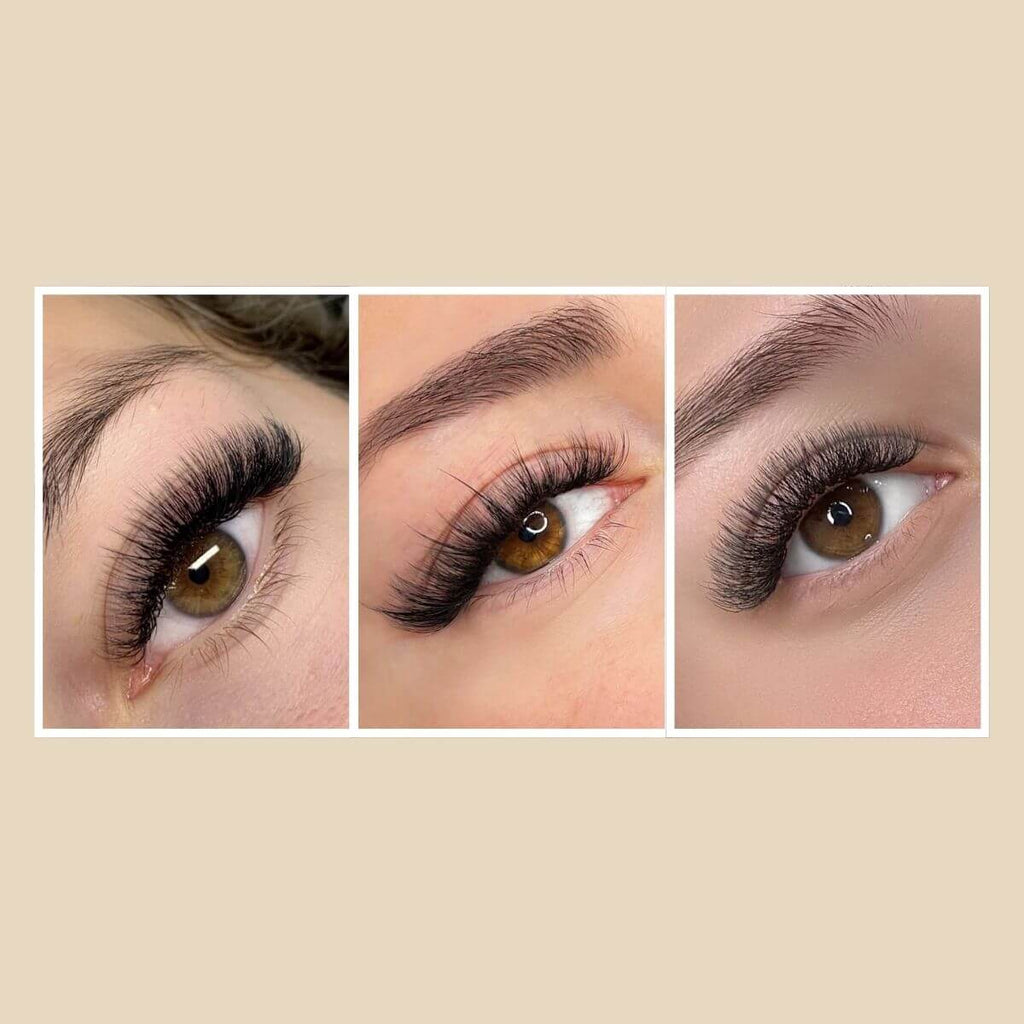
The W-lash architecture (3D/4D/5D) is designed for vertical and horizontal fiber alignment. Unlike handmade fans that can be inconsistent, pre-shaped geometries provide a predictable "footprint."
Understanding U-Shape Geometries
For clients desiring maximum fluff with minimal weight, the 4D U Shaped Eyelash Extension and 5D U Shaped Eyelash Extension offer a specialized "U" curvature at the base. This design further enhances the "wrap" around the natural lash, acting almost like a structural sleeve.
Methodology Note: Weight Distribution Analysis
- Assumption: We compare a 0.07mm 5D W-lash to a 0.15mm Classic lash.
- Logic: Although the 5D W-lash has more fibers, the total volume of PBT material is distributed over a larger contact area (the flat base).
- Outcome: This reduces the "downward torque" on the natural lash root, preventing the drooping often seen in heavy classic sets.
This structural support is critical when Selecting Curls Based on Natural Lash Growth Angles. A flat-base W-lash can help "lift" a downward-pointing natural lash more effectively than a round-base extension, which would likely slide or droop under the same tension.
Troubleshooting Retention and Structural Failure
Even with superior geometry, retention can be compromised by environmental factors and technique errors.
The "Bulky Bond" Pitfall
The most common mistake is over-gluing. When an artist uses too much adhesive, it pools at the base, creating a rigid "bead." This bead creates a leverage point. When the client blinks, the eyelid hits this bead, causing a mechanical "flick" that weakens the bond over time.
Managing the Ocular Microbiome
Recent studies in PMC (2024) emphasize the importance of tear film stability. If the lash base is not flush, it disrupts the lipid layer of the tear film. This can lead to dry eye symptoms, which the WebMD guide on Dry Eyes notes can be confused with allergic reactions. As a professional, diagnosing whether a client has a "glue allergy" or simply "dry eye from poor placement" is vital for client retention.
Technical Specifications Table: W-Lash vs. YY-Lash
| Feature | 0.07MM YY Volume Eyelash Extensions | W-Lash (3D/4D/5D) |
|---|---|---|
| Base Shape | Long Flat Base | Wide Flat Base |
| Fiber Count | 4 Fibers (Split Tip) | 3, 4, or 5 Fibers |
| Effect | Criss-cross / Textured | Fluffy / Uniform Volume |
| Best For | Camouflaging Gaps | Maximum Density |
| Application Skill | Beginner to Intermediate | Intermediate to Advanced |
The Role of Aftercare in Maintaining Integrity
Structural integrity does not end at the salon door. Because the flat base provides more surface area, it also provides more surface area for "biofilms" to attach if not cleaned.
Research on Demodex mite infestation (PMC) shows a direct correlation between poor ocular hygiene and lash loss. Professionals must mandate the use of a lash-safe foam cleanser. Marketing this as "Blepharitis Prevention" rather than just "cleaning" increases client compliance. A clean base ensures that the adhesive bond remains flexible and free from the degrading effects of skin oils.
Conclusion: Engineering Better Outcomes
The shift toward W-lash and flat-base geometries is a response to the professional's need for reliability. By eliminating the mechanical "rocking" of round bases, these designs provide a more stable, comfortable, and long-lasting set for the client.
For the salon owner, adopting these specialized geometries means fewer "infills" due to twisting and higher client satisfaction. When paired with a high-performance adhesive like 0.5-1 Second Diamond Eyelash Extension Glue and a rigorous "slide and seal" technique, the result is a set that maintains its structural integrity from day one until the natural lash naturally sheds.
YMYL Disclaimer: This article is for informational purposes only and does not constitute professional medical or legal advice. Eyelash extension application involves chemicals and proximity to the eye; always consult local licensing regulations and medical professionals regarding ocular health. If a client experiences persistent redness, pain, or vision changes, refer them to an ophthalmologist immediately.
References
- American Academy of Ophthalmology (AAO) - Eyelash Extension Safety
- Mayo Clinic - Blepharitis Symptoms and Causes
- Health Canada - Cosmetic Regulations and Cyanoacrylate Enforcement
- PubMed - pH and Formaldehyde in Eyelash Adhesives (Amano et al.)
- PMC - Ocular Surface Microbiome and Extension Wear
- CDC - Conjunctivitis Prevention and Hygiene