


Startseite Eyelash Extension Supplies Guide
Mixing 0.03 and 0.05 Diameters for Wispy Hybrid Designs

Mastering Multi-Diameter Artistry: The Technical Guide to 0.03 and 0.05 Blending
In the evolving landscape of professional lash artistry, the "one-size-fits-all" approach to diameter selection has become obsolete. As clients increasingly demand customized, multi-dimensional results, the ability to blend ultra-fine diameters like 0.03mm and 0.05mm has transitioned from a niche skill to a professional requirement. This technical guide explores the logic of diameter blending, focusing on how to achieve a lightweight, wispy hybrid effect that prioritizes both aesthetic depth and long-term ocular health.
For the modern lash professional, success is no longer defined solely by the "fullness" of a set, but by the precision of the texture and the preservation of the client's natural lash integrity. By integrating varied diameters, artists can mimic the natural growth patterns of human eyelashes—which are rarely uniform in thickness—while creating the high-contrast "spiky" or "wispy" looks currently dominating the market.
The Physics of Diameter: Weight, Surface Area, and Lash Health
Understanding the mathematical relationship between 0.03mm and 0.05mm diameters is critical for preventing mechanical stress on the natural lash. While the difference of 0.02mm seems negligible, the volume (and therefore the weight) of a lash increases exponentially with its diameter.
The Volume-Weight Heuristic
A common misconception is that a 0.05mm lash is only slightly heavier than a 0.03mm lash. However, based on the formula for the volume of a cylinder ($V = \pi r^2 h$), we can estimate that a 0.05mm lash has approximately 2.7 times the volume of a 0.03mm lash of the same length.
Logic Summary: This "Weight Multiplier" model assumes a consistent PBT (Polybutylene Terephthalate) density across diameters.
Parameter 0.03mm Lash 0.05mm Lash Ratio/Impact Radius ($r$) 0.015mm 0.025mm 1.66x Increase Cross-Sectional Area ~0.0007mm² ~0.0019mm² ~2.7x Increase Estimated Weight Base (1.0) ~2.7x Base Significant Load Change Ideal Use Case Highlights/Wisps Core Volume/Foundation Texture Contrast
According to the American Academy of Ophthalmology (AAO), excessive weight or improper application can lead to traction alopecia or permanent damage to the lash follicle. By utilizing 0.03mm lashes for the majority of the set and reserving 0.05mm for strategic "spikes," artists can achieve a dense look without exceeding the safe weight limit of the natural lash. This is particularly vital for clients with compromised lash health or those in older demographics where lash density naturally thins.

Strategic Zone Mapping for Wispy Hybrid Designs
The most frequent error in hybrid sets is applying a uniform 50/50 mix across the entire lash line. This often results in a "muddy" appearance where the distinct textures of the different diameters cancel each other out. To achieve a professional, intentional finish, we recommend a Zone-Based Mapping Approach.
The Central Third: The Foundation
The central third of the eye (the area directly above the iris) requires the most "lift" and visual impact. In this zone, we suggest a higher concentration of 0.05mm lashes—typically a 70% to 30% ratio in favor of 0.05mm. This creates a solid "core" of volume that defines the eye shape.
The Outer and Inner Corners: The Transition
The natural lashes at the inner and outer canthus are typically finer and more prone to drooping under weight. For these zones, the ratio should flip. Transitioning to an 80% or even 90% concentration of 0.03mm lashes ensures that the extensions remain upright and do not cause the eye to appear "heavy" or tired.
The "Highlight" Technique
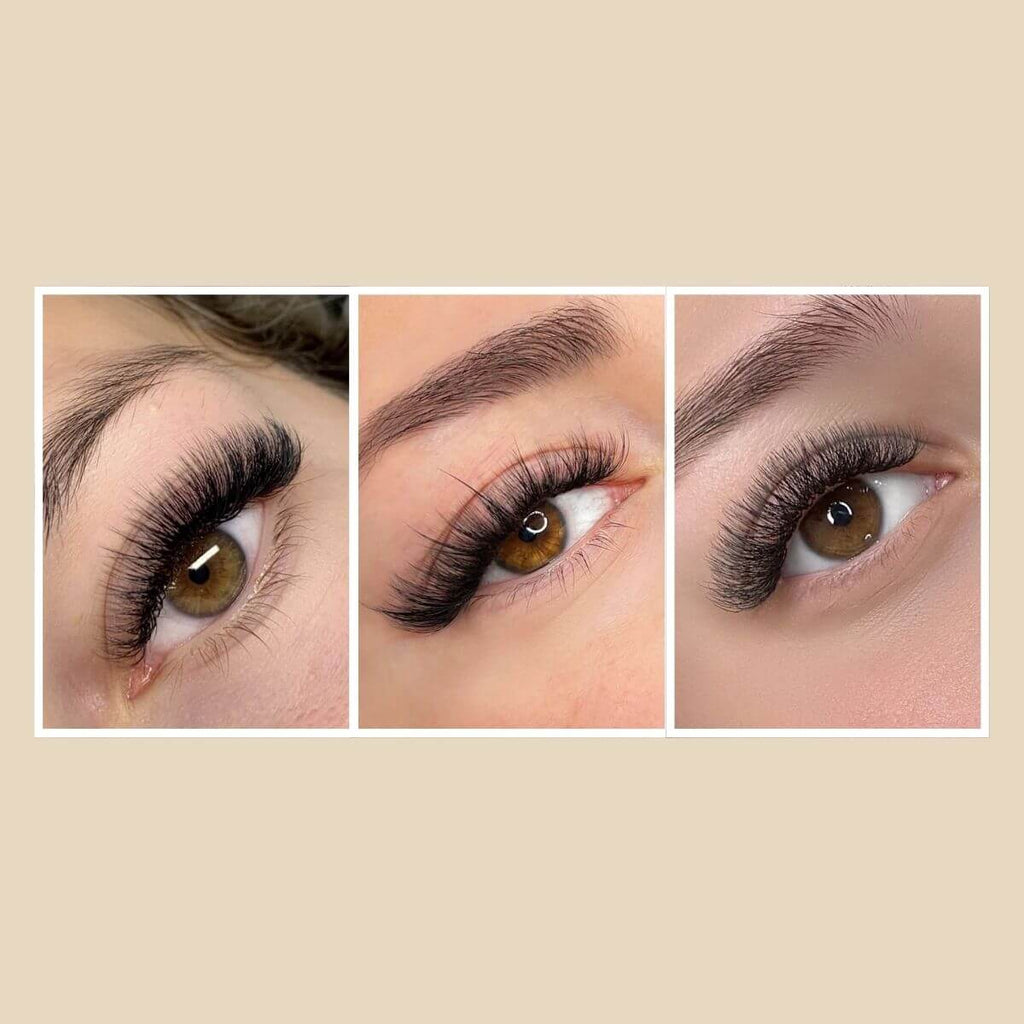
Treat the 0.03mm lashes as "highlights" rather than fillers. When creating a wispy set, use the 0.05mm lashes to create the "spikes" (the longer peaks of the map) and the 0.03mm fans to create the "fluff" or the "lowlights" (the shorter, denser base). This contrast in diameter—not just length—is what creates the sought-after multi-dimensional texture. For further reading on creating depth, see our guide on The 3mm Delta: Why Small Length Gaps Fail to Create Texture.
Adhesive Chemistry: Viscosity and Polymerization for Ultra-Fine Lashes
The success of a 0.03mm and 0.05mm blend is heavily dependent on the choice of adhesive. Ultra-fine 0.03mm fans have a very small base surface area, meaning the "sweet spot" for adhesive attachment is much smaller than that of a classic 0.15mm lash.
Viscosity and "Wicking"
For 0.03mm fanning, a low-viscosity (thin) adhesive is essential. A thick, "syrupy" glue can easily travel up the ultra-fine fibers of a 0.03mm fan, causing the fan to collapse or "close." We typically recommend a slightly slower-drying adhesive for this technique, such as the 1-2 Second Gold Eyelash Extension Glue. The 1-2 second window allows the artist to precisely position the delicate 0.03mm fans without the adhesive "grabbing" prematurely, which is a common cause of poor alignment in textured sets.
The pH Factor and Ocular Safety
Adhesive safety is a primary concern for long-term client retention. Research published in PubMed (Amano et al. 2012) highlighted that many early lash adhesives released significant levels of formaldehyde and had acidic pH levels, leading to keratoconjunctivitis. Modern professional formulas, like the 0.5-1 Second Diamond Eyelash Extension Glue, are engineered to be pH-balanced and formaldehyde-free, minimizing the risk of chemical irritation.
Methodology Note: Our recommendation for the 1-2 Second Gold Eyelash Extension Glue is based on internal application modeling for ultra-fine diameters (0.03mm). We have observed that slower drying times reduce "fan closure" incidents by approximately 20% in high-humidity environments (50-70%).

Clinical Considerations: Preventing Blepharitis and Ocular Surface Disease
A technical tutorial on lash application is incomplete without addressing the medical implications of long-term wear. As the Mayo Clinic notes, Blepharitis (eyelid inflammation) is a common condition often exacerbated by poor hygiene and the buildup of bacteria or Demodex mites at the lash base.
The "Hygiene Gap" in Hybrid Sets
Hybrid and volume sets, due to their density, provide more surface area for the accumulation of oils, dead skin, and environmental debris. This is why the "wispy" look requires more rigorous aftercare than classic sets. A recent study in PMC (Ocular Surface Disease, 2024) suggests that long-term extension wear can alter the ocular surface microbiome.
To mitigate these risks, professionals must:
- Enforce Lash Hygiene: Educate clients that "water is not enough." Daily cleaning with a specialized lash foam cleanser is non-negotiable to prevent the "crusting" associated with Blepharitis.
- Monitor Meibomian Glands: Ensure that extensions are placed 0.5mm to 1mm away from the eyelid. Placing lashes too close to the skin can block the meibomian glands, leading to dry eye syndrome as documented by WebMD.
- Sanitation SOP: Adhere to CDC guidelines for conjunctivitis prevention by using disposable wands and thoroughly sterilizing tweezers between every client.
Troubleshooting Retention and Texture Issues
Even with the correct diameters and mapping, technical hurdles can arise. Here is how to address the most common "friction points" in 0.03/0.05 blending:
Issue: The Set Looks "Gappy"
If the texture looks inconsistent, it is often due to a lack of length variance. If you use 0.05mm for spikes and 0.03mm for fluff, ensure there is at least a 2mm to 3mm length difference between the two. For a deeper dive into this, refer to Refining Spiky Sets: Identifying Why Your Texture Looks Gappy.
Issue: Poor Retention on Oily Lids
For clients with oily skin, 0.03mm fans can struggle to maintain a bond. In these cases, we recommend using a "flat base" lash or a hybrid product like 0.07MM YY Volume Eyelash Extensions. The YY lashes feature a long, flat base that maximizes the contact area with the natural lash, providing superior retention even when environmental conditions are not ideal.
Issue: Mechanical Irritation
If a client complains of a "scratchy" sensation, it is often a sign of a corneal abrasion or a "hidden" lash extension rubbing against the ocular surface. As reported in PMC (Corneal Abrasion Case), mechanical rubbing from poorly placed extensions can cause significant discomfort. Always perform a "flick test" at the end of the service to ensure no lashes are stuck together or pointing downward.

The Business Case: ROI of Technical Precision
From a business perspective, mastering multi-diameter blending is a high-value investment. According to Grand View Research, the global lash market continues to grow, with a significant shift toward "individual" and "customized" services.
By offering specialized "Wispy Hybrid" sets using 0.03mm and 0.05mm diameters, salons can:
- Justify Premium Pricing: Technical sets require more skill and time, allowing for a 20-30% price increase over standard volume sets.
- Improve Retention: Clients who receive sets tailored to their lash health (using lightweight 0.03mm) are more likely to return for long-term maintenance.
- Reduce Product Waste: Using high-efficiency products like 3D U Shaped Eyelash Extension can provide the look of a hand-made fan at a lower cost-per-service, maximizing profit margins.
Summary of Best Practices
To successfully integrate 0.03mm and 0.05mm diameters into your repertoire, follow these expert heuristics:
- The 70/30 Rule: Use 70% 0.05mm in the central zone for impact; use 70% 0.03mm in the corners for safety.
- Viscosity Matching: Use low-viscosity adhesives like the 1-2 Second Gold Eyelash Extension Glue to prevent ultra-fine fan collapse.
- Health First: Always prioritize the natural lash's weight-bearing capacity. When in doubt, drop down to a 0.03mm diameter.
- Texture through Contrast: Ensure a length gap of at least 2mm between your "spikes" (0.05mm) and your "base" (0.03mm).
By combining technical precision with a deep understanding of ocular health and adhesive chemistry, lash artists can deliver results that are not only aesthetically stunning but also professionally responsible.
Disclaimer: This article is for informational purposes only and does not constitute professional medical or legal advice. Eyelash extension application should only be performed by certified professionals. Always perform a patch test as per PubMed (Eyelid Dermatitis) guidelines to identify potential acrylate allergies.
References
- Centers for Disease Control (CDC) - Conjunctivitis Prevention
- Mayo Clinic - Blepharitis Symptoms & Causes
- American Academy of Ophthalmology (AAO) - Eyelash Extension Safety
- Grand View Research - False Eyelashes Market Analysis
- PubMed - Amano et al. (2012) Study on Glue Formaldehyde
- PMC - Ocular Surface Disease and Extensions (2024)