


Premade Fans for Lash Artists: The Complete Guide

Applying premade fans lash extensions means balancing speed with retention and natural lash safety through the right base, diameter, dimension, curl, and tray style. The article also explains how to apply premade fans correctly, when to use lighter options, and which client situations fit them best.
Premade fans lash extensions help lash artists complete volume sets faster without losing structure. A full volume appointment can often drop to 1.5 to 2 hours when the fan choice and placement are correct. The result still depends on weight control, base type, adhesive use, and isolation. Premade fans are not a shortcut around lash knowledge. They are a tool for faster, cleaner, and more consistent volume work.
What Are Premade Lash Fans?
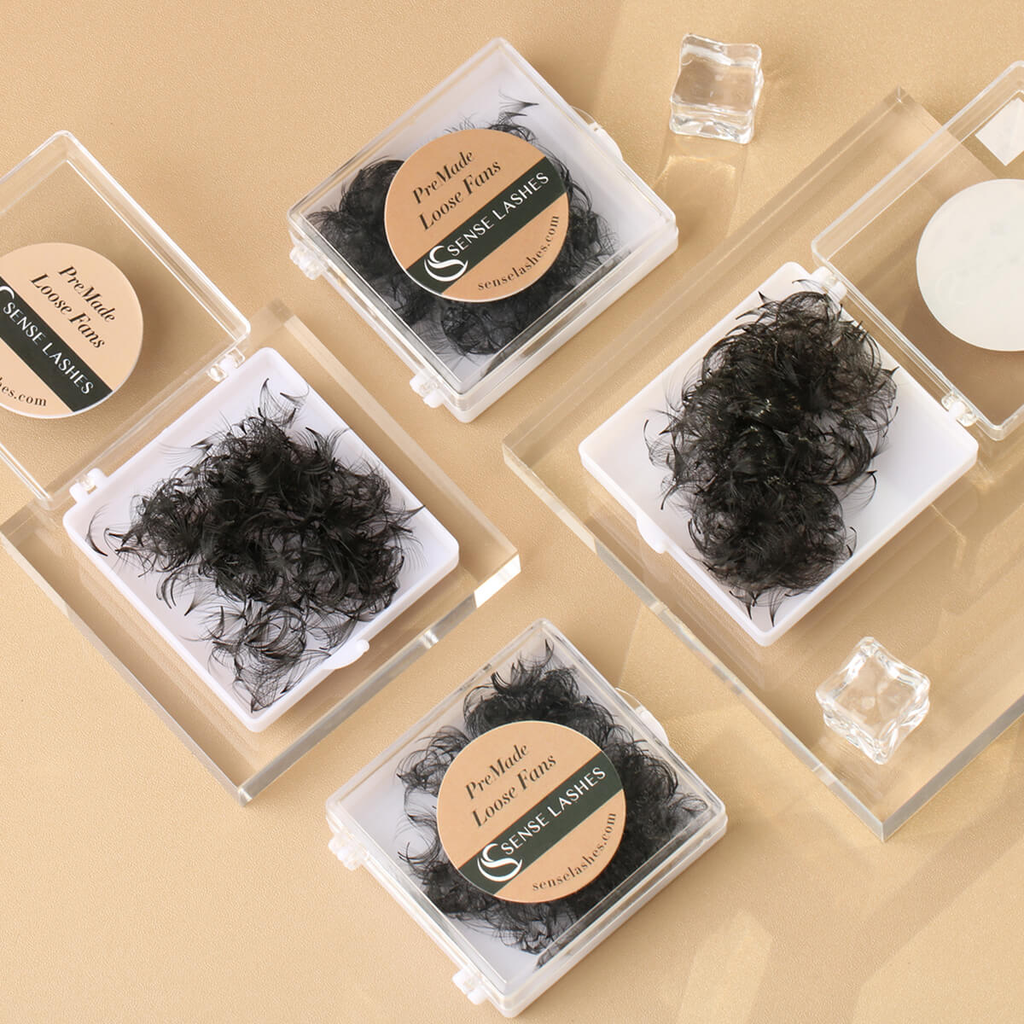
Premade fans and loose promade fans are related, but they are not the same product type. The difference starts with how the fan is made before it reaches your tweezer.
Premade Fans vs. Promade Fans
A premade fan is a volume fan created before the lash appointment. It is ready to pick up and apply to one natural lash.
Tray premade fans are usually machine made and arranged on adhesive strips. They look similar to classic lash trays during pickup. A promade fan is usually handmade before the service and stored loose in a box.
Both are applied the same way. You isolate one natural lash, pick up one fan, dip the base, and place it correctly.
The main difference is production method. Promade or loose promade fans often have finer bases because they are handmade. Tray premade fans usually offer faster pickup and easier organization.
How Premade Fans Differ From Easy Fanning Lashes
Easy fanning lashes are not already open fans. They are layered lash strips designed to help artists create fans during pickup.
Premade fans are ready to use. You do not need to build the fan during the service.
Choose easy fanning lashes if you want to keep practicing fan control. Choose premade fans if you need speed, consistency, and shorter appointment times.
How to Choose Premade Fans: 5 Factors That Matter
The wrong base, dimension, or diameter can reduce retention. These five factors decide whether premade fans lash extensions perform well.
Base Type: Pointy Base vs. Flat Base
The base is the root area where the fan attaches to the natural lash. It controls weight, adhesive contact, and placement quality.
Flat base premade fans can create a double base effect. That means the base sits wide and flat instead of wrapping around the natural lash. This can reduce adhesive contact and make placement less secure.
Pointy base premade fans have a tapered base. The narrow shape allows better contact with the natural lash. It can also help the adhesive form a cleaner bond.
You should also check how the base is bonded.
● Heat bonded fans use heat to secure the base.
● Glue bonded fans use adhesive during manufacturing.
● Heat bonded pointy base fans are usually lighter.
● Glue bonded flat base fans may add extra weight.
For professional work, confirm the base before buying. Heat bonded pointy base fans are often the safer choice for retention and weight control.
Dimension: From 3D to 40D
Dimension means the number of extensions in one fan. For example, 5D means five extensions in one fan.
Client preference should not decide the highest dimension. Natural lash health decides the safe limit.
Here is a simple working reference for professional planning.
| Fan Dimension | Common Use | Typical Diameter Range |
|---|---|---|
| 3D to 5D | Light volume | 0.07 mm |
| 6D to 9D | Full volume | 0.05 mm or 0.07 mm |
| 10D to 16D | Soft mega volume | 0.03 mm or 0.05 mm |
| 20D to 40D | Advanced mega volume | 0.03 mm |
Use this table as a planning tool, not a fixed rule. Natural lash strength, length, growth stage, and isolation still matter.
Diameter
Diameter means the thickness of each extension in the fan. A smaller diameter allows more extensions per fan.
For premade fans, common choices include:
● 0.03 mm for mega volume and high dimension fans
● 0.05 mm for medium to full volume
● 0.07 mm for light volume and lower dimension fans
High dimension fans above 10D should usually use 0.03 mm. This helps keep the total fan weight within a safer range.
A 10D 0.03 mm fan is often used as a light mega volume option. It can create density without the heavy feel of thicker extensions.

10D Fans Preconfezionati Fatti a Mano con Base Punta (500 Fans)
Spessore: 0.03
Curl: C
Lunghezza: 8mm
Curl Type
Curl type means the bend of the lash extension. It affects lift, openness, and final style.
Common curls include C, CC, and D.
● C curl gives soft lift and a natural finish.
● CC curl gives more lift while staying wearable.
● D curl creates a stronger lifted effect.
If your client has downward natural lashes, curl choice needs extra care. A strong curl may look lifted, but poor attachment angle can reduce retention.
For deeper curl planning, link this section to your curl type cluster article.

Loose Fans vs. Tray Fans
Loose premade fans and tray premade fans can both work well. The better choice depends on workflow.
Tray premade fans are attached to strips. Pickup feels similar to classic lash pickup. They are organized, clean, and beginner friendly.
Loose promade fans are stored loose in a box. Many artists use a silicone pad to organize them during the service. They can be more flexible for high volume use.
Tray fans work well for newer lash artists. Loose fans work well for busy artists who already have strong pickup control.
How to Apply Premade Fans for Maximum Retention
Application technique decides how long premade fans stay attached. The fan can be well made, but poor adhesive use will still cause shedding.
Pickup and Adhesive Dipping
Pick up the fan from the base, not from the top. Holding the top can close the fan or distort its shape.
Dip 2 to 3 mm of the base into adhesive. This depth helps create a small sleeve around the natural lash.
The adhesive should coat the base without flooding the fan. Too much adhesive can close the fan and cause stickies.
Replace your adhesive drop every 15 to 20 minutes. Fresh adhesive supports better curing and cleaner attachment.
Placement Angle
Attach each fan based on the natural lash direction. Do not force every fan into the same angle.
You can place the fan on the top, side, or bottom of the natural lash. The right choice depends on growth direction and visibility.
For straight natural lashes, top placement often gives clean contact. For downward lashes, side placement may help control direction.
Check the base after placement. It should sit flush with the natural lash, not floating above it.
Common Mistakes That Kill Retention
Premade fans retention tips often start with adhesive control. Most early fallout comes from small placement errors.
Watch for these issues:
● Too much adhesive closing the fan
● Too little adhesive reducing base contact
● Dipping less than 2 mm into adhesive
● Placing the base at a poor angle
● Using old adhesive drops
● Working outside the correct humidity range
Temperature and humidity also affect curing. Follow your adhesive’s working range and adjust room conditions when needed.
Are Premade Fans Safe for Natural Lashes?
Premade fans do not damage natural lashes by themselves. Safety depends on fan weight, isolation, placement, and client lash health.
The 50% Weight Guideline
According to professional lash training guidelines, one extension should not overload the natural lash. Many artists use the 50% weight guideline as a safety reference.
This means the applied fan should stay within a safe weight range for that natural lash.
A 10D 0.03 mm fan is often close in weight to one 0.10 mm classic extension. This is why diameter matters in volume work.
Heat bonded pointy base fans can be safer than glue bonded flat base fans. They usually reduce extra base weight and improve adhesive contact.

When to Use Lighter Dimensions
Use lighter dimensions when the natural lashes are thin, weak, or sparse. The same rule applies to anagen lashes, which are still in the early growth stage.
Anagen lashes are shorter and less mature. They should not carry heavy fans.
Do not increase dimension only because a client wants more density. A fuller look must still respect natural lash capacity.
When in doubt, reduce dimension and improve coverage. Healthy retention is better than heavy density.
When Premade Fans Work Best and When They Don’t
Premade fans work well when speed and consistency matter. They are not the right tool for every client or every style.
Premade fans work best for:
● Express volume services with shorter appointment times
● Clients who want even and balanced volume
● Artists still improving handmade fanning skills
● Salons that need consistent service timing
● Full sets where symmetry matters more than custom texture
They may not be ideal for:
● Clients needing wrapping technique for maximum retention
● Sparse natural lashes that need custom weight control
● Fine natural lashes with uneven strength
● Wispy sets needing irregular lengths and mixed dimensions
● Advanced styling that depends on custom fan shape
Wrapping technique means placing a handmade fan around the natural lash. It can increase contact area when done correctly.
Build Your Premade Fan Strategy Around Your Client List
Choose premade fans based on natural lash strength, service time, and style goals. Use pointy base, heat bonded fans when weight and retention matter most. Match dimension and diameter to the client, not the trend. For busy volume services, link clients and artists toward your loose promade fan collection.
FAQ
Q1. How Many Premade Fans Do I Need for a Full Volume Set?
A full volume set often needs 80 to 120 fans per eye pair. The number depends on natural lash count, coverage goals, and lash line density. Keep extra fans ready for inner corners and correction areas.
Q2. Are Premade Fans Lash Extensions Good for Beginner Lash Artists?
Yes, premade fans can help beginners build speed and consistency. They do not replace isolation, adhesive control, or weight judgment. Beginners should start with lower dimensions before using mega volume fans.
Q3. How Do I Choose Premade Lash Fans for Different Clients?
Start with natural lash strength, then choose dimension, diameter, curl, and base type. Fine lashes need lighter fans. Stronger lashes may support fuller volume when isolation and placement are correct.
Q4. Can Premade Fans Be Used for Mega Volume Sets?
Yes, premade fans can work for mega volume sets. Use very fine diameters, usually 0.03 mm, for high dimension fans. Choose a clean pointy base to reduce extra weight and improve attachment.
Lascia un commento