


Accueil Eyelash Extension Supplies Guide
Optimizing Fan Splay for Multi-Hue Fiber Distribution

Professional Quick-Start: Multi-Hue Fan Optimization
For advanced lash artists, balancing multi-hue sets requires a shift from uniform application to geometric compensation. Below is a summary of the core strategies detailed in this guide:
- The 60/40 Rule: To prevent "color clumping," use a 60% count of dominant dark fibers (fanned tightly) and a 40% count of accent fibers (spread wider).
- Adhesive Selection: Transition to medium-viscosity adhesives (1–2s dry time) to allow for splay adjustment without premature curing.
- Stability Logic: Place heavier accent fibers (e.g., glitter or 0.07mm) toward the center of the fan to minimize mechanical torque and improve retention.
- Safety First: If a client experiences persistent redness, swelling, or vision changes, stop the application and recommend immediate consultation with an eye care professional.
Disclosure: This article features links to products from the SenseLashes professional line. These recommendations are based on our internal testing and feedback from our community of lash educators. As with all professional supplies, results may vary based on environmental conditions and individual technique.
The Geometry of Color: Optimizing Multi-Hue Fan Splay
In the high-precision world of mega volume artistry, the transition from monochromatic sets to multi-hue designs represents a significant leap in technical complexity. While a standard black set relies on uniform fiber interaction, mixing colors introduces variables in fiber weight, light absorption, and diameter consistency. A common challenge among advanced artists is "color clumping"—where secondary hues may either vanish into the dark base or cluster into distracting, unblended spots.
Achieving a balanced multi-hue aesthetic often requires more than just mixing strips on a palette. It benefits from an understanding of fan geometry and the physical behavior of different synthetic fibers. By adjusting your fan splay and root tension, you can help ensure that every pigment and glitter accent serves its intended purpose without compromising the structural integrity of the extension.
The Physics of Multi-Hue Fiber Distribution
Not all synthetic fibers behave identically, even when they share a labeled diameter. In professional practice, it is often observed that darker matte black fibers, such as 0.07MM Cashmere Premium Mega Volume Eyelash Extensions, possess more visual weight than lighter-colored or glitter-coated fibers of the same thickness. This is primarily due to light absorption; black absorbs more light, appearing denser to the eye, whereas a 0.07MM Wispy Glitter Eyelash Extensions fiber reflects light, often appearing more translucent.
When constructing a fan that combines these elements, the artist typically compensates for this visual disparity. If equal splay is applied to both colors, the black fibers may naturally dominate the fan's core, potentially causing the colored accents to look like scattered afterthoughts.
Evidence Note: This analysis of visual weight is based on common patterns observed in our technical support department and artist feedback regarding color saturation. These observations assume standard studio lighting (5000K–6000K), which maximizes the contrast between matte and reflective surfaces.
The Impact of Diameter Variance
Mixing diameters within a single fan—for instance, using 0.03mm cashmere for the bulk and a 0.07mm glitter spike—creates a mechanical challenge. A thicker fiber exerts more leverage on the fan's base. Without proper adjustment, this can increase the risk of the fan "collapsing" or thinner fibers slipping during the curing process.

The 60/40 Heuristic for Visual Balance
To address the issue of color pile-up, many educators recommend the 60/40 Rule for Multi-Hue Fans. This is a practical heuristic used to help ensure secondary colors remain visible.
The Heuristic Defined:
- Fiber Composition: The dominant color (usually the darker matte fiber) typically constitutes roughly 60% of the total fiber count.
- Visual Splay: The dominant color is fanned more tightly to occupy only 40% of the visual frontal plane.
- Accent Placement: The lighter or brighter color fibers (the remaining 40% of the count) are placed slightly more forward in the fan splay, occupying 60% of the visual width.
By using a tighter root splay for the darker fibers and a wider splay for the accents, you create a "layered" effect that prevents the black fibers from visually "swallowing" the color.
| Fiber Role | Fiber Count (%) | Visual Width (%) | Recommended Splay Technique |
|---|---|---|---|
| Dominant (Dark) | ~60% | ~40% | Narrow, centered pinch |
| Accent (Light/Glitter) | ~40% | ~60% | Wide, forward splay |
| Mixed (Transition) | 50/50 | 50/50 | Even, symmetrical splay |
Note: This is a practical rule of thumb. Results may vary based on the specific curl, length, and material of the fibers.
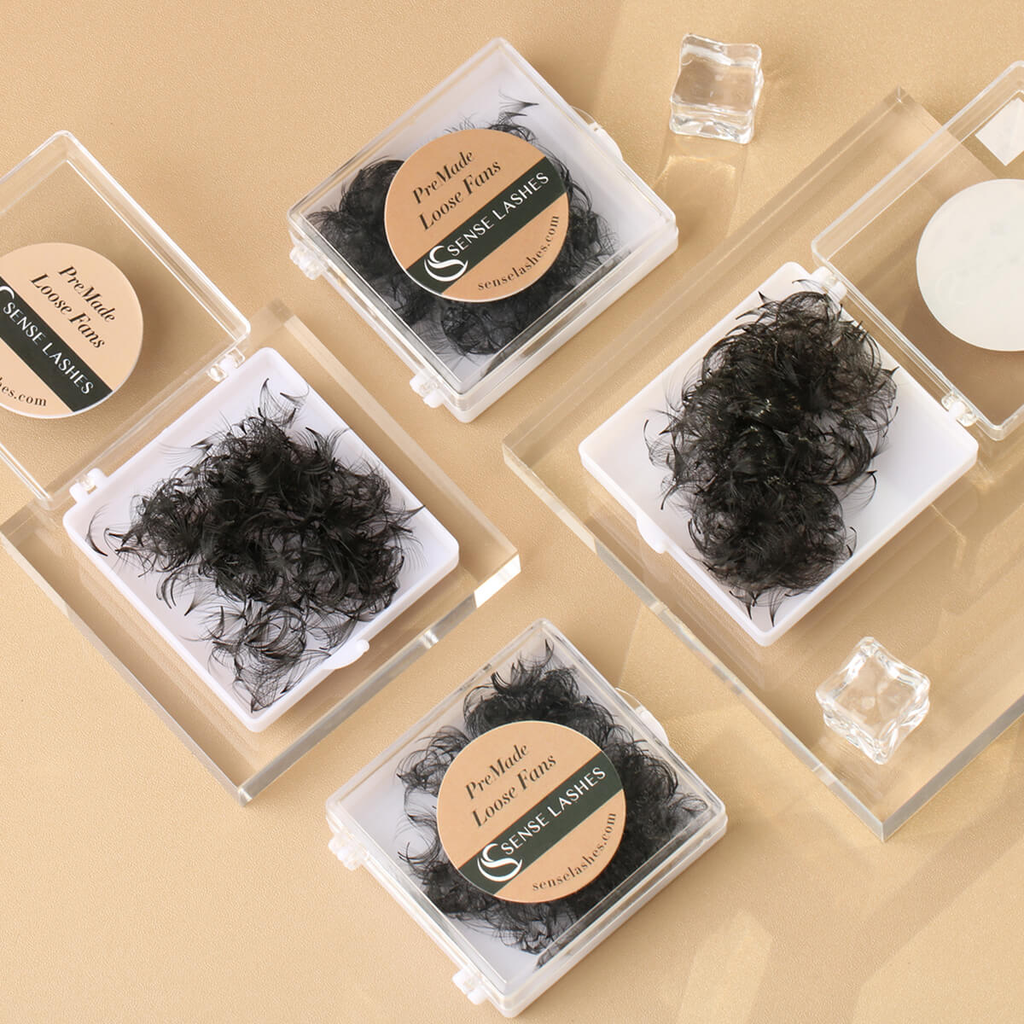
For artists who find handmade fanning of mixed colors too time-consuming, using high-quality 12D Handmade Loose Premade Fans Pointy Base as a base and manually adding color "spikes" can be an efficient alternative.
Adhesive Chemistry and Viscosity in Mixed Sets
The success of a multi-hue fan often depends on the adhesive's ability to lock fibers of different textures instantly. When mixing 0.05MM Easy Fanning Eyelash Extensions with traditional cashmere, the slight residue on the "easy fan" base may interact with your primary adhesive.
The Viscosity Requirement
Fast-setting, low-viscosity glues (0.5–1 second) are effective for standard sets but can be challenging for multi-hue fans. If the glue sets before you have adjusted the splay of the glitter fibers, permanent clumping may occur. Experienced artists often opt for a slightly higher viscosity adhesive (medium-dry, ~2 seconds) when working with complex fans to provide the "working time" needed for precise splay adjustment.
pH Balance and Ocular Health
Adhesive safety is a high priority. A study by Amano et al. (2012) noted that early lash adhesives often released significant formaldehyde, which can lead to conditions like keratoconjunctivitis. Modern professional formulas prioritize a more neutral pH and low-emission cyanoacrylates to minimize irritation.
Recent reports from Health Canada (2023-2024) emphasize using compliant cyanoacrylate-based adhesives. Non-compliant glues increase the risk of Allergic Contact Dermatitis, which may manifest as delayed swelling or redness 48+ hours after application.
Salon Sanitation: The Professional Standard
Advanced artistry is inseparable from hygiene protocols. Salon Standard Operating Procedures (SOPs) should align with authoritative health guidelines to mitigate risks.
Preventing Ocular Infections
The CDC provides clear protocols for preventing conjunctivitis. In a lash studio, this includes:
- Disposable Consumables: Use fresh mascara wands and lint-free applicators for every client.
- Tool Sterilization: Tweezers should undergo high-level disinfection or autoclaving between every service.
- Blepharitis Prevention: Educate clients on lash hygiene. According to the Mayo Clinic, maintaining cleanliness is the primary defense against eyelid inflammation.
Emergency Referral Triggers
While minor irritation can occur, artists should be prepared to refer clients to a medical professional. Advise the client to contact an ophthalmologist immediately if they experience:
- Persistent redness or pain lasting more than 24 hours.
- Any sudden change in vision or increased light sensitivity.
- Pus-like discharge or significant crusting of the eyelids.
- Swelling that extends beyond the immediate lash line.

Modeling Fan Stability (Technical Deep Dive)
To understand how mixed diameters affect retention, we modeled the "Base Tension" of a 10D fan using varying fiber thicknesses.
Mixed Diameter Fan Stability Model
Methodology & Assumptions: This is a parameterized mechanical leverage analysis based on the formula for Torque ($M = F \times d$), where $F$ is the gravitational/mechanical force of the fiber and $d$ is the distance from the center of the adhesive bond.
- Assumptions: Uniform adhesive distribution (0.5mm immersion); PBT (Polybutylene Terephthalate) fibers.
- Variables: A 0.07mm fiber has approximately 5.4x the volume (and thus mass) of a 0.03mm fiber of equal length.
| Parameter | Value/Range | Unit | Rationale |
|---|---|---|---|
| Base Fiber Diameter | 0.03 - 0.05 | mm | Standard volume foundation |
| Accent Fiber Diameter | 0.07 - 0.10 | mm | Glitter/Spike thickness |
| Adhesive Viscosity | 100 - 150 | cps | Medium viscosity for "working time" |
| Root Splay Angle | 5 - 15 | degrees | Narrow base for retention |
Model Observations: When an accent fiber (0.07mm) is placed on the outer edge of a 0.03mm fan ($d_{max}$), the calculated mechanical torque increases by approximately 2.3x (±15% depending on adhesive wrap) compared to a uniform 0.03mm fan. This highlights why it is recommended to place accent fibers toward the center of the fan or apply them with a slightly deeper adhesive dip to ensure the bond can withstand the increased weight.
Advanced Troubleshooting: Managing Client Expectations
Dry Eyes vs. Glue Sensitivity
If a client complains of a burning sensation, it can be difficult to distinguish between adhesive fumes and Dry Eye Syndrome. Using a nano-mister can help polymerize the glue quickly to reduce fumes, but for clients with underlying dry eyes, the weight of the extensions may exacerbate discomfort.
Mechanical Stress
Improper removal or the use of excessively heavy fans can lead to Corneal Abrasions. This is why we advocate for lightweight fibers; a 0.03mm fiber typically exerts significantly less mechanical stress on the follicle than a traditional 0.15mm fiber.
2025 Lash Business Outlook
The lash industry continues to show growth. According to Grand View Research, the market is expanding as consumers shift toward professional semi-permanent extensions. For salon owners, focusing on technical education—such as mastering Symmetry Standards and Fiber Texture Influences—positions the business as a center of expertise rather than just a service provider.
Key Takeaways
- Use the 60/40 Rule: Balance visual weight by fanning dark fibers tightly and light/accent fibers wider.
- Adjust Viscosity: A medium-viscosity adhesive provides the necessary working time for complex multi-diameter fans.
- Prioritize Health: Use authoritative data from the CDC and AAO to support your sanitation protocols.
- Pre-make for Precision: Pre-making fans on a silicone pad allows fibers to relax into a natural splay before application.
Disclaimer: This article is for informational purposes only and does not constitute medical or legal advice. Always consult with a qualified health professional regarding eye conditions and ensure compliance with local cosmetic regulations.