


How to Choose the Right Lash Curl Based on Natural Growth Direction

Smart mapping matches curls to growth for healthy, lasting sets. Save time while creating a perfectly balanced, natural aesthetic for every single client.
Great lash retention starts with one simple thing: choosing curls that match your client's natural lash growth. Too many artists jump straight into their favorite eyelash extension styles without checking which way the natural lashes actually point. This mismatch causes extensions to twist, stress the natural lash, and fall out early. Smart lash mapping for eye shapes means assessing growth direction first, then selecting curls that enhance rather than fight it—and your clients will notice the difference in how long their sets last.
Step 1: Check How Your Client's Natural Lashes Grow
Before selecting any curls, spend a few minutes examining how your client's natural lashes actually grow.
Growth patterns you'll see:
- Straight growth: Most clients have lashes that grow straight out from the lash line at about a 90-degree angle. These give you the most options since there's no strong upward or downward angle to work around.
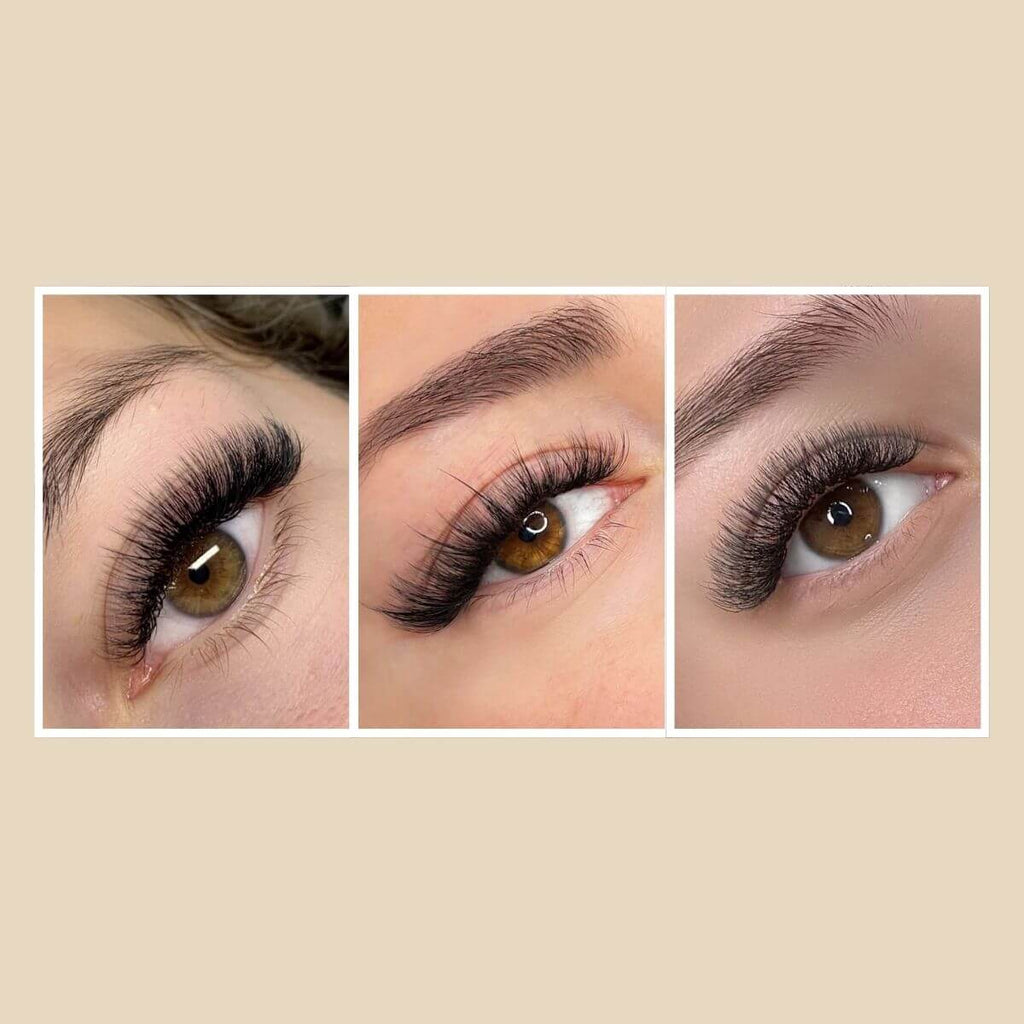
- Downward growth: Common with hooded eyes, monolids, and aging skin, these lashes point down toward the cheek. Even when your client looks straight ahead, the lash tips aim downward and can make eyes look smaller or tired.
- Upward growth: Less common but easy to spot, these lashes naturally lift from the base. Clients with this pattern already have visible lashes, so too much curl makes them look fake.
- Different growth in different areas: Most clients don't have uniform growth across the lash line. Inner corners might grow straight while outer corners point down. Check each section separately instead of assuming the whole eye is the same.
Before isolating lashes, brush them gently with a clean spoolie in their natural direction.

couleur: blanc
Step 2: Pick the Right Curl for Each Growth Pattern
Once you know how the lashes grow, choosing the right curl becomes straightforward. Each growth pattern needs a specific curl range to look natural and stay secure.
For downward-growing lashes:
Best curls: C, CC, or D – These curls provide the lift needed to open up the eye without working against the natural angle. A C curl gives moderate lift, CC offers more drama, and D creates maximum openness for very downward lashes. You'll see this growth pattern most often in clients with hooded eyes, mature skin where the eyelid has started to droop, and many Asian eye shapes where the lid covers more of the lash line.
For straight-growing lashes:
Best curls: B, C, or CC – These enhance what's already there without adding too much curve. B curl keeps things natural and wispy, C curl is your go-to for everyday glam, and CC works when clients want more definition.
For upward-angled lashes:
Best curls: B or J – Stick with minimal curl to avoid an overly dramatic look. J curl follows the natural lash curve and adds length without extra lift, while B curl provides just a subtle enhancement.
| Growth Direction | Best Curl Options | Effect |
| Downward | C, CC, D | Lifts and opens the eye |
| Straight/Parallel | B, C, CC | Enhances without over-curling |
| Upward | B, J | Maintains natural appearance |
When you match curl to growth pattern, extensions sit properly on the natural lash and create the look your client wants without compromising retention.
Step 3: Add Curl Choices to Your Lash Map
Your lash map isn't complete until you've noted which curls go where. After assessing growth direction, you can plan out curl placement zone by zone to create a cohesive set.
Building your map with curls in mind:
- Start with growth, then style: Always assess the natural lash growth first, then decide on your eyelash extension styles. A client might ask for a cat eye, but if her outer corner lashes grow downward, you'll need to adjust your curl choices in that area to make the style work.
- Map curls by zone: Break the lash line into three sections: inner corner, center, and outer corner. Note which curl you'll use in each zone. Most lash maps need at least two different curls to look natural and account for how growth varies across the eye.
- Balance curl with length and diameter: Curl doesn't work alone. If you're using a dramatic D curl in the center, you might need to keep the length moderate so it doesn't look too intense. Lighter curls like B can handle longer lengths without looking overdone.
Example:
Cat eye with mixed growth: Say your client has downward lashes at the outer corners but straight growth in the center. Your map might use CC curl in the center for definition, then switch to D curl at the outer corners to lift those downward lashes and create the elongated cat eye shape.
Where to place different curls:
- Inner corner: This area usually needs less curl since these lashes are shorter and finer. B or C curl keeps things soft and natural without poking the client or looking too dramatic near the nose.
- Center lash line: The longest, strongest lashes live here, so they can handle more curl. C, CC, or D curls work well depending on how much lift you need and what the client wants.
- Outer corner: Your curl choice here depends on two things: the style you're creating and the natural growth angle. For a cat eye, you might use a stronger curl to lift and extend. For a natural look, match whatever curl you used in the center or go slightly less dramatic.
Writing your curl choices directly on your lash map before you start keeps you consistent and helps you remember your plan as you work through the application.
Step 4: Handle Difficult Lash Growth Patterns
1. Severely downward-growing lashes:
Place D curl extensions on the center section of the lash line, roughly from the pupil area extending about 5-7mm on each side.
As you move toward the inner and outer corners, switch to C curl for the last 3-4mm of lashes on each end. This creates a gradual transition instead of an abrupt curl change.
Skip L curl entirely—while the flat base seems helpful, the 90-degree angle leaves too little surface area for the adhesive to bond properly.
2. Irregular or crossed natural lashes:
Pick one curl type (usually C or CC) and use it across the entire lash line.
When you isolate each lash, straighten it gently with your tweezers before applying the extension. Position the extension so it sits along the natural lash shaft, not twisted or angled to one side.

Série Onyx | Ensemble de pinces à extensions de cils à embout en fibre
If a natural lash crosses over its neighbor, isolate it completely before attaching the extension—don't try to work around the crossing or you'll end up with stickies.
3. Different growth between left and right eyes:
Map each eye separately on your consultation card. If the right eye has downward growth, note that you'll use CC or D curl. If the left eye grows straight, write down that you'll use C curl.
Apply extensions according to each eye's individual map rather than mirroring the same curls on both sides.
Check symmetry by stepping back and looking at both eyes together—they should appear balanced even if you're using different curls.
4. Sparse, damaged, or inconsistent lashes:
Choose B or C curl maximum, regardless of what the client requests.
Apply extensions that are no more than 1.5x the length of the natural lash and use 0.07mm or 0.10mm diameter.
Place the extension along at least 2-3mm of the natural lash base to maximize the bonding surface. Use a slightly larger bead of adhesive than normal (but still controlled) to ensure full contact, and hold each extension in place for 2-3 seconds instead of the usual 1-2 seconds.
With challenging growth patterns, your curl placement and application technique matter more than the curl type itself. Take extra time on isolation and positioning to get clean, secure attachments.
5 Common Curl Selection Mistakes to Avoid
Mistake #1: Using L or M curl on downward lashes for "maximum lift"
- Why it doesn't work: L and M curls have a sharp 90-degree bend at the base. This creates a tiny contact point where the extension meets the natural lash—sometimes just 1mm of surface area. Less contact means the adhesive has nowhere to grip, so extensions pop off within days.
- What to do instead: Use D curl and apply it correctly. D curl provides plenty of lift (about 60-70 degrees) while keeping 2-3mm of the extension base flush against the natural lash.
Mistake #2: Ignoring the natural lash base angle
- Why it doesn't work: When you attach an extension without checking the angle where the natural lash grows from the lid, the extension twists or sits crooked.
- What to do instead: Before placing each extension, look at the exact angle where the natural lash emerges from the lash line. Position your extension so it follows that same angle from the base. The first 2mm of contact should sit completely flat against the natural lash direction—adjust your hand position and tweezers to make this happen.
Mistake #3: Using the same curl across the entire lash line despite different growth
- Why it doesn't work: Most clients don't have uniform growth from inner to outer corner. If you use CC curl everywhere but the outer corner lashes grow downward, those outer extensions won't sit properly. You'll see gaps, poor retention in specific zones, and an unbalanced final shape.
- What to do instead: Divide your lash map into at least three zones—inner corner, center, and outer corner. Check the growth direction in each zone and assign the appropriate curl. For example, use C curl at the inner corner, CC in the center, and D at the outer corner if needed. Transition gradually between curls so there's no obvious line where one curl ends and another begins.
Mistake #4: Over-curling to make up for short natural lashes
- Why it doesn't work: When you put a D or DD curl on very short natural lashes (4-5mm), the extensions stick straight up or point toward the forehead instead of curving outward.
- What to do instead: Keep the curl moderate—B or C maximum—and focus on length instead. You can safely go up to 2x the natural lash length with a gentler curl. A 10mm extension in C curl on a 5mm natural lash looks much better than an 8mm extension in D curl. The gentler curve lets the length extend outward rather than just upward.
Mistake #5: Not asking about the client's daily habits
- Why it doesn't work: Side sleepers crush their lashes into the pillow every night, which bends dramatic curls and causes premature shedding. Clients who wear heavy eye makeup need to rub their lashes during removal, which also affects curl choice. You won't know these things unless you ask.
- What to do instead: During consultation, ask three specific questions: "Do you sleep on your side or stomach?" "Do you wear eye makeup daily?" and "Do you rub your eyes often?" Side sleepers do better with B or C curl that can handle some pressure. Daily makeup wearers need curls that won't trap product at the base—again, B or C works better than dramatic D curls. Adjust your curl recommendations based on what they tell you, not just what looks pretty in the moment.
Most curl mistakes happen when you focus only on the desired look without considering how the lashes actually grow and how the client lives. Take an extra two minutes to assess properly and you'll avoid these common problems.
Curl Selection Checklist
Run through this checklist with every client to avoid curl mistakes.
Before starting:
☐ Check growth direction in each area: Brush lashes with a clean spoolie. Note if they grow straight, up, or down at the inner corner, center, and outer corner.
☐ Note the eye shape: Hooded and monolid eyes usually have downward growth. Deep-set eyes typically grow straight.
☐ Ask about lifestyle: Find out if they sleep on their side, wear eye makeup daily, or rub their eyes. Ask what look they want. These answers affect your curl choices.
☐ Write your curl plan: Mark which curl goes where before you start (example: "B inner, C center, CC outer").
While working:
☐ Match the attachment angle: The extension base should sit flat against the natural lash at the same angle it grows. Adjust if it's twisted.
☐ Stay consistent in each zone: If your plan says C curl for the center, every center lash gets C curl. Check your tray before grabbing each extension.
☐ Compare both eyes: Step back after each zone and check that both eyes look balanced, even if you're using different curls.
After finishing:
☐ Extensions follow natural growth: Look from all angles. Extensions should point in the same general direction as the natural lashes, not twist or bend oddly.
☐ No stress at the base: Check where extensions meet natural lashes. You shouldn't see gaps, rotation, or tension.
Get Your Eyelash Extension Curl Selection Right Every Time
Smart curl selection is the foundation of good lash mapping for eye shapes—it affects retention, appearance, and how natural the final look feels. Assess growth direction first, choose curls that complement it, and map each zone with the right curl for that specific area. Your clients will keep their sets longer and you'll spend less time troubleshooting why extensions aren't lasting. Start using these curl strategies tomorrow and watch your retention rates improve within a week.
Laissez un commentaire