


Eyelash Extensions for Monolid and Hooded Asian Eyes: Curl Guide + Mapping

Working with Asian clients who have monolid or hooded eyes requires a different approach than your standard lash application. If you've noticed that your usual techniques aren't giving these clients the dramatic results they want, you're not alone. The good news is that with the right curl selection and mapping strategy, you can create stunning lash sets that actually show up and last.
What's Different About Doing Lashes on Asian Eyes?
Three Main Eye Shapes You'll See
Asian eyes typically fall into three categories:
- Monolids: No visible crease, entire eyelid is one smooth surface
- Hooded eyes: Crease hidden by skin fold that hangs over the lash line
- Double eyelids: Visible crease but smaller lid space than Caucasian eyes
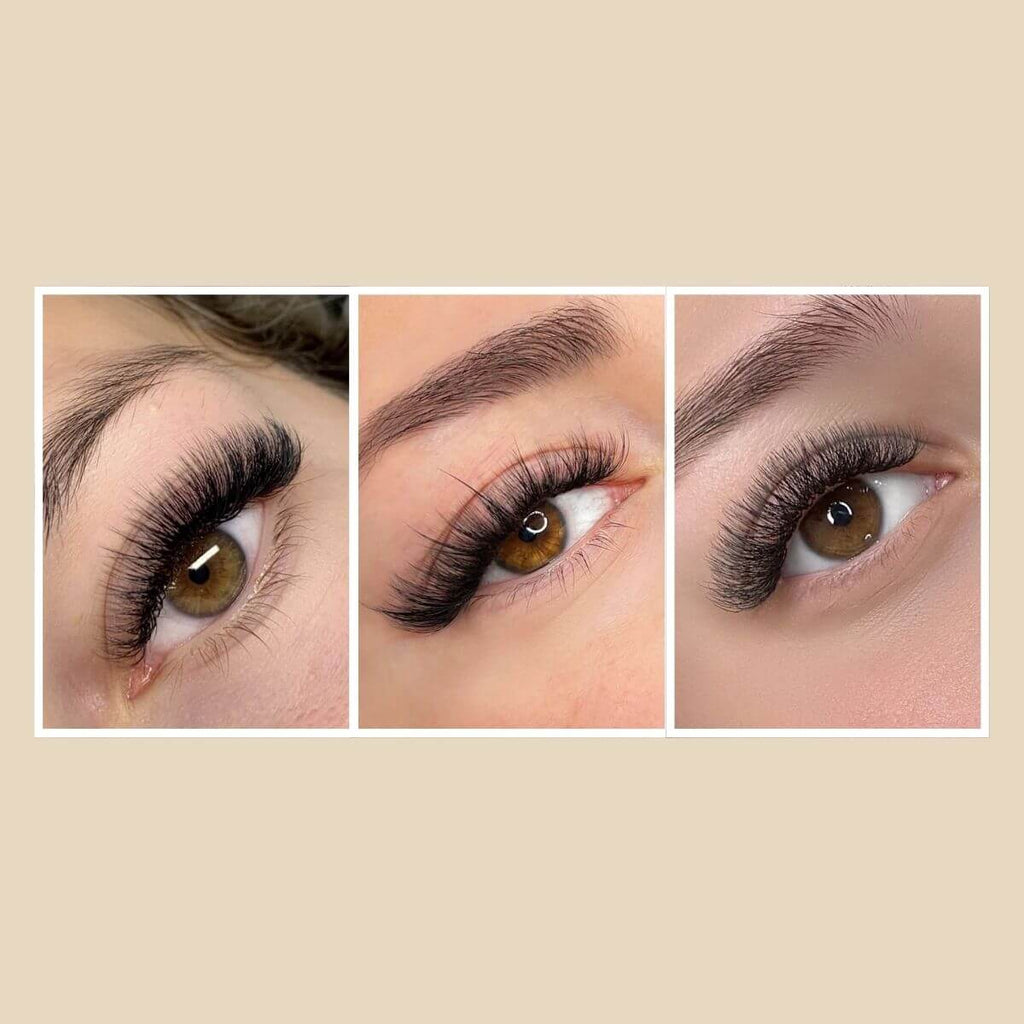
The main challenge? The eyelid often covers part of the extensions. Lashes that look perfect with eyes closed can completely disappear when open, so you'll need to adjust your curl choice and mapping strategy.
How Asian Lashes Grow Differently
Asian lashes often grow straight down or point downward instead of naturally curving upward. They're also typically shorter and thicker. This means standard C curls often get hidden by the eyelid fold—your client looks great leaving the salon, but the effect disappears once they're home looking in the mirror with fully open eyes.
Your Usual Methods Might Not Work
If you usually work with Caucasian clients, your go-to methods won't translate here. The same curls, lengths, and mapping that work on eyes with more lid space will look underwhelming or invisible on Asian eyes.
Retention can also be trickier due to:
- higher natural oil production in Asian skin types
- Constant lid-to-lash contact when blinking causes premature shedding
But there are solutions for all of this.
Which Lash Curls Work Best for Hooded Eyes and Monolids?
Choosing the right curl is the most important decision you'll make. Here's a breakdown of what works and what doesn't:
L Curl
L curl lash extensions are specifically designed for Asian eye shapes, and they're total game-changers. The base of an L curl is completely flat for about 1-2mm, then it shoots straight up at a 90-degree angle before curving. This design means the flat part sits perfectly on those downward-pointing natural lashes, while the dramatic lift ensures the extensions actually show up above the eyelid fold.
L curls are especially great for monolid and severely hooded eyes—both eye shapes with very limited visible lid space. They give you maximum visibility without needing to go crazy with length. Most lash artists find that L curls between 10-13mm work beautifully, creating visible, fluttery lashes that don't look overdone.
D Curl and M Curl
D curl lashes have a more dramatic curve than C curls, making them another solid choice for hooded eyes. They provide enough lift to clear the eyelid fold while still looking natural and feminine. D curls work particularly well on clients who have some lid space but still experience lashes disappearing.
M curl (also called L+ curl by some brands) is like a hybrid between L and D curls. It has a slightly longer flat base than L curl but not quite as dramatic an angle, giving you a middle ground option. M curls are perfect for clients who want something softer than the sharp angle of L curls but need more lift than a standard C or D curl can provide.
C Curl and CC Curl
Here's the honest truth: standard C curl extensions rarely work well on monolid or severely hooded eyes. They just don't have enough lift to overcome the eyelid coverage. However, C curls can work if your client has double eyelids with decent lid space.
CC curl (a tighter curl than C) can work for hooded eyes if you're looking for a more natural look and your client has at least some visible lid space. Just make sure you're testing during the appointment with the client's eyes open to confirm the lashes are actually visible.
| Curl Type | Best For | Lift Level | Recommended Use |
| L Curl | Monolid, severely hooded eyes | Maximum | First choice for most Asian clients |
| M Curl | Moderate hooding, hybrid look | High | Clients wanting softer than L curl |
| D Curl | Hooded eyes with some lid space | High | Natural-looking drama |
| CC Curl | Mild hooding, double eyelids | Medium | Natural look with visible lid space |
| C Curl | Double eyelids with good lid space | Medium | Not recommended for monolids |
How to Map Lashes for Asian Eye Shapes
Getting your lash mapping right makes all the difference between lashes that pop and lashes that disappear. Let's break down the strategy:
Cat Eye vs. Doll Eye: Which One Works Better?
- Cat eye mapping tends to be your best bet for monolids and severely hooded eyes. This is where you place the longest lashes at the outer corners, creating a lifted, elongated effect that opens up the eyes and draws attention outward. It's especially flattering for clients with round eye shapes or very limited lid space.
- Doll eye mapping (longest lashes in the center) can work, but you need to be more careful with it. On very hooded eyes, centring the longest extensions can actually make the eyes look more closed or heavy. But if your client has double eyelids or only mild hooding, doll eye mapping can create a pretty, wide-eyed look.
When in doubt, go with a modified cat eye where the length gradually increases toward the outer corners. This gives you consistently good results across different Asian eye shapes.
| Mapping Style | Best For | Effect Created | When to Avoid |
| Cat Eye | Monolids, round eye shapes, most Asian clients | Lifted, elongated, opens up the eyes | Rarely—works for almost everyone |
| Doll Eye | Double eyelids, mild hooding | Wide-eyed, open look | Very hooded eyes (can make eyes look closed) |
| Modified Cat Eye | All Asian eye shapes | Balanced lift and fullness | Your safest go-to option |
Where to Place Each Length: A Simple Zone-by-Zone Guide
Here's your go-to mapping strategy that works for most Asian clients:
- Inner corner (from the eye opening to the pupil): Start with 8-10mm extensions using L or M curl. Keeping these shorter prevents the lashes from poking the nose or looking too heavy.
- Center section (around the pupil): Gradually increase to 10-12mm. This is where you build the fullness and body of the lash line.
- Outer corner (from pupil to outer edge): This is where you go longest—typically 11-13mm depending on your client's natural lash length and how dramatic they want to go. The outer corner extensions do the heavy lifting when it comes to creating that lifted, open-eye effect.
Remember, these are starting points. Every client is different, so you'll need to adjust based on their natural lash length, eye size, and personal style.
| Eye Zone | Recommended Length | Curl Type | Purpose |
| Inner Corner | 8-10mm | L or M Curl | Prevent heaviness, avoid nose contact |
| Center (Pupil) | 10-12mm | L, M, or D Curl | Build fullness and body |
| Outer Corner | 11-14mm* | L or D Curl | Create lift and cat eye effect |
*At the outer corner, use 11-13mm for monolids/hooded eyes or up to 14mm for double eyelids with good lid space.
How to Work with the Inner Eye Fold
Many Asian clients have an epicanthic fold—that's the extra bit of skin at the inner corner of the eye. This fold can completely cover the innermost lashes, so there's no point putting long, dramatic extensions there. Keep your inner-corner eyelash extensions short and simple, typically 1-2mm shorter than you might use on eyes without this fold. Save your artistry for the center and outer portions of the lash line, where the extensions will actually be visible and create impact.
How to Pick the Right Length and Thickness for Your Client
Length and thickness work together to create the final look. Here's how to nail both:
What Length Should You Actually Use?
- For monolid eyes: Stick with 10-13mm as your maximum length range. Because monolids have no crease at all, the entire eyelid is one smooth surface that can hide longer lashes. The dramatic curl of L or D curls already creates plenty of impact, so you don't need extreme length to get great results. Going longer can overwhelm the eye and create a heavy, droopy appearance.
- For hooded eyes: You have a bit more flexibility. Clients with moderate hooding can sometimes handle 11-14mm, especially at the outer corners. Why? Hooded eyes do have a crease (it's just hidden), which means there's often slightly more lid space than with true monolids. However, if your client has severely hooded eyes where the skin fold covers most of the lash line, treat them like monolids and stick to the 10-13mm range.
- For double eyelids with good lid space: You can go up to 12-14mm if requested, though most Asian clients still look best in the 11-13mm range.
General rule: Err on the side of caution. Shorter lashes with dramatic curl almost always look better and more natural than overly long extensions that weigh down the lash line.
| Eye Type | Lid Space Characteristics | Recommended Max Length | Why |
| Monolid | No crease, flat eyelid surface | 10-13mm | Entire lid can hide extensions; dramatic curl provides enough impact |
| Severely Hooded | Deep skin fold covers most of lash line | 10-13mm | Similar lid coverage to monolids despite having a crease |
| Moderately Hooded | Some visible lid space, crease partially hidden | 11-14mm | More lid space allows slightly longer lengths |
| Double Eyelid | Visible crease with decent lid space | 12-14mm | More room to showcase length, though still conservative compared to Caucasian eyes |
Choosing Thickness: Natural or Dramatic?
For everyday, natural-looking lash sets on Asian clients, 0.10-0.15mm diameter extensions work beautifully. They're thick enough to show up but light enough not to stress those downward-growing natural lashes.
If your client wants drama, you can use 0.15-0.18mm for classic sets or create volume fans with 0.05-0.07mm lashes. Just be mindful that anything too heavy will cause the natural lashes to droop even more downward, which defeats the whole purpose of choosing lifted curls.
| Look Type | Classic Lash Diameter | Volume Lash Diameter | Best For |
| Natural | 0.10-0.12mm | 0.05-0.07mm | Everyday wear, first-time clients |
| Enhanced Natural | 0.12-0.15mm | 0.05-0.07mm | Subtle glamour, professional settings |
| Dramatic | 0.15-0.18mm | 0.05-0.07mm | Special events, bold look lovers |
Finding the Balance Between Volume and Weight
A common mistake lash artists make is thinking that more volume automatically equals better results. On Asian eyes, too much weight from mega-volume lash sets or thick extensions can actually pull the natural lashes down and reduce retention.
If your client wants a full, voluminous look, try creating 2D-4D volume fans with lighter diameter lashes (0.05-0.07mm) rather than using thick classic lashes. You'll get the fullness they want without the weight that causes premature shedding and drooping.
How to Get Better Lash Retention on Asian Clients
Retention issues are common with Asian clients due to oilier skin, but they're totally solvable with the right approach.
Prep and Prime the Right Way
Thorough prep is essential for oily skin types:
- Deep cleanse with lash shampoo at every appointment, even if your client pre-cleaned at home
- Prime every lash with primer or protein remover to eliminate oils, makeup residue, and dead skin cells
- Let lashes dry completely before applying extensions to ensure proper adhesive bonding
Pick the Right Adhesive and Room Conditions
- Use a slightly stronger adhesive for very oily lids (while keeping it safe for sensitive eyes)
- Choose adhesives with good initial tack that dry quickly
- Maintain workspace at 68-72°F with 45-60% humidity—use a hygrometer to monitor conditions
Aftercare Instructions That Work
- Keep lashes dry for 24-48 hours after application to allow full adhesive cure
- Cleanse daily with oil-free products—regular cleansing improves retention by removing oils that break down adhesive
- Use silk or satin pillowcases to reduce friction for side sleepers
With these adjustments to prep, adhesive selection, and aftercare, you'll see noticeable improvement in retention rates.
Best Products and Tools for Working with Asian Lash Clients
Having the right products in your kit makes everything easier. Here's what you actually need:
Which Curl Types Should You Stock?
Essential curls to have on hand:
1. L curl and D curl extensions (9-13mm): These are your minimum stock requirements. Look for quality L curl extensions specifically designed for Asian eye shapes when you're shopping for supplies.
2. M curl extensions: Consider stocking these if you work with a lot of Asian clients. M curl gives you more versatility in creating customized looks without needing to stock ten different curl types.
3. Volume lashes in 0.05mm and 0.07mm: Keep these on hand in L and D curls. These lighter diameters let you create voluminous fans without the weight that causes issues on Asian eyes.
Tools That Make Application Easier
The three tools that will make your life easier:
1. Angled tweezers: Invest in good quality, angled tweezers that let you work at the precise angles needed for L curl application. L curls require a slightly different hand position than C curls, and the right tweezers make all the difference.
2. Magnifying lamp: This is essential, not optional. When you're working with limited lid space and trying to place extensions on downward-growing lashes, you need to see exactly what you're doing. Don't try to wing it with poor lighting.
3. Lash lift shields (smaller sizes): Consider getting these to use during application. Some lash artists like to use these to help lift the natural lashes away from the lid, making it easier to isolate and apply extensions on very flat, downward-pointing lashes.
Primers, Sealants, and Other Must-Haves
Products that improve your results:
1. Lash primer or protein remover: This is non-negotiable when working with Asian clients. Look for products that specifically target oil removal, not just general cleansing. Primer should be applied to every single natural lash before you start applying extensions.
2. Lash sealants: These can help improve retention by adding an extra protective layer over the adhesive bonds. Just make sure you're using a sealant that's compatible with your adhesive and won't cause brittleness or premature shedding.
3. Oil-free makeup remover and cleanser: Keep these in stock to retail to your clients. Many drugstore eye makeup removers contain oils that will destroy lash extensions, so offering them a safe alternative helps protect your work and their investment.
Essential Product Checklist
| Product Category | What to Stock | Why You Need It |
| Curl Types | L Curl, D Curl, M Curl (9-13mm) | Cover all Asian eye shape needs |
| Volume Lashes | 0.05mm and 0.07mm | Lightweight volume options |
| Primers | Oil-targeting formulas | Remove oils for better adhesion |
| Sealants | Adhesive-compatible options | Improve retention |
| Tools | Angled tweezers, magnifying lamp | Precision application |
| Retail Products | Oil-free cleansers and removers | Client aftercare support |
Level Up Your Lash Mapping for Asian Eye Shapes
Asian eye shapes aren't harder to work with—they just need a different approach. Once you get the hang of L curl lash extensions and smart mapping, the results will blow you away. Try these techniques on your next monolid or hooded eye client and snap those before-and-after pics with eyes open and closed. When you nail it, these clients become your biggest fans and best walking advertisements.
Laissez un commentaire