


Inicio Eyelash Extension Supplies Guide
Symmetry Standards: Maintaining Spacing in 10D to 20D Fans

The Architecture of Density: Mastering 10D to 20D Fan Symmetry
In the high-stakes world of Mega Volume lash artistry, the transition from standard volume (3D-6D) to high-density sets (10D-20D) represents more than just an increase in lash count. It is a shift into advanced structural engineering where technical precision, material science, and ocular health converge. For the advanced technician, achieving a "blackout" look is secondary to maintaining the structural integrity of the fan and the long-term health of the client's natural lashes.
We have observed through pattern recognition in high-density studios that the most common failure point in Mega Volume is not the lack of lashes, but the loss of symmetry. A 20D fan that collapses or features uneven spacing creates visual "noise"—clumps and gaps that diminish the premium feel of the service. True mastery lies in the "Fan Gap" heuristic: ensuring the distance between each lash tip is visually consistent and proportional to the diameter of the fiber itself.
The Geometry of Mega Volume: The 1:1 Fan Spacing Heuristic
Symmetry in high-density fans is governed by the relationship between the base and the tips. As we move into the 10D to 20D range, the margin for error narrows significantly. If the fan is too "closed," the set appears heavy and plastic-like; if it is too "wide," the tips may cross or tangle, leading to mechanical stress on the natural lash.
The professional standard for high-density symmetry is the 1:1 Spacing Heuristic. This suggests that the negative space between each lash tip should approximately equal the diameter of a single lash extension.
Logic Summary: The Fan Gap Heuristic Our analysis of professional Mega Volume sets assumes the following parameters for visual consistency:
- Input X: Lash Diameter (e.g., 0.03mm).
- Input Y: Fan Dimension (e.g., 15D).
- Heuristic: Spacing = Diameter. This ensures that even at 20D, the fan remains "airy" enough to prevent a solid block appearance while maintaining maximum density.
- Boundary Condition: This heuristic may vary if using "flat" lashes or specific textures like Synthetic Fiber Elasticity.
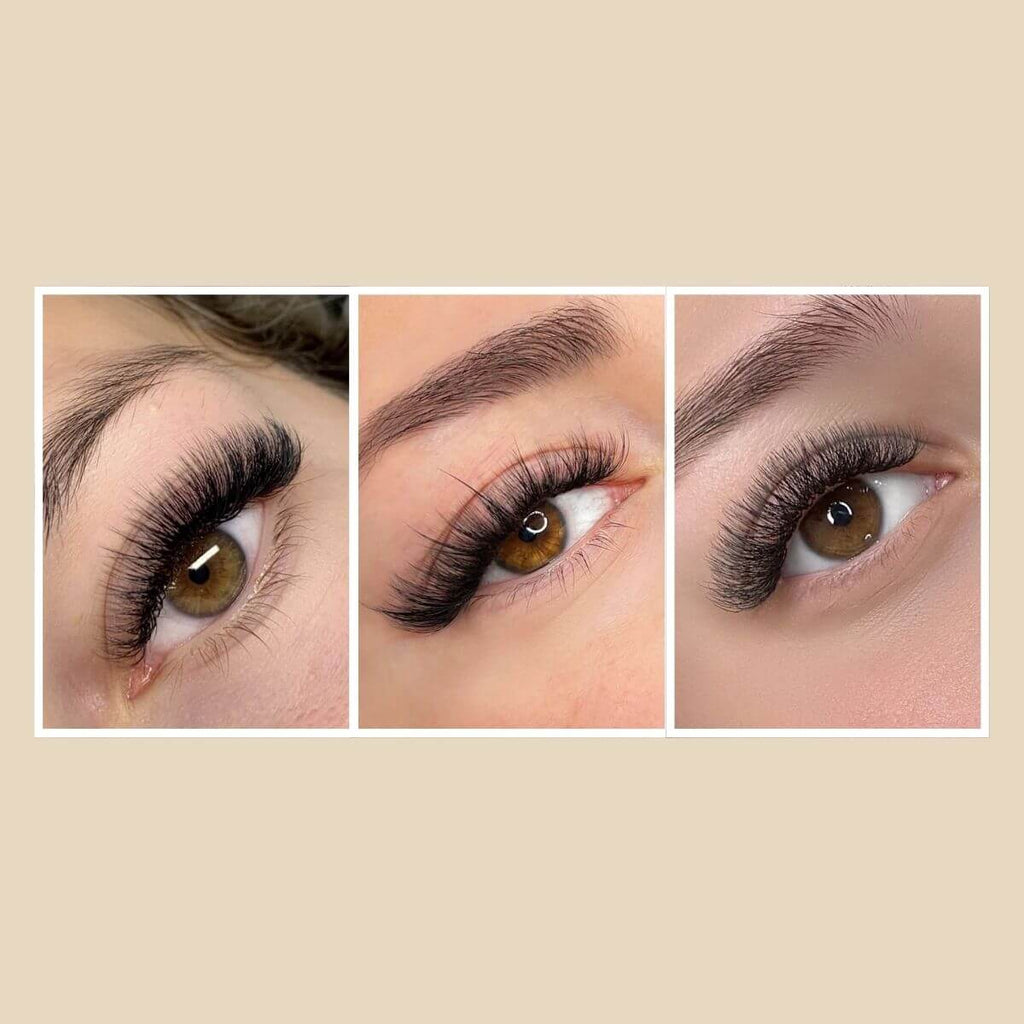
When creating these fans manually, technicians often prioritize the "count" over the "spread." However, a perfectly symmetrical 12D fan using 0.03MM Cashmere Premium Mega Volume Eyelash Extensions often provides a more luxurious, uniform appearance than a crowded 20D fan that has lost its geometry.

Material Science: Why Diameter is Non-Negotiable for Lash Health
The physics of Mega Volume requires ultra-fine diameters. Traditional 0.15mm or 0.10mm lashes are structurally unsuitable for 10D+ fans due to the exponential increase in weight. According to a 2024 study published in PubMed, mechanical damage and chemical toxicity are the primary drivers of extension-related ocular disorders. To mitigate this, professionals must utilize 0.03mm or 0.05mm fibers.
The weight of one 0.15mm lash is roughly equivalent to twenty 0.03mm lashes. By choosing 0.03MM Cashmere Premium Mega Volume Eyelash Extensions, technicians can achieve the desired "Mega" density without exceeding the safe load-bearing capacity of the natural lash. This is critical for preventing traction alopecia—a condition where the natural follicle is prematurely pulled out due to excessive weight.
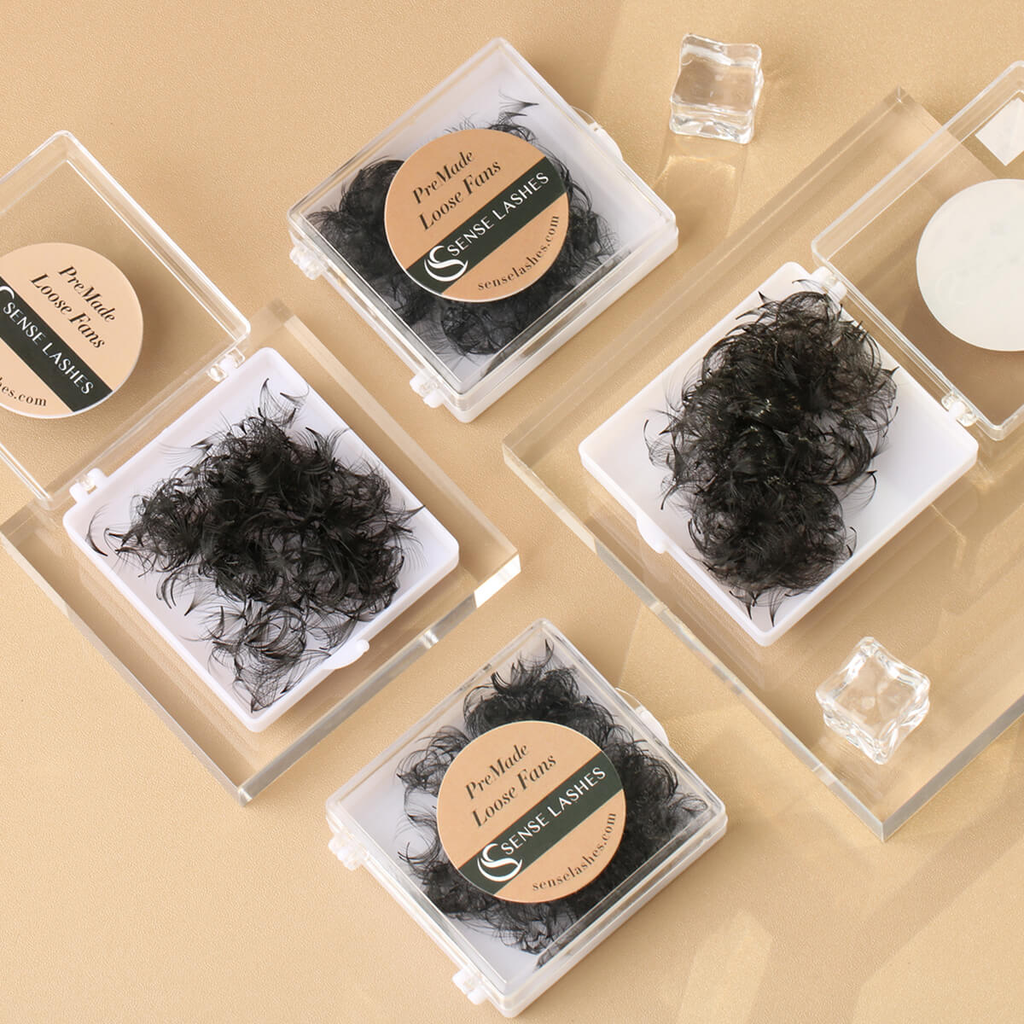
For technicians who want to balance speed with this high-level symmetry, using high-quality premade options is a strategic choice. Products like the 14D Handmade Loose Premade Fans Pointy Base(500 Fans) or the 16D Handmade Loose Premade Fans Pointy Base(500 Fans) are heat-bonded to ensure an ultra-slim, pointy base. This mimics the look of a hand-crafted fan while guaranteeing that every fan in the set maintains identical spacing and weight.
Adhesive Engineering: Scaffolding and Viscosity
The adhesive is the "mortar" of the lash architecture. In Mega Volume, the adhesive must do more than just bond; it must act as a temporary scaffold. We often see technicians struggle with "fan snap-back," where a beautifully crafted 18D fan closes the moment it touches the natural lash.
This is often a result of using an adhesive with a viscosity that is too low (water-like). For high-density fanning, a slightly higher viscosity—often described as "syrup-like"—is preferred. This thicker consistency provides enough surface tension to hold the fan's wide spread during the 1-2 second placement window.
Furthermore, ambient environment plays a decisive role. High humidity accelerates the curing of cyanoacrylate, which can cause the adhesive to "skin over" before a proper bond is formed. Conversely, low humidity slows the cure, leading to "wicking," where the glue travels up the fan and causes it to collapse. Based on academic insights from the University of Waterloo, the shelf-life and storage conditions of these adhesives are vital; using degraded glue not only hurts retention but can increase the risk of irritation.
| Environmental Factor | Impact on 10D-20D Fans | Professional Adjustment |
|---|---|---|
| High Humidity (>60%) | Instant cure; risk of "shock curing" and brittle bonds. | Increase speed of placement; use a slower-setting adhesive. |
| Low Humidity (<40%) | Slow cure; fans may "wick" or snap shut. | Use a humidifier; select a faster-setting, higher-viscosity glue. |
| High Temperature | Lowers adhesive viscosity; glue may become too runny. | Store glue in a temperature-controlled environment; refresh glue drop every 15 mins. |
Ocular Health: Moving Beyond "Clean" to Prevention
For a premium salon, client safety is the ultimate "trust signal." While many market lash cleansers as simple makeup removers, the medical reality is more complex. Poor hygiene in high-density sets can lead to Blepharitis—an inflammation of the eyelids often caused by a buildup of bacteria and skin debris.
The Mayo Clinic identifies Blepharitis as a chronic condition that is difficult to treat once established. In Mega Volume, the density of the fans (10D-20D) creates more surface area for debris to trap. We recommend a "Prevention-First" protocol: educating clients that water is insufficient. Daily cleansing with a professional-grade foam is non-negotiable to prevent the proliferation of Demodex mites, which thrive in the stagnant environment of unwashed extensions, as detailed in recent research on ocular hygiene.
Troubleshooting: Irritation vs. Allergy
Distinguishing between a chemical burn, an irritation, and a true allergy is a hallmark of an expert technician.
- Irritation (Fumes): Usually presents as redness and "dry eye" sensations immediately after the set. This is often linked to the release of formaldehyde during the curing process, a phenomenon identified in the seminal Amano et al. 2012 study.
- Allergic Contact Dermatitis: A delayed immune response (typically 24-72 hours post-exposure) to ethyl cyanoacrylate. PubMed research highlights that these patterns are increasingly common in acrylate-containing cosmetics.
- Chemical Burns: Often caused by the adhesive or primer entering the eye due to poor isolation or the use of liquid removers that "run." Using a non-drip cream remover is a safer professional choice to prevent corneal abrasions, as documented in case reports of removal-related trauma.
Scenario Analysis: Implementing Density Standards
To apply these principles, let us look at two distinct client scenarios we frequently encounter in professional practice.
Scenario A: The Mature Natural Lash (The Standard Case)
- Client Profile: Healthy, thick natural lashes with a consistent growth cycle.
- Approach: 12D to 15D fans using 0.05MM Cashmere Premium Mega Volume Eyelash Extensions.
- Logic: The 0.05mm diameter provides a slightly more "defined" look. With healthy lashes, the 1:1 spacing heuristic allows for a dense, dark lash line that maintains its symmetry for 3-4 weeks.
Scenario B: The Fine or Sparse Lash (The Edge Case)
- Client Profile: Naturally thin or sparse lashes that require "filling" without damage.
- Approach: 16D to 20D fans using 0.03MM Cashmere Premium Mega Volume Eyelash Extensions.
- Logic: To compensate for the lack of natural lashes, we increase the fan count (D) but decrease the diameter to 0.03mm. This creates a soft, "cloud-like" volume that covers gaps without overloading the delicate follicles. In this scenario, the precision of 16D Handmade Loose Premade Fans Pointy Base(500 Fans) can be a lifesaver for maintaining consistent symmetry across the sparse areas.

Global Compliance and Professional Integrity
As the lash industry matures, regulatory scrutiny is increasing. Health Canada’s 2023-2024 enforcement report recently highlighted significant non-compliance rates regarding the labeling and chemical safety of cyanoacrylate-based adhesives. For salon owners, sourcing from manufacturers that prioritize import compliance is a matter of business continuity.
Using products that adhere to FDA eye cosmetic safety guidelines ensures that the pigments used in colored or deep-black lashes are compliant and free from industrial dyes that can cause long-term ocular surface disease. This commitment to quality allows you to justify premium pricing and protects your reputation from the "compliance signaling gap" that plagues lower-end suppliers.
Achieving Professional Outcomes
Mastering 10D to 20D fans is the pinnacle of lash artistry. By focusing on the 1:1 symmetry heuristic, selecting the correct ultra-fine diameters like 0.03MM Cashmere Premium Mega Volume Eyelash Extensions, and adhering to strict medical hygiene standards, you elevate your service from a simple beauty treatment to a high-level technical procedure.
Key Takeaways for the Professional:
- Prioritize Geometry: A symmetrical 12D fan is visually superior to a collapsed 20D fan.
- Health First: Use 0.03mm diameters for Mega Volume to prevent mechanical stress and traction alopecia.
- Sanitation is Retention: Educate clients on Blepharitis prevention to ensure long-term lash health and better adhesive bonding.
- Consistency is Key: Consider high-quality premade fans like the 14D Handmade Loose Premade Fans Pointy Base(500 Fans) to maintain uniform spacing throughout a full set.
For further reading on the technical aspects of fiber behavior, see our guide on How Fiber Texture Influences Handmade Volume Fan Creation.
Disclaimer: This article is for informational purposes only and does not constitute professional medical or legal advice. Eyelash extension application involves risks, including infection and allergic reactions. Always consult with a qualified health professional regarding eye health concerns and ensure compliance with local licensing and safety regulations.
References
- American Academy of Ophthalmology (AAO) - Eyelash Extension Safety
- Centers for Disease Control (CDC) - Conjunctivitis Prevention
- Health Canada - Cosmetic Regulations Enforcement Summary
- Mayo Clinic - Blepharitis Symptoms and Causes
- PubMed - Ocular Disorders Caused by Eyelash Extensions (2024)
- University of Waterloo - Cosmetics and Eye Health