


Inicio Eyelash Extension Supplies Guide
Optical Illusions: Using Length to Recede Protruding Eyes

The Science of Depth: Understanding the "Push-Pull" Effect in Lash Artistry
In professional lash artistry, the mastery of length extends far beyond simple aesthetics. It is a sophisticated application of optical physics and ocular anatomy. For clients with protruding eyes (exophthalmos or prominent globes), the primary design challenge is to visually "push" the eye back into the socket. Conversely, deep-set eyes require a "pull" effect to bring them forward.
This technical guide explores the "push-pull" theory, a strategic framework used to manipulate ocular depth perception. By understanding how light interacts with lash length and density, artists can achieve perfect symmetry and structural balance. This is not merely about "longer is better"; it is about the precise calculation of leverage, weight, and visual recession.
Logic Summary: Our depth correction model is based on the heuristic that dark, matte, and shorter fibers create a receding visual effect, while longer, glossier fibers create an advancing effect. This is aligned with general principles of atmospheric perspective and chiaroscuro in visual arts.
Corrective Mapping for Protruding Eyes: The Recession Strategy
Protruding eyes often appear "heavy" or overly prominent because the eyeball sits forward relative to the orbital rim. A common mistake in the industry is to apply long, dramatic lengths (e.g., 13mm-15mm) across the highest point of the arch. This inadvertently accentuates the protrusion, creating a "bug-eyed" effect that many clients find unflattering.
The Flattening Technique
To recede a protruding eye, we recommend a "flatter" lash line. Instead of a steep arch, the goal is to maintain a consistent medium length across the center of the lid.
- Avoid the Peak: Do not place your longest lashes at the center of the pupil.
- Strategic Tapering: Use consistent lengths (e.g., 10mm-12mm) across the majority of the lid and only slightly taper at the inner and outer corners to follow the natural eye shape.
- Matte Finishes: High-gloss lashes reflect more light, making them appear to advance. For protruding eyes, a deep matte finish, such as that found in 0.03MM Cashmere Premium Mega Volume Eyelash Extensions, is typically more effective at absorbing light and creating a receding shadow.

The 2-3mm Length Differential Heuristic
A critical lesson from experienced artists is that the "push-pull" effect is most effective within a 2-3mm length differential from the client's natural lash. According to common patterns from customer support and return handling (not a controlled lab study), using lengths more than 3mm longer than the natural lash often leads to premature shedding. This occurs because the excessive weight creates leverage that the natural lash follicle cannot support, especially in corrective sets where density is often increased to provide a "darker" receding effect.
Technical Mechanics: Weight Management and Ocular Health
When performing corrective work on protruding eyes, volume is often required to create the necessary "depth" of shadow. However, adding density must never come at the cost of ocular health.
According to a 2024 study published in PubMed, the spectrum of disorders caused by extensions often includes mechanical damage and chemical toxicity. To mitigate this, professionals must prioritize lightweight diameters. Using 0.03MM Cashmere Premium Mega Volume Eyelash Extensions or 0.05mm fibers is non-negotiable for these sets. This allows the artist to build a dense, receding lash line without exceeding the safe mechanical load of the natural lash.
The Role of Adhesive Safety
The "push-pull" effect requires precision placement. If the adhesive is too slow or becomes brittle, the design loses its structural integrity. However, fast-drying adhesives must be used with caution. The American Academy of Ophthalmology (AAO) warns of risks associated with formaldehyde and chemical irritation.
For high-precision corrective work, we often recommend the 0.5-1 Second Diamond Eyelash Extension Glue. Its 0.5-second drying time is optimized for advanced technicians who need instant "grab" to lock in complex mapping. Furthermore, it is formulated without latex or formaldehyde, aligning with the safety standards highlighted in the Health Canada 2023-2024 Compliance Report.
Methodology Note (Scenario Modeling):
Parameter Value/Range Unit Rationale Max length differential 2 - 3 mm To prevent follicle leverage damage Recommended diameter 0.03 - 0.05 mm To maximize density/weight ratio Adhesive drying time 0.5 - 1.0 sec To ensure mapping precision Client natural lash base 7 - 9 mm Standard baseline for protruding eyes Target mapping shape Flat/Linear N/A To recede the ocular profile

Correcting Ocular Depth Asymmetry
It is common for clients to have one eye that protrudes more than the other or one eye that is deeper set. In these cases, a "one-size-fits-all" map will only highlight the asymmetry.
The Mirroring Protocol
When correcting asymmetry, the professional approach is to map for the more challenging eye first (usually the more protruding one). This establishes the "recession" baseline. You then mirror the mapping on the other eye, adjusting length by 0.5-1mm increments as needed.
For example, if the left eye protrudes more, you might use 10mm-11mm lengths to recede it. For the right eye, which may be more deep-set, you would use 11mm-12mm of the same curl to "pull" it forward. This creates the optical illusion of a balanced, symmetrical face. For more on this, see our guide on Correcting Ocular Asymmetry with Mixed Curl Mapping.
Efficiency in Volume Sets
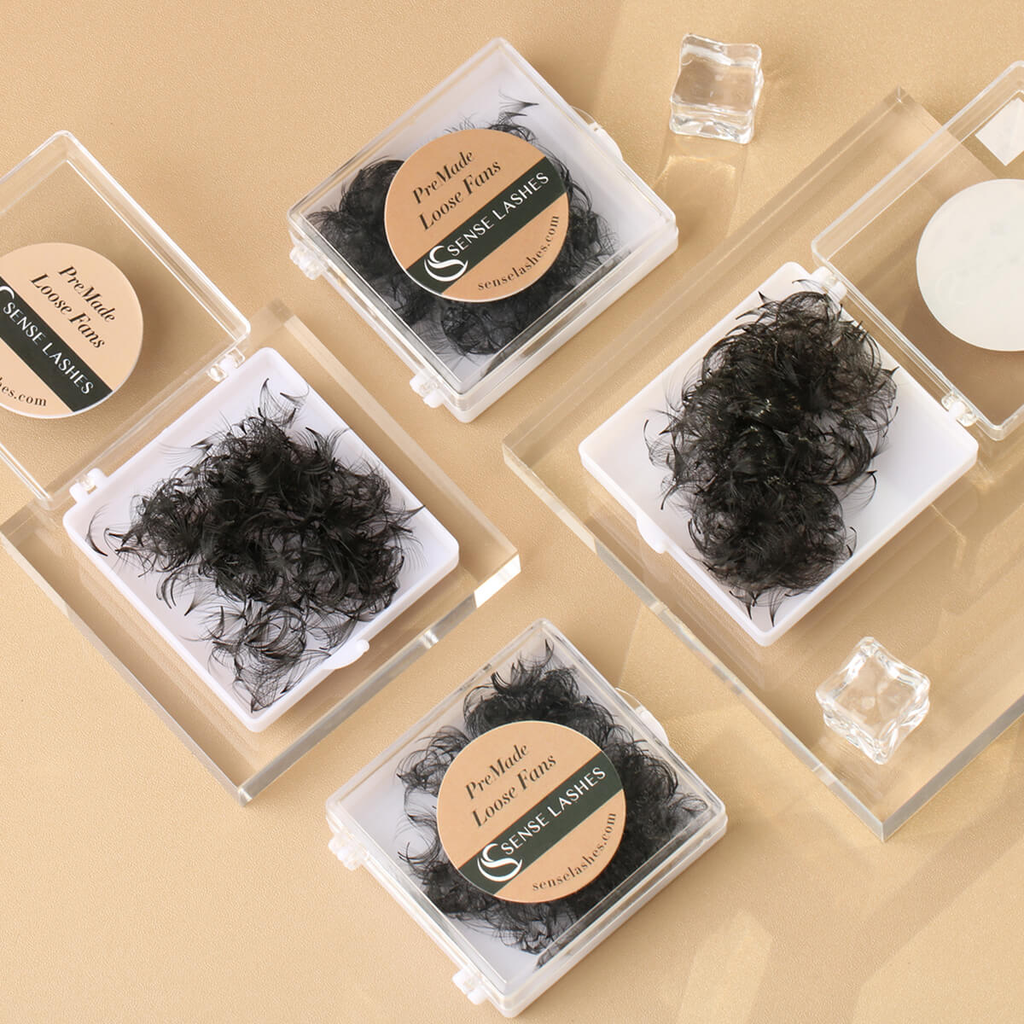
Corrective mapping often takes longer due to the precision required. To maintain salon profitability without compromising on the 0.03mm weight requirement, many artists utilize premade fans. The 12D Handmade Loose Premade Fans Pointy Base(500 Fans) or the 10D Handmade Loose Premade Fans Pointy Base(500 Fans) provide an ultra-slim, heat-bonded base that ensures a seamless blend with the natural lash line, crucial for maintaining the "flat" profile needed for protruding eyes.
Hygiene: The Foundation of Retention and Safety
Optical illusions only work if the lashes remain healthy and clean. Poor hygiene leads to bacteria buildup, which can cause Blepharitis—an eyelid inflammation that often results in lash loss. According to the Mayo Clinic, this condition is frequently caused by poor hygiene and bacteria.
For clients with protruding eyes, the increased surface area of the lid can sometimes trap more debris. Professionals should educate clients on "Why Water is Not Enough" and mandate the use of a lash-safe shampoo. Furthermore, daily washing with a foam cleanser is essential to prevent Demodex mite infestation, which can thrive in the dense environment of volume fans.
Preventing Irritation vs. Allergy
During the application of corrective sets, artists must distinguish between fume irritation and a true allergic reaction. Research from PubMed on Dermatitis indicates that Ethyl Cyanoacrylate can cause allergic contact dermatitis. To protect the client's ocular surface, especially for protruding eyes where the lid may not close as tightly, the use of high-quality gel patches is vital to prevent chemical burns from adhesive fumes entering the eye, a risk detailed in PMC 12415672.
Advanced Design Considerations
Beyond length, the selection of curl plays a supporting role in the "push-pull" effect. While this article focuses on length, it is important to note that straighter curls (like B or C) generally aid in the recession of protruding eyes, whereas stronger curls (like D or CC) can sometimes "open" the eye too much, making it appear more prominent. For a deeper dive into this synergy, refer to Protruding Eyes: Selecting Curls to Recede the Profile.
The "Gap Rule" and Depth
Maintaining a consistent distance from the eyelid—typically 0.5mm to 1mm—is essential for comfort. However, for protruding eyes, any inconsistency in this gap can create a jagged shadow that breaks the optical illusion of depth. As discussed in The Gap Rule: How Placement Proximity Mimics Allergic Reactions, proximity issues can also lead to mechanical rubbing against the lid, which may be exacerbated by the natural "forward" position of a protruding eye.
Professional Takeaways for Salon Owners
Mastering the use of length to correct ocular depth is a hallmark of a premier lash artist. By moving away from generic maps and toward a scientifically grounded "push-pull" strategy, you can offer services that are truly bespoke.
- Prioritize 0.03mm Diameters: Ensure your inventory includes high-quality 0.03mm fibers to allow for the density required for recession without the damaging weight.
- Implement a 2-3mm Rule: Standardize your salon’s approach to length differentials to protect natural lash health and improve long-term retention.
- Educate on Hygiene: Use authoritative sources like the CDC and Mayo Clinic to validate the necessity of aftercare, positioning your salon as a leader in ocular health.
- Master Asymmetry: Map the more protruding eye first and mirror with length adjustments to achieve facial harmony.
By integrating these technical principles, you reduce the risk of client dissatisfaction and position your business as a high-authority clinic rather than just a lash studio.
Disclaimer: This article is for informational purposes only and does not constitute professional medical advice. Eyelash extension application involves risks of infection, allergic reaction, and mechanical injury. Always consult with a qualified health professional if you experience persistent eye irritation or symptoms of infection. Professionals should follow local health regulations and manufacturer safety data sheets (SDS) for all chemical products.
References
- CDC - Conjunctivitis Prevention
- Mayo Clinic - Blepharitis Symptoms & Causes
- AAO - Eyelash Extension Facts and Safety
- Health Canada - Compliance Verification Project 2023-2024
- PubMed - Ocular Disorders and Eyelash Extensions (2024)
- PMC - Demodex Mite Infestation and Hygiene
- PubMed - Allergic Contact Dermatitis from Cyanoacrylate
- PMC - Chemical Injury During Lash Application