


Startseite Eyelash Extension Supplies Guide
Solving Fan Collapse: Adjusting Tweezer Closure Pressure

The Mechanics of Fan Integrity: Why Tweezer Closure Pressure Matters
In the high-precision world of volume lashing, the difference between a symmetrical, wide-reaching fan and a collapsed, unusable cluster often comes down to a few grams of pressure. For the professional artist, "fan collapse" is more than a technical frustration; it is an operational bottleneck that compromises retention, aesthetic consistency, and client safety. While much focus is placed on adhesive humidity or lash fiber quality, the mechanical interaction between the tweezer’s "sweet spot" and the artist’s hand tension remains the most frequent point of failure in handmade volume sets.
We have observed that even the most skilled technicians can struggle when transitioning between different lash diameters—such as moving from a standard volume set to a mega volume set. This is because the tactile requirements for a 0.07MM Cashmere Premium Mega Volume Eyelash Extensions are fundamentally different from those required for ultra-fine 0.03MM Cashmere Premium Mega Volume Eyelash Extensions. Mastering this "tactile calibration" is essential for standardizing salon outcomes and reducing the mechanical stress that leads to hand fatigue.
Logic Summary: Our analysis of technician performance assumes that fan collapse is a multi-factor mechanical failure. We prioritize the "Pressure-to-Diameter Ratio" as the primary variable, based on common patterns observed in professional training and tool maintenance reports (not a controlled lab study).
The Physics of Tweezer Tension and the "Sweet Spot"
Every pair of professional tweezers possesses a unique "sweet spot"—the specific area along the biting surface where the closure pressure is most uniform. When an artist applies pressure, the metal arms flex. If the tension is too high, the tips may splay outward (the "beak effect"); if it is too low, the lashes will slip through the center of the closure.
For handmade fans, the goal is to achieve a "parallel closure." This means the entire biting surface meets simultaneously, trapping the lash bases without crushing the delicate PBT (polybutylene terephthalate) fibers. When working with high-density fibers like the 0.07MM YY Volume Eyelash Extensions, the braided base requires a firmer, more consistent pinch to ensure the 4-D structure doesn't shift during the dip into the adhesive.
Heuristic for Tweezer Selection
- The Squeeze Test: Close the tweezers slowly. Do the tips touch first, or does the back of the biting surface close first? A professional-grade tool should close evenly across the designated "sweet spot."
- The Resistance Check: The tension should be "reassuring but not resistive." If you feel a strain in your thumb muscle after ten minutes of fanning, the tweezer tension is likely too high for your hand's ergonomic profile.

Tactile Calibration: Adjusting for 0.03mm vs. 0.07mm
The most common mistake we see in studios is using a "one-size-fits-all" pressure for every tray. This lack of calibration leads to two specific types of failure:
- Base Crushing (The 0.03mm Problem): Ultra-fine lashes are incredibly soft. Excessive pressure with the tweezers can actually flatten the base of the fan. This creates a "T-shape" rather than a "V-shape," preventing the fan from wrapping around the natural lash. This mechanical damage often leads to immediate fan collapse as the fibers lose their structural memory.
- Fiber Slippage (The 0.07mm Problem): Thicker lashes have more mass and "spring." If the closure pressure is too light, the lashes will splay unevenly or fall out of the tweezer during the "pinch" motion.
Modeling Tweezer Pressure Dynamics
To help artists visualize these adjustments, we have developed a hypothetical model of tension requirements based on industry heuristics.
| Lash Diameter | Recommended Tension | Unit of Effort (Scale 1-10) | Primary Risk of Over-Pressure |
|---|---|---|---|
| 0.03mm | Ultra-Light / Precision | 2-3 | Base deformation; fiber crushing |
| 0.05mm | Medium-Light | 4-5 | Uneven splaying (asymmetrical fans) |
| 0.07mm | Firm / Consistent | 6-7 | Fiber slippage; "popping" off the strip |
| YY / Flat Lashes | Firm / Structural | 7-8 | Base misalignment; adhesive shield failure |
Method & Assumptions: This model is a scenario-based heuristic for quick self-checking. It assumes high-quality PBT fibers and stainless steel tweezers with a 10mm biting surface. It does not account for variations in tweezer coatings (e.g., plasma vs. matte).
Solving Fan Collapse: The "Fanning Test" SOP
To ensure your tools are calibrated before a client arrives, we recommend a 30-second "Fanning Test" with every new tray or tool.
- Isolation: Pick up a small group of lashes (e.g., 5-6 fibers) from the strip.
- Initial Pinch: Apply what you believe is the correct pressure.
- Visual Audit: Observe the fan. If the lashes splay evenly in a "V" shape, your pressure is optimized. If the outer lashes compress toward the center, your pressure is too high. If the lashes stay bundled or slip, your pressure is too low.
- Tactile Memory: Once the "V" is achieved, hold that pressure for 3 seconds to "record" the tactile sensation in your hand.
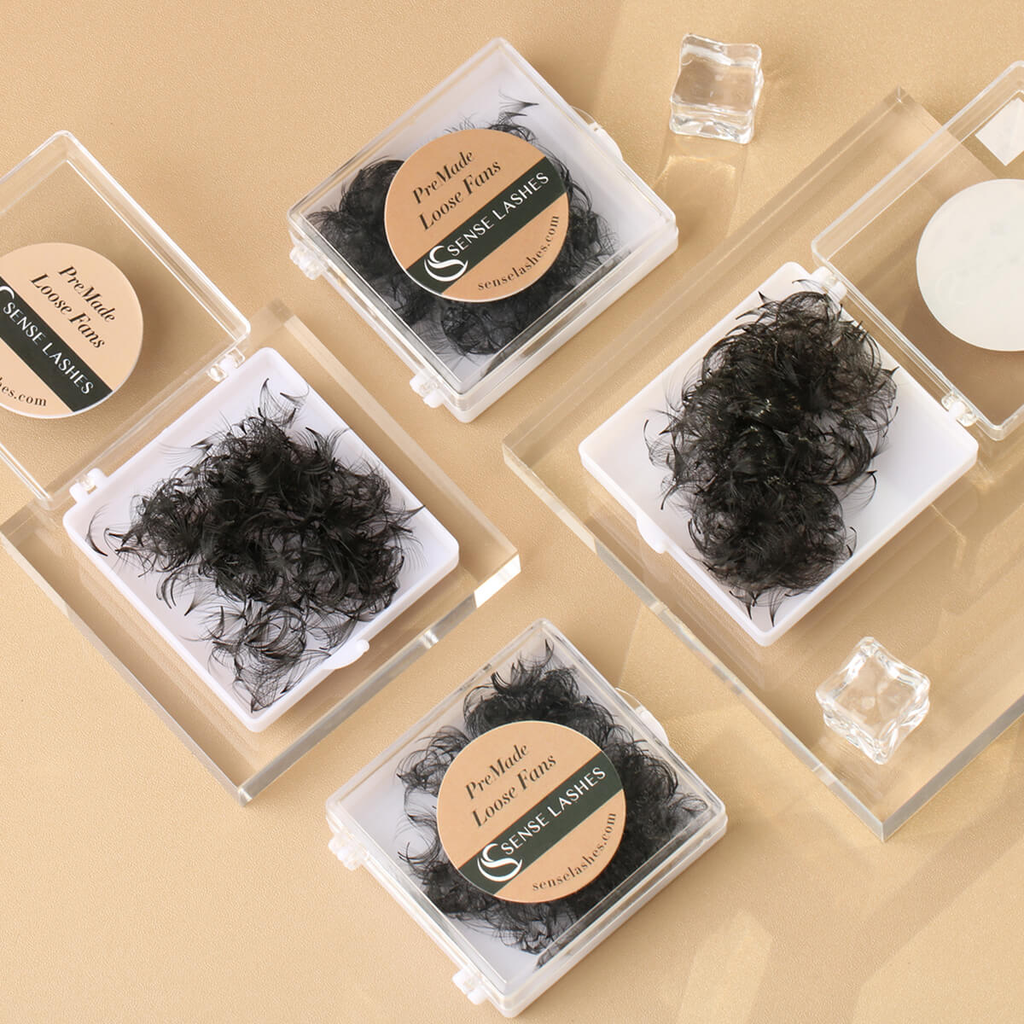
This process is particularly vital when using 14D Handmade Loose Premade Fans Pointy Base(500 Fans). While these are premade, the way you pick them up and place them still requires precise pressure to avoid damaging the heat-bonded pointy base.
The Health and Safety Connection: Why Precision Protects the Eye
Technical precision is not just about aesthetics; it is a critical component of ocular health. When a fan collapses or is improperly constructed due to poor tool control, the artist often compensates by using more adhesive. According to research published in PubMed (Amano et al. 2012), excessive adhesive can lead to the release of formaldehyde and altered pH levels, which are linked to keratoconjunctivitis.
Furthermore, a "chunky" or collapsed base creates mechanical friction against the eyelid. The American Academy of Ophthalmology (AAO) notes that trauma and infection are primary risks of extensions. A collapsed fan base can trap bacteria and debris, significantly increasing the risk of Blepharitis—a chronic inflammation of the eyelids often caused by poor lash hygiene and bacteria buildup, as detailed by the Mayo Clinic.
The Role of Sanitation in Tool Performance
Residue is the enemy of precision. Even a microscopic amount of dried cyanoacrylate on your tweezer tips will change the closure pressure and cause fans to stick to the tool rather than the natural lash.
- Maintenance Rule: Clean your tips with 99% isopropyl alcohol every 2-3 fans if you notice any "drag."
- Deep Clean: Use a professional adhesive remover at the end of every day to ensure the "sweet spot" remains clear of debris. This practice is aligned with CDC guidelines on preventing the spread of conjunctivitis and maintaining general eye hygiene in a professional setting.

Scenario Analysis: High-Speed Volume vs. Ultra-Fine Mega Volume
To further demonstrate how closure pressure adapts to different professional goals, let's look at two distinct scenarios.
Scenario A: The High-Speed Volume Artist
- Goal: 90-minute full set using 0.07mm lashes.
- Challenge: Maintaining speed without losing fan symmetry.
- The Solution: Use a firmer tweezer with a larger sweet spot. The artist should prioritize a "pinch" technique that relies on the natural Synthetic Fiber Elasticity of the 0.07mm lashes. Because these lashes are more robust, the artist can afford a slightly higher margin of error in pressure without crushing the base.
Scenario B: The Mega Volume Specialist
- Goal: Creating 10D-15D fans using 0.03mm lashes.
- Challenge: Preventing the "base-pinch" from becoming a "base-crush."
- The Solution: This requires "feather-light" pressure. The artist should look for tweezers with very low resistance (soft tension). In this scenario, understanding How Fiber Texture Influences Handmade Volume Fan Creation is vital, as the "buttery" feel of cashmere lashes requires the tool to act as a guide rather than a clamp.
Standardizing Your Practice for 2025
As the industry moves toward more complex textures and finer diameters, the ability to troubleshoot your own tools becomes a competitive advantage. Standardizing your "tweezer-to-lash" calibration reduces the "compliance signaling gap" between what you promise (perfect sets) and what you deliver (consistent, healthy results).
By treating your tweezers as a calibrated instrument rather than a simple clamp, you mitigate the risks of chemical injury and mechanical irritation. This professional rigor is what separates a technician from an artist.
Key Takeaways for the Professional
- Test Every Tray: Different diameters require different "hand feels." Never assume your 0.07mm pressure will work for 0.03mm sets.
- Audit Your Tools: If you find yourself "fighting" the tweezers to keep a fan open, the tool is either misaligned or the tension is too high for the fiber type.
- Hygiene is Performance: A clean tool is a precise tool. Alcohol cleaning is not just for safety; it’s for mechanical consistency.
- Prioritize Health: Use high-quality, pH-balanced products and precise application to avoid the ocular surface changes and microbiome alterations noted in recent PMC studies.
Disclaimer: This article is for informational purposes only and does not constitute professional medical, legal, or financial advice. Eyelash extension application involves risks of infection and injury; always follow local regulations and consult with a healthcare professional regarding eye health concerns.