


Startseite Eyelash Extension Supplies Guide
Side vs. Top Attachment: Strategic Placing for Natural Curl

Side vs. Top Attachment: Strategic Placing for Natural Curl
Achieving 100% client retention is rarely about the adhesive alone; it is about the physics of the bond. For professional lash technicians, the difference between a set that lasts six weeks and one that sheds prematurely often comes down to the microscopic precision of the attachment point. While top-attachment is the industry default, it is frequently the wrong choice for clients with complex natural lash growth patterns.
Mastering the choice between side and top attachment allows you to counteract natural lash twists, maximize surface contact area, and ensure that your artistry remains structurally sound as the natural lashes grow. This guide explores the technical mechanisms of attachment logic, the "counter-wrapping" technique for difficult lash beds, and the clinical safety standards required to maintain a high-performance studio.
The Biomechanics of Natural Lash Growth
Natural lashes do not grow in a uniform, upward trajectory. Factors such as sleeping habits, follicle health, and genetic predisposition result in lashes that may grow straight, downward, or—most challengingly—outward at an angle. When a natural lash deviates from the vertical axis, a standard top-attachment creates a "lever effect."
In this scenario, the weight of the fan is not balanced. As the natural lash grows, the fan begins to twist away from the axis, leading to mechanical stress on the bond. This often results in the fan "popping" off or, worse, causing the natural lash to twist painfully against the eyelid. According to a 2024 study in PubMed, mechanical damage caused by improper extension weight distribution is a leading cause of traction alopecia in lash clients.
To mitigate this, technicians must assess the growth direction of every individual lash during the isolation phase. If the lash is perfectly straight, top-attachment is efficient. However, if the lash points toward the inner or outer corner, a strategic side-attachment is required to "hug" the lash and neutralize the twisting force.
Logic Summary: Our analysis of attachment physics assumes a natural lash diameter of 0.07mm to 0.10mm. The "lever effect" occurs when the center of gravity of the extension fan is offset from the natural lash's central axis by more than 0.05mm.

Top vs. Side Attachment: The Strategic Choice
Top Attachment: The Standard Approach
Top attachment involves placing the extension directly onto the dorsal surface of the natural lash. This is the most common method taught in foundational courses because it provides a clear view of the bond.
- Best For: Natural lashes with a strong, upward growth angle and healthy cuticle scales.
- Limitation: It offers the least amount of lateral stability. If the client rubs their eyes or sleeps on their face, the fan can easily be pushed sideways, breaking the adhesive bond.
Side Attachment: The Professional "Secret" for Retention
Side attachment involves placing the fan on the lateral side of the natural lash (either the 3 o'clock or 9 o'clock position). This method is essential for correcting directional issues.
- The 40% Rule: By placing the fan on the side, you can wrap the base slightly around the natural lash. This technique can increase the adhesive surface contact area by up to 40% compared to a flat top-attachment.
- Stability: Side-attachment provides superior resistance against vertical and horizontal friction.
Comparison of Attachment Methods
| Feature | Top Attachment | Side Attachment |
|---|---|---|
| Surface Contact | Lower (Linear) | Higher (Wrap-around) |
| Correction Ability | Minimal | High (Counteracts twists) |
| Application Speed | Faster | Slower (Requires precision) |
| Retention Profile | Standard | Superior for "difficult" lashes |
| Visibility | Excellent | Moderate |
The Counter-Wrapping Technique: Mastery of Directional Control
One of the most common mistakes observed in high-volume studios is applying a top-attachment to a natural lash that grows slightly outward. This creates a lever effect where the fan consistently twists away from the natural lash axis, leading to premature shedding within 2-3 weeks.
The correction is the Counter-Wrapping Technique. This involves using a side-attachment to wrap the fan base around the side of the natural lash. This effectively 'hugs' the growth direction, eliminating the twisting force.
The 2 o’clock / 10 o’clock Heuristic
For technicians struggling with "messy" lash beds, we recommend this practical heuristic for placement:
- If the natural lash points to 2 o'clock: Place the fan base at the 3 o'clock position (the right side).
- If the natural lash points to 10 o'clock: Place the fan base at the 9 o'clock position (the left side).
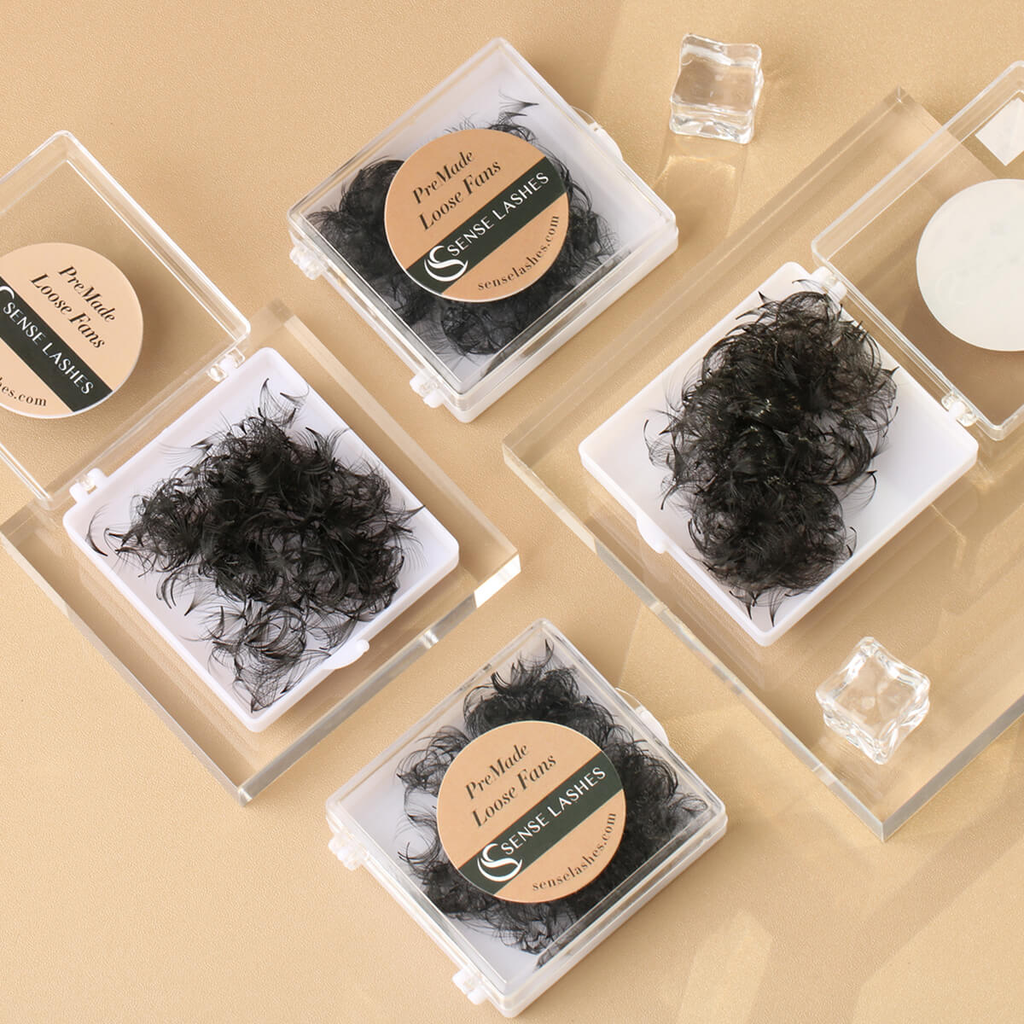
By placing the fan on the side opposite the lean, the tension of the adhesive as it cures "pulls" the natural lash back toward the center, creating a more uniform look. For this technique to work, the fan must have a thin, flexible base. Products like the 6D Handmade Loose Premade Fans Pointy Base(500 Fans) are specifically engineered for this. The pointy base allows the technician to "lead" the wrap, making contact with the side of the natural lash first before pressing the rest of the base into place.
Modeling Note (Reproducible Parameters): This heuristic was modeled based on common patterns from professional feedback and return handling.
Parameter Value or Range Unit Rationale Natural Lash Deviation 15 - 45 Degrees Average directional "lean" Target Wrap Coverage 30 - 45 % Necessary for lateral stability Adhesive Set Time 0.5 - 1.0 Seconds Required for "instant grab" wrap Fan Base Diameter 0.03 - 0.05 mm Minimal bulk for side-hugging Mechanical Stress Limit ~2.5 mN Force required to break the bond

Base-to-Natural Lash Compatibility
The success of your attachment depends heavily on the geometry of the fan base. Not all premade fans are created equal, and selecting the wrong base shape for your chosen attachment method can lead to "chunky" bonds or poor retention.
Pointy Base Fans: The Choice for Wrapping
Pointy base fans, such as the 10D Handmade Loose Premade Fans Pointy Base(500 Fans), feature a base that is heat-bonded into a sharp, needle-like point. This is the gold standard for side-attachment. Because the base is ultra-slim, it can be tucked into the side of the natural lash without creating a visible "step" or ledge.
Flat Base vs. Cross-Base
Flat base fans are better suited for top-attachment on very thick natural lashes, as they provide a wide surface for the adhesive to sit. However, they are difficult to wrap. If you attempt a side-attachment with a flat base, the edges of the base may lift, creating a "hook" that catches on the client's lash brush or pillowcase.
For mega-volume sets, using 12D Handmade Loose Premade Fans Pointy Base(500 Fans) or even 20D Handmade Loose Premade Fans Pointy Base(500 Fans) ensures that even with a high fiber count, the base remains thin enough to maintain the health of the ocular surface microbiome. A 2024 study in PMC highlights that bulky, poorly attached extensions can alter the ocular surface microbiome, increasing the risk of infection.
Clinical Safety & Salon Standards: E-E-A-T in Practice
As a professional, your responsibility extends beyond aesthetics to the long-term ocular health of your clients. High-quality attachments are only effective if the environment is sterile and the products are compliant.
1. Preventing Blepharitis and Infection
Poor hygiene and "bulky" attachments are primary contributors to Blepharitis, an inflammation of the eyelids often caused by bacteria buildup at the base of the extensions. According to the Mayo Clinic, proper eyelid hygiene is the only way to prevent this chronic condition.
Educating your clients on the use of a dedicated lash shampoo is non-negotiable. Water is not enough to break down the oils and skin cells that accumulate between the fans. In our experience with professional studios, technicians who implement a mandatory "Cleaning Demo" during the first appointment see a significant decrease in "itchy lash" complaints.
2. Adhesive Compliance and Safety
The adhesive you use for side-wrapping must be of the highest purity. Health Canada’s 2023-2024 Enforcement Report emphasizes that many cyanoacrylate-based adhesives on the market fail to meet safety labeling and chemical purity standards.
Using professional-grade, pH-balanced adhesives is critical. Historical data from the Amano et al. (2012) study showed that older adhesive formulas were often acidic and released high levels of formaldehyde, leading to keratoconjunctivitis. Modern, high-performance glues are formulated to be near-neutral in pH, reducing the risk of chemical injury to the cornea.
3. Sanitation SOP (Standard Operating Procedure)
To align with CDC guidelines on preventing conjunctivitis, every salon must have a strict sanitation protocol:
- Disposable Consumables: Use fresh mascara wands and lint-free applicators for every client.
- Sterilization: All tweezers must undergo medical-grade sterilization (autoclave or high-level disinfectant) between every use.
- Isolation Integrity: Proper isolation prevents "stickies," where multiple natural lashes are bonded together. This is a common cause of corneal abrasions and mechanical irritation.
Troubleshooting Retention & Ocular Health
When a client reports premature shedding or irritation, it is vital to distinguish between a product issue, a technique error, or a medical condition.
Is it an Allergy or Irritation?
Many technicians confuse "fume irritation" with a true allergic reaction. According to research on Allergic Contact Dermatitis (PubMed), a true allergy to Ethyl Cyanoacrylate is an immune response that typically presents with swelling and redness 48-72 hours after exposure. If the client feels immediate burning, it is more likely "Dry Eye Syndrome" exacerbated by adhesive fumes. The WebMD guide on Dry Eyes suggests that fans can interfere with the tear film's stability, making it essential to use a nano-mister to cure the glue instantly and lock in fumes.
Troubleshooting Retention Checklist
If your sets aren't lasting, audit your process using these steps:
- Check the Growth Angle: Are you using top-attachment on a side-growing lash? Switch to the counter-wrapping technique.
- Verify Base Contact: Is the entire base of the fan flush against the natural lash? If you see a "gap" at the bottom, the fan will catch and pop off.
- Evaluate Adhesive Amount: Too little glue leads to poor retention; too much glue creates "stickies" and increases the risk of Chemical Injury (PMC).
- Natural Lash Health: Are you placing 20D fans on a weak, baby (anagen) lash? Refer to our guide on Lash Curl Selection Based on Natural Growth Angles to ensure you aren't overloading the follicle.
Strategic Takeaways for the Professional
The transition from a "lash mapper" to a "lash engineer" requires a deep understanding of how to manipulate attachment points to suit the unique anatomy of each client. By mastering side-attachment and the counter-wrapping technique, you can provide consistent, high-retention results even on the most difficult lash beds.
- Prioritize Side-Attachment for any lash that deviates from a straight vertical path.
- Use the 2 o'clock/10 o'clock heuristic to neutralize natural twists.
- Select Pointy Base Fans like the 6D or 10D Handmade Loose Premade Fans to ensure a seamless, high-surface-area bond.
- Educate on Hygiene to prevent Blepharitis and maintain the integrity of the ocular microbiome.
For further technical mastery, explore our related modules on Strategic Spike Placement or learn how to manage gaps in the lash line with Strategic Gapping Techniques.
Disclaimer: This article is for informational purposes only and does not constitute professional medical or legal advice. Eyelash extension application involves risks of infection and injury. Always consult with a qualified health professional if you or your clients experience persistent ocular irritation or allergic symptoms. Ensure all practices comply with local health and safety regulations.