


Startseite Eyelash Extension Supplies Guide
Deep Skin Artistry: Why Jewel Tones Outperform Pastels

The Contrast Gap: Why Deep Skin Requires a Different Palette
For the professional lash artist, mastering the nuances of melanin-rich complexions is a hallmark of advanced artistry. One of the most common frustrations in specialized lash design is the "invisible application"—a phenomenon where carefully applied colored extensions seemingly vanish once the client leaves the chair. This occurs primarily because traditional color theory often overlooks the physics of light absorption on deeper skin tones.
When working with clients who fall within the Fitzpatrick Scale types V and VI, the background (the skin) has a high concentration of eumelanin, which absorbs a significant portion of the visible light spectrum. Pastel shades—such as mint green, lavender, or pale baby blue—rely on high reflectivity and "whiteness" (tints) to be visible. Against a deep, rich background, these low-chroma colors often appear as a muddy grey or simply fail to provide enough contrast to be perceived by the human eye.
To achieve professional outcomes that satisfy high-end clientele, the artist must pivot from pastels to high-saturation jewel tones. Emerald, sapphire, and ruby do not rely on "whiteness" for visibility; they rely on intense pigment density that creates a sharp, vivid contrast against the natural warmth of deep skin.
The 70% Saturation Heuristic for Visibility
In our professional consultations and feedback loops from seasoned technicians, we have identified a specific heuristic for color selection on deep skin: The 70% Saturation Rule. This is not a rigid law but a practical baseline for ensuring color payoff.
Modeling Note (Color Payoff Analysis): This heuristic is based on a scenario-based model of visual contrast. We assume standard salon lighting conditions (approx. 5000K–5600K) and typical viewing distances of 1–3 feet.
Parameter Value/Range Unit Rationale Skin Reflectance (Fitzpatrick V-VI) 10–25 % High light absorption of deep melanin Extension Diameter 0.05–0.07 mm Standard volume/mega-volume fibers Required Saturation (Chroma) >70 % Minimum pigment density for edge definition Ambient Lighting 500–1000 lux Standard professional salon environment Viewing Contrast Ratio 4.5:1 ratio Minimum for clear visual distinction
When an extension has a saturation value below 70%, the fiber's surface area (which is already microscopic at 0.07mm) cannot reflect enough specific wavelengths to overcome the background's absorption. Jewel tones naturally sit in the 75% to 90% saturation range, making them the most reliable choice for deep skin artistry.
Harmonizing Jewel Tones with Undertones
Selecting a jewel tone is only the first step; the second is matching the hue to the client's underlying skin temperature. While deep skin is often categorized as "warm," it can possess cool (blue/red) or neutral undertones that significantly affect how a lash set interacts with the overall facial aesthetic.
Warm Undertones (Golden, Red, or Amber)
For clients with golden or reddish undertones, warm jewel tones create a seamless, sophisticated glow.
- Ruby Red: Complements the natural warmth of the skin without looking "costume-like."
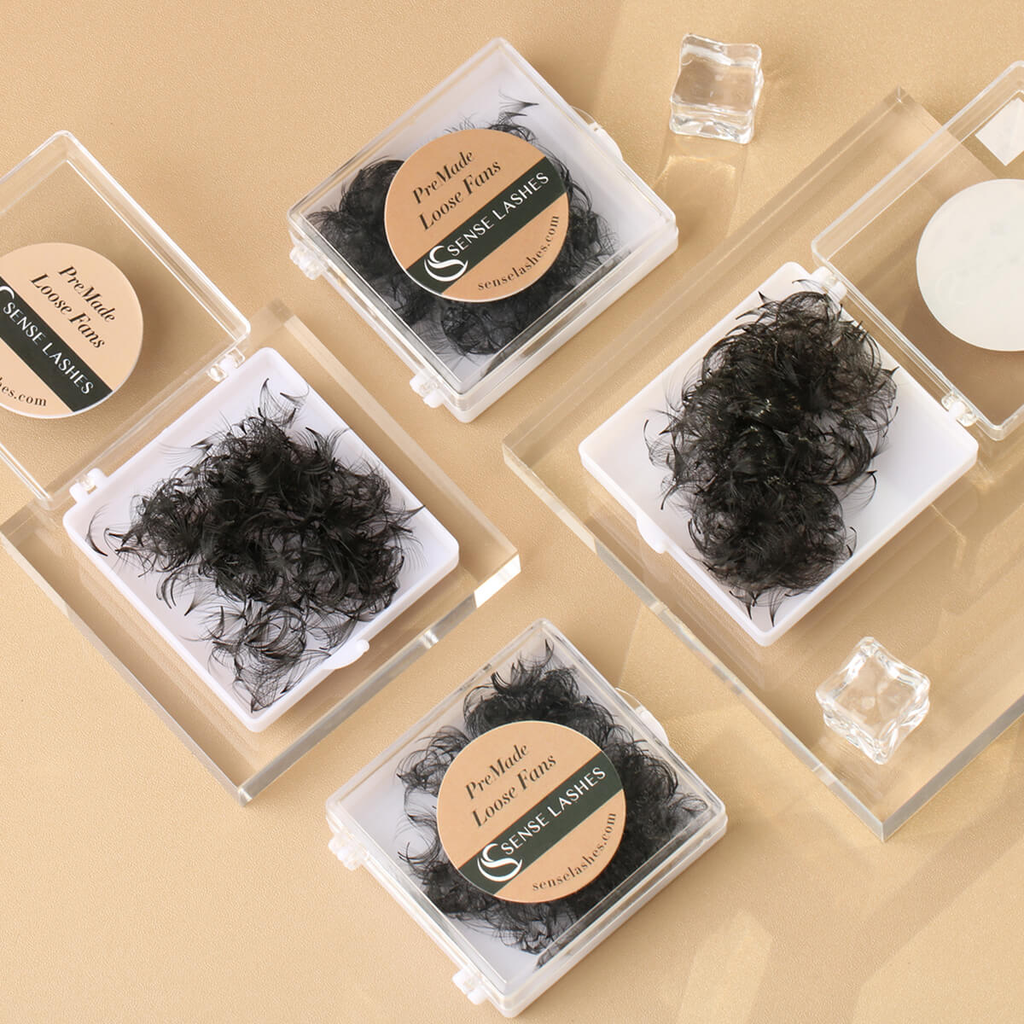
- Amber/Topaz: These tones bridge the gap between traditional black and creative color. Using Brown 20D PreMade Loose Fans - 0.05 - 500 Fans can provide a rich, chocolatey base that enhances warmth more effectively than a standard jet black.
- Emerald Green: As a complementary color to red/orange undertones, emerald provides a striking pop that remains grounded in professional elegance.
Cool Undertones (Blue, Violet, or Olive)
Deep skin with cool undertones often looks best with "regal" shades that lean into the blue spectrum.
- Sapphire Blue: This is perhaps the most versatile color for deep skin, providing high visibility and a brightening effect on the whites of the eyes.
- Amethyst Purple: A deep, saturated purple creates a mysterious, velvet-like texture that is far more impactful than a pastel lavender.
- Deep Teal: A mix of sapphire and emerald, teal provides a modern, high-fashion look that maintains its integrity in various lighting conditions.

Technical Integrity: Adhesive Selection and Pigment Safety
The artistry of color is moot if the application compromises eye health or retention. When working with colored lashes, technicians often face a dilemma: use clear adhesive for color purity or carbon black adhesive for better visibility during placement.
According to research published in PubMed regarding Ethyl Cyanoacrylate, allergic contact dermatitis is a real risk with lash adhesives. For colored sets, the choice of adhesive is critical. While clear adhesive prevents a "black ring" at the base of a colored fan, it requires much higher precision. If you are mixing jewel tones with black lashes, many artists prefer Clear vs. Carbon Black Adhesives based on the client's sensitivity profile.
Furthermore, the quality of the pigment in the lash fiber matters. The FDA (Eye Cosmetic Safety) highlights the importance of using compliant color additives. Professional-grade fibers, like those used in SenseLashes, utilize stable pigments that do not bleed or irritate the ocular surface. This is particularly important for high-impact sets like the 0.07MM Wispy Glitter Eyelash Extensions, where the glitter must be cosmetic-grade and securely bonded to the PBT fiber to prevent shedding into the eye.
The Sanitation SOP: Protecting the Melanin-Rich Eye
Deep skin can sometimes mask early signs of irritation, such as mild redness or "pink eye." It is the artist's responsibility to maintain a rigorous sanitation protocol to prevent complications like conjunctivitis or blepharitis.
The CDC (Centers for Disease Control) provides authoritative guidelines on preventing the spread of eye infections. In a professional lash setting, this translates to:
- Disposable Consumables: Always use fresh eye patches and wands for every client.
- Sterilization: All tweezers must undergo medical-grade disinfection between sets.
- Lash Hygiene: Educate clients that "water is not enough." Poor hygiene can lead to Blepharitis (Mayo Clinic), an inflammation of the eyelids that is exacerbated by bacteria buildup in the lash line.
We recommend a daily cleansing routine using a dedicated lash shampoo. This not only prevents infection but also improves the retention of your jewel-toned sets by removing sebum that can break down the cyanoacrylate bond.
Strategic Mapping: Placement for Maximum Impact
You do not always need a full set of colored lashes to make a statement. On deep skin, strategic placement often yields a more "expensive" and professional look than a uniform color application.
The "Accent Spike" Method
Using 0.07mm jewel-toned lashes as "spikes" in a wispy mapping (such as a Kim K look) creates a glimmer of color that catches the light as the client moves. This is where 0.07MM Wispy Glitter Eyelash Extensions shine. By placing 5-7 glitter spikes per eye, you add a "bling" factor that is visible even from a distance.
The Outer Corner Pop
Applying a high-saturation sapphire or emerald only to the outer 25% of the lash line creates a "cat-eye" effect that elongates the eye and provides a sophisticated hint of color. This technique is excellent for clients who are new to color and want to test the visibility on their skin tone.
The Layered Blend
For experienced artists, "sandwiching" a layer of Brown 8D PreMade Loose Fans - 0.07 - 500 Fans between two layers of black lashes can create a dimensional "Natural Black" look that avoids the harshness of jet black against certain warm complexions. This is discussed further in our guide on Deep Black vs. Natural Black: Navigating Fiber Color Profiles.

Business Perspective: The Growing Market for Specialized Artistry
The lash industry is not just about aesthetics; it is a booming global market. According to Grand View Research, the global false eyelashes market continues to see a significant CAGR, with a growing demand for customization and specialized applications.
By positioning your salon as an expert in "Deep Skin Artistry," you tap into a high-value niche. Clients with melanin-rich skin are often underserved by artists who only understand "standard" (Eurocentric) color theory. Offering specialized jewel-tone consultations and demonstrating an understanding of Matching Lash Finishing to Client Skin Tones and Ages builds immense trust and client loyalty.
Logic Summary: Our emphasis on jewel tones over pastels is a direct response to the "visibility gap" reported in professional communities. By selecting products with higher saturation, artists reduce "wasted application" time and increase client satisfaction rates.
Advanced Troubleshooting: pH and Retention
One non-obvious factor in lash retention is the pH balance of the natural lash. Early research by Amano et al. (2012) identified that older adhesive formulas could release formaldehyde and disrupt the ocular surface's pH. Modern professional adhesives are formulated to be more neutral, but the artist must still ensure the lash is properly primed.
For colored lashes, which sometimes have a slightly different surface texture due to the pigments used in the PBT fiber, using a high-quality primer is essential. This ensures the cuticle of the natural lash is open and ready to receive the adhesive, leading to the 6-8 week retention that high-end clients expect.
Key Takeaways for the Professional Artist
To excel in deep skin artistry, remember these core principles:
- Saturation is King: Prioritize jewel tones (70%+ saturation) over pastels to ensure visibility.
- Undertone Matching: Use warm jewel tones (ruby, amber) for golden skin and cool tones (sapphire, amethyst) for blue/olive skin.
- Safety First: Align your salon with AAO safety advisories and maintain strict hygiene to prevent blepharitis.
- Product Quality: Use premium Korean PBT fibers that hold their curl and pigment density.
- Strategic Design: Use accents and spikes to create dimension rather than a flat wall of color.
By mastering these technical and artistic nuances, you move beyond being a "lash tech" and become a true lash artist, capable of delivering stunning, visible results for every client, regardless of their skin tone.
Disclaimer: This article is for informational purposes only and does not constitute professional medical or financial advice. Always consult with a qualified health professional regarding eye health and follow local regulations regarding cosmetic applications.