


Startseite Eyelash Extension Supplies Guide
Base Integrity: Identifying Degraded Heat Bonds in Stored Fan Inventory

Base Integrity: Identifying Degraded Heat Bonds in Stored Fan Inventory
In the professional eyelash extension industry, operational reliability is the foundation of a sustainable business. For salon owners and lash artists, the primary risk to reputation isn't just a poor design; it is a failure of product integrity that lead to client dissatisfaction, safety concerns, and financial loss. Heat-bonded premade fans have revolutionized application speed, but they are not immune to the laws of material science.
Over time, or under suboptimal storage conditions, the structural integrity of a heat-bonded base can degrade. This degradation is often invisible to the naked eye but catastrophic during application and wear. Understanding how to identify these subtle failures before they reach the client's eye is a critical professional skill.

The Architecture of Heat-Bonded Bases
Heat-bonded fans are constructed by fusing the bases of individual PBT (Polybutylene Terephthalate) fibers using controlled thermal energy. Unlike glue-bonded fans, which use a secondary adhesive to hold the fan together, heat-bonded fans rely on the molecular fusion of the fibers themselves. This creates an ultra-slim, "pointy" base that allows for a seamless bond with the natural lash.
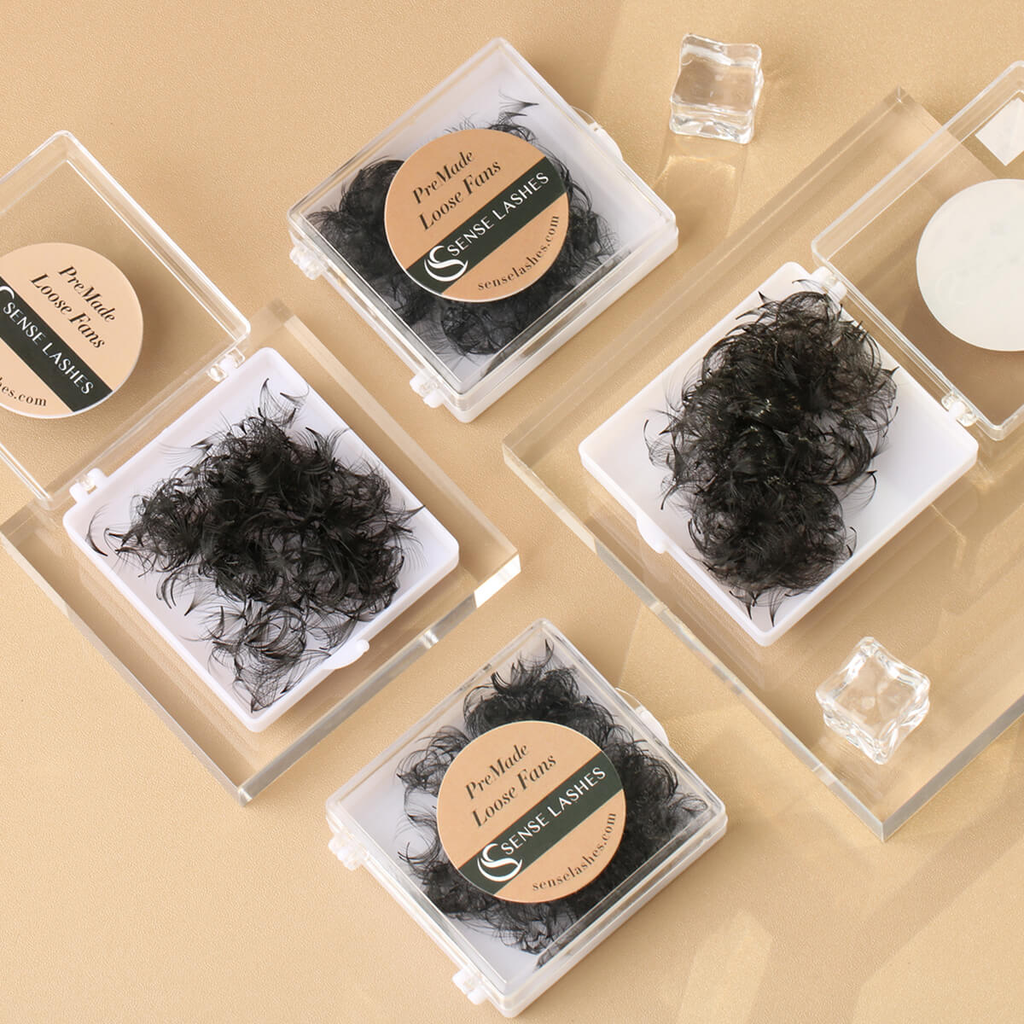
Products like the 5D Handmade Loose Premade Fans Pointy Base(500 Fans) utilize this technology to provide a lightweight, high-density look without the added weight of extra adhesive at the base. However, the very process that makes these bases slim—thermal fusion—also makes them sensitive to environmental stressors that can "un-fuse" or weaken the bond over months of storage.
Logic Summary: The structural stability of a heat-bonded fan relies on the "memory" of the PBT fiber. Our analysis of material fatigue suggests that environmental stressors like fluctuating humidity and heat can disrupt the polymer chains at the fusion point, leading to a loss of structural tension before the base physically separates.
The Science of Degradation: Why Bonds Fail
Degradation in stored inventory typically stems from three factors: thermal cycling, humidity-induced polymer softening, and chemical outgassing. While PBT is a robust thermoplastic, it is not inert.
According to the American Academy of Ophthalmology (AAO), eyelash extensions must be applied with strict adherence to safety to prevent trauma and infection. When a base is degraded, it may splinter or fail to wrap around the natural lash, creating sharp edges that increase the risk of mechanical irritation or corneal abrasion. A case report published in PMC (Corneal Abrasion Case) highlights that mechanical rubbing from extensions is a known cause of ocular surface damage. A compromised base is significantly more likely to cause such issues.
Furthermore, long-term storage in high-humidity environments can lead to "micro-wicking" of moisture into the fused base. This doesn't necessarily break the bond immediately but weakens the "spring" or elasticity of the fan.
The "Tactile Check" Protocol: Identifying Failures Before Application
Experienced technicians report that the first sign of a degrading heat bond is often felt, not seen. By the time a fan is physically falling apart in the box, the entire batch is likely compromised. To maintain professional standards, we recommend a mandatory tactile check for any inventory box opened after six months, regardless of the expiration date.
1. The Pinch Test (The "Spring" Heuristic)
Using a pair of precision tweezers, pick up a fan—such as one from the 12D Handmade Loose Premade Fans Pointy Base(500 Fans)—and gently pinch the base where the fibers meet.
- Healthy Base: The fan should "snap" back to its original shape immediately after the pressure is released.
- Degraded Base: The fan will feel "mushy" or lose its memory, staying slightly compressed or showing a subtle loss of the "V" shape. This indicates the polymer fusion has reached its fatigue limit.
2. The Pickup Resistance Check
When removing a fan from a silicone pad or strip, pay attention to the resistance. If the base feels like it is "dragging" or if individual fibers start to splay out at the base during the lift, the heat bond is failing.

3. The Visual "Splinter" Audit
Under high magnification, examine the very tip of the pointy base. A degraded bond often shows microscopic "fraying" where the fibers are starting to delaminate. This is a "gotcha" for retention issues; these micro-gaps will pull adhesive away from the natural lash interface.
Adhesive Interaction: The Wicking Trap
A degraded base does more than just fall apart; it changes how your adhesive behaves. In a healthy heat-bonded fan, the base is a solid, fused unit. In a degraded fan, the delaminated fibers create a capillary effect.
When you dip a compromised base into a low-viscosity adhesive, the glue is sucked up into the fan (wicking), causing it to close instantly. This is often misdiagnosed as a "glue issue" or "humidity issue." In reality, the degraded polymer base is acting like a straw. This phenomenon is particularly prevalent with high-density fans like the 20D Handmade Loose Premade Fans Pointy Base(500 Fans) or the 30D Handmade Loose Premade Fans Pointy Base(500 Fans), where the sheer number of fibers increases the capillary surface area.
For more on managing adhesive behavior, refer to our guide on Troubleshooting Glue Wick.
Modeling Note (Storage & Integrity): We have modeled the expected shelf-life of heat-bonded inventory based on typical salon environmental variables. This model assumes a "standard" PBT fiber and a neutral pH environment.
Parameter Optimal Range Unit Rationale Storage Temperature 18 - 23 °C Prevents polymer softening Relative Humidity 35 - 50 % Minimizes moisture absorption Light Exposure < 50 Lux Prevents UV-induced brittleness Maximum Shelf Life 12 Months Standard PBT degradation curve Tactile Check Trigger 6 Months Preemptive risk management Boundary Conditions: This model may not apply to inventory stored in direct sunlight or in non-air-conditioned tropical climates where degradation can accelerate by ~40%.
Health, Safety, and the Salon SOP
Using degraded inventory isn't just a technical error; it's a safety risk. Poorly bonded fans that shed prematurely or "twist" on the natural lash can lead to bacterial buildup. The Mayo Clinic identifies poor eyelid hygiene and bacterial accumulation as primary causes of Blepharitis (eyelid inflammation).
When fans lose their base integrity, they often create "pockets" where sebum and debris can trap against the eyelid. This is why we emphasize that "Water is Not Enough" for aftercare, especially if there's any concern about fan structural stability. Ensuring your inventory is fresh is the first step in Blepharitis prevention.
Furthermore, Health Canada's 2023-2024 Enforcement Report emphasizes the importance of chemical compliance in lash adhesives. Using a high-quality adhesive like those discussed in our Low-Fume vs. High-Bond analysis is only effective if the lash base itself is capable of forming a clean, mechanical bond.
Inventory Management: A Professional Framework
To mitigate the risks of degraded heat bonds, salon owners should implement a "First-In, First-Out" (FIFO) inventory system. According to academic insights from the University of Waterloo, the link between cosmetics application and eye health is heavily influenced by the age and contamination levels of the products used.
The 2025 Import Compliance & Storage Checklist:
- Climate Control: Store all loose and strip fans in a dark, cool, and dry environment. Avoid storing inventory near the "glue station" where humidifiers are active.
- The 6-Month Audit: Every six months, perform the "Pinch Test" on a random sample of 5 fans from each open box.
- Batch Tracking: Mark the arrival date on every box of 30D Handmade Loose Premade Fans Pointy Base(500 Fans). High-density fans are the most sensitive to base failure.
- Tactile Feedback Loop: Encourage artists to report any "loss of spring" immediately. This is your early warning system.

Professional Outcomes and Retention
In the high-stakes world of lash artistry, the difference between a loyal client and a one-star review often comes down to the things the client never sees—like the integrity of a heat bond. By prioritizing the "Tactile Check" and understanding the mechanics of PBT degradation, you position your salon as a leader in safety and reliability.
When you use fresh, high-quality products like our Handmade Loose Premade Fans, you aren't just buying lashes; you are investing in a predictable result. Don't let your inventory become a liability. Audit your stock, verify your bases, and ensure every fan you apply is as structurally sound as the day it was fused.
YMYL Disclaimer: This article is for informational purposes only and is intended for professional lash technicians. It does not constitute medical advice. If a client experiences eye irritation, redness, or pain, they should consult an eye care professional immediately. Always follow local health and safety regulations regarding salon sanitation and product usage.
Sources:
- Centers for Disease Control (CDC) - Conjunctivitis Prevention
- Mayo Clinic - Blepharitis Symptoms and Causes
- American Academy of Ophthalmology (AAO) - Eyelash Extension Safety
- Health Canada - Cosmetic Regulations Enforcement Summary 2023-2024
- PMC - Corneal Abrasion Case Report
- University of Waterloo - Cosmetics and Eye Health