


Home Eyelash Extension Supplies Guide
Stopping Adhesive Wicking: Why Your Premade Fans Are Closing Prematurely

Disclosure: This technical guide features professional products from the Sense Lashes catalog (including our Gold Adhesive and various premade fan series) to illustrate specific application techniques and performance standards.
Quick Summary (Answer-First): To prevent adhesive wicking and fan closure, use a medium-viscosity adhesive (like a 1-2s Gold formula), limit dipping depth to exactly 1–2mm, and utilize the "Swipe and Tap" method to remove excess glue. Maintaining a controlled environment with 45–60% relative humidity is essential for managing polymerization speed and preventing capillary travel.
The Architecture of Premade Fans and Capillary Action
In the professional lash industry, the transition from handmade volume to premade fans is often driven by the need for efficiency. However, a common technical hurdle is "wicking"—a phenomenon where adhesive travels up the fibers, causing the fan to collapse into a "spike" before application.
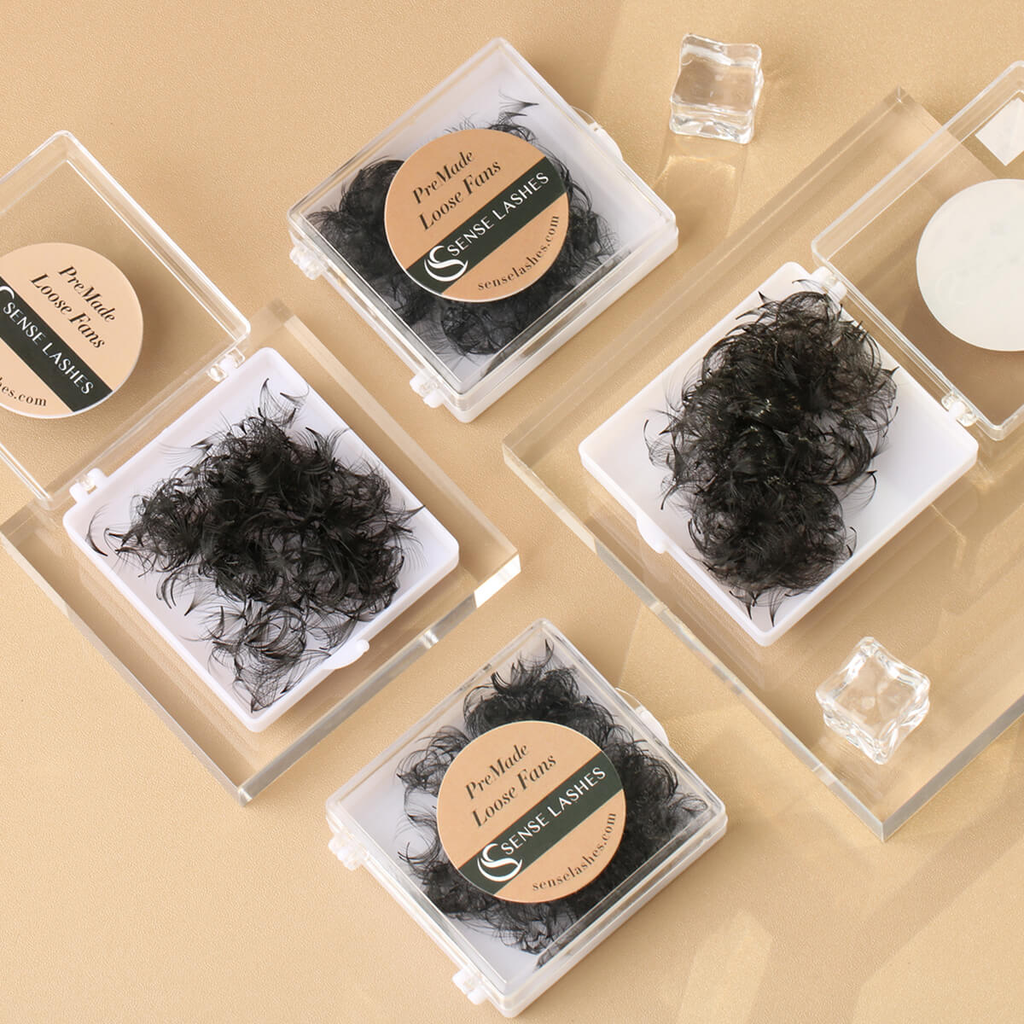
To solve this, we must understand the physics of the lash base. Premade fans, such as the 10D Handmade Loose Premade Fans Pointy Base(500 Fans), are engineered using PBT (Polybutylene Terephthalate) fibers. These are typically heat-bonded or glue-bonded at the base.
Heat-bonded fans are often preferred for their lightweight nature, but the lack of a secondary "seal" at the base creates microscopic gaps. According to fluid dynamics, surface tension pulls liquid into these narrow gaps—a process known as capillary action.
Base Type Comparison: Wicking Tendencies
| Base Type | Wicking Risk | Weight | Application Nuance |
|---|---|---|---|
| Heat-Bonded | Higher | Ultra-lightweight | Requires strict dipping depth control. |
| Glue-Bonded | Lower | Slightly heavier | Base is pre-sealed, reducing travel. |
Practical Observation: Based on technical support patterns, heat-bonded fans are more susceptible to capillary action because the fibers are held by thermal fusion rather than a physical glue barrier. This requires the artist to manage adhesive viscosity more strictly to prevent the liquid from "climbing" the fibers.
If the adhesive wicks too far, the fan will close. This is particularly frequent with high-density options like the 30D Handmade Loose Premade Fans Pointy Base(500 Fans), where the high fiber count creates more "channels" for travel.

The Role of Adhesive Viscosity and Chemistry
The choice of adhesive is a primary factor in controlling wicking. Very thin, watery adhesives are often designed for fast-drying "wrap" techniques in handmade volume. However, with premade fans, these thin formulas can move too quickly, wicking up the base before placement.
For premade application, a medium-to-syrup-like viscosity is often more effective. The 1-2 Second Gold Eyelash Extension Glue is formulated with a consistency designed to bead at the base rather than being immediately absorbed into the fiber gaps.
Safety and pH Considerations
Adhesive safety is a critical industry standard. A study by PubMed (Amano et al. 2012) identified that certain adhesives can release formaldehyde or have acidic pH levels that may cause keratoconjunctivitis. Modern professional formulas prioritize pH neutrality and low-fume profiles to mitigate these risks.
When adhesive wicks up a fan, it increases the total surface area of the "wet" adhesive. This can result in higher fume emission near the client's eyes, potentially exacerbating conditions like Dry Eye Syndrome. Keeping the adhesive at the base helps preserve fan fluffiness while minimizing chemical exposure.
Environmental Influence: Humidity and Wicking
Ambient humidity dictates how quickly cyanoacrylate polymerizes (cures).
- High Humidity (>70%): The adhesive may begin to cure almost instantly. However, high moisture can also cause certain formulas to behave more "thinly" momentarily, which can increase the risk of sudden wicking.
- Low Humidity (<40%): The adhesive remains liquid longer. While this prevents "shock curing," it gives the glue more time to travel up the fibers.
In high-humidity environments, we often observe that adhesives lose their "bead" shape. To combat this, we recommend using a fresh glue drop every 15–20 minutes and maintaining a range of 48–60% humidity for optimal control. For more details, see our guide on Humidity vs. High Density: Managing Glue Speed.
Technical Solutions: The 'Swipe and Tap' Technique
The most common mistake leading to fan closure is dipping the fan too deeply. If the adhesive reaches the point where the fibers begin to flare, wicking becomes much more likely.
The Professional Dipping Protocol
- Controlled Entry: Dip only the bottom 1–2mm of the 14D Handmade Loose Premade Fans Pointy Base(500 Fans) into the adhesive.
- The Swipe and Tap: Gently swipe the base through the glue, then immediately tap the side of the base against the glue ring or stone. This removes the excess "micro-bead" that tends to travel upward.
- Instant Attachment: Move quickly to the natural lash. A 1–2 second drying time is intended to "lock" the fan before capillary action can occur.
Heuristic Note: Based on internal training observations, we estimate that approximately 60–80% of fan closure issues can be resolved simply by reducing dipping depth by 1mm.
If a fan begins to close during application, it is generally more efficient to discard it. For deeper insights, refer to our troubleshooting guide on Why Mega Fans Close on Application.
Clinical Implications: Hygiene and Eye Health
Wicking can have implications for long-term ocular health. When a fan closes, it creates a denser, less breathable area at the lash line, which can trap sebum and debris.
Managing Risks of Blepharitis
According to the Mayo Clinic, Blepharitis is an eyelid inflammation often linked to clogged oil glands or bacteria. Closed fans are significantly harder to clean. Research on Demodex mite infestation suggests that poor hygiene is a risk factor for irritation and lash loss.
Professional artists should emphasize that using a dedicated lash shampoo is essential. If fans have closed due to wicking, the cleaning process becomes less effective as the cleanser cannot easily penetrate the solidified adhesive mass.

Safety, Compliance, and Risk Management
Technical proficiency must be paired with regulatory awareness. A 2023-2024 report by Health Canada highlighted the importance of compliant labeling and chemical composition in cyanoacrylate adhesives.
Using professional-grade products from reputable suppliers is a primary defense against technical failure and safety risks. Furthermore, referencing resources from the American Academy of Ophthalmology (AAO) helps position a salon as a safety-conscious establishment.
Irritation vs. Allergy
It is vital to distinguish between irritation and true allergic contact dermatitis. A study in PubMed (2022) notes that Ethyl Cyanoacrylate can be a source of allergic reactions. While wicking increases the amount of adhesive used (potentially increasing fume irritation), a true allergy requires medical assessment. Always follow the latest safety patterns, such as those in late 2024 studies on contact dermatitis.
Modeling the Impact of Technique (Estimates)
The following table models the relationship between adhesive volume and lash health based on internal workshop observations (using 0.03mm fibers).
| Variable | Optimized Technique | Heavy Wicking (Estimate) |
|---|---|---|
| Adhesive Mass | ~0.5mg | ~1.5mg |
| Drying Time | 1–2 Seconds | 4–6 Seconds (due to volume) |
| Fan Openness | Optimal Opening | <30% (Spiky/Closed) |
| Cleaning Ease | High | Low (Debris Trapping) |
| Retention Potential | 6–8 Weeks | 3–4 Weeks (due to weight) |
Note on Data: These values are illustrative heuristics based on internal practitioner feedback and are not intended as precise laboratory measurements. We estimate that "wicked" fans can be significantly heavier than optimized fans, which can increase the risk of premature natural lash shedding.
Professional Best Practices Checklist
- Match Viscosity to Base: Use a medium-viscosity adhesive like the 1-2 Second Gold Glue for heat-bonded fans.
- Restrict Dipping Depth: Aim for 1–2mm of depth; never exceed the flare point.
- Monitor Environment: Keep humidity between 45% and 60% for the best balance of speed and control.
- Prioritize Hygiene: Educate clients on the link between fan health and Blepharitis.
- Quality Control: If a fan closes, discard it immediately to maintain the set's integrity.
Disclaimer: This article is for informational purposes only and does not constitute medical or legal advice. Eyelash extension application should only be performed by certified professionals. If a client experiences persistent irritation, they should consult an ophthalmologist.