


Home Eyelash Extension Supplies Guide
Solving Retention Gaps: Why Premades Fail Without the Adhesive Wrap

Solving Retention Gaps: Why Premades Fail Without the Adhesive Wrap
For professional lash artists, the transition from handmade volume fans to premade fans is often driven by a need for operational efficiency. However, a common frustration emerges: clients who previously enjoyed six weeks of retention with handmade sets might return after only two or three weeks when premades are used. This discrepancy is rarely a fault of the fiber itself; rather, it is a fundamental mechanical challenge.
Handmade fans allow for the "wrap"—the physical act of the lash extensions encircling the natural lash during application. Premade fans, by their nature, are pre-cured at the base, creating a rigid structure that cannot wrap. To achieve professional-grade retention, artists must shift their focus from mechanical wrapping to "adhesive compensation." By mastering the adhesive wrap, you can bridge this gap and ensure your volume sets remain as durable as they are beautiful.
The Physics of the Bond: Handmade vs. Premade Architecture
The primary difference between a handmade fan and a premade fan lies in the state of the base. When you create a fan by hand, the individual fibers are loose until they meet the natural lash. This allows the fibers to splay and "hug" the natural lash, creating a 360-degree bond.
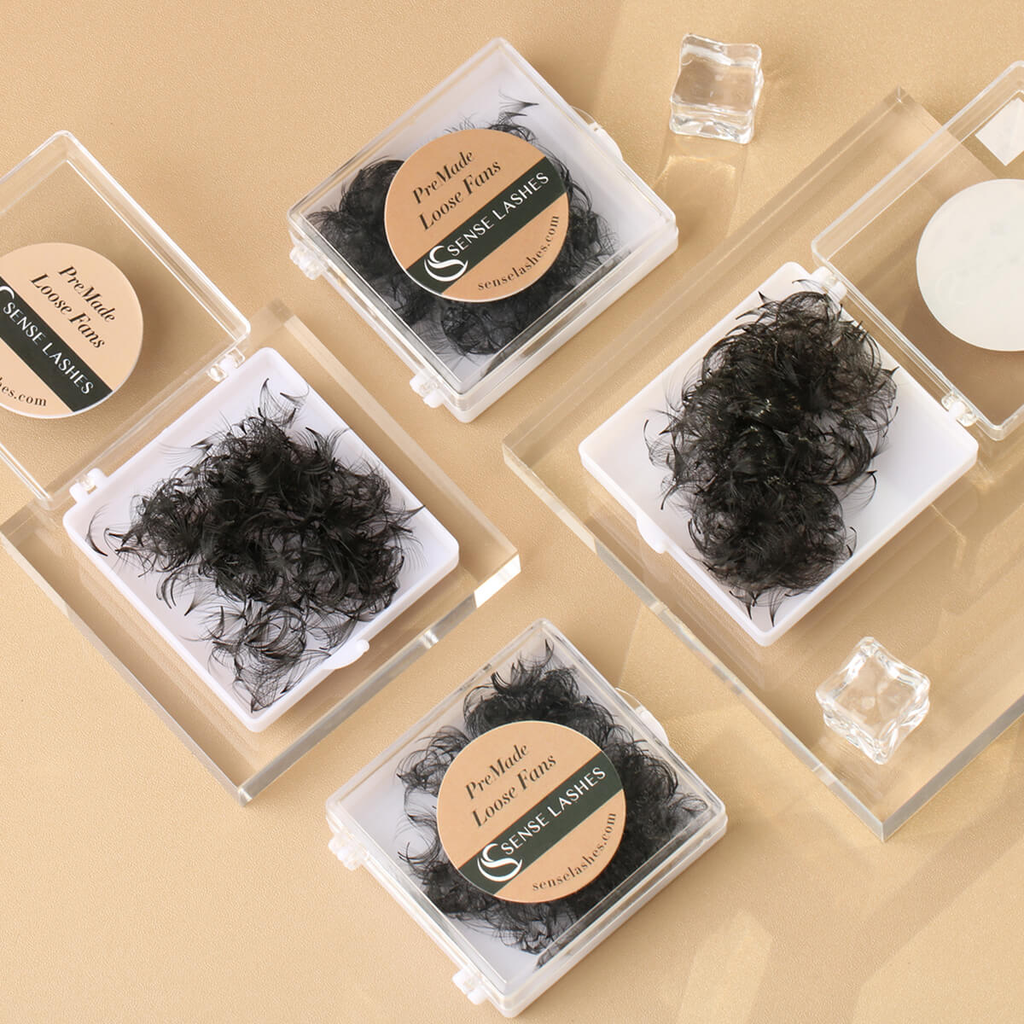
In contrast, products like 12D Handmade Loose Premade Fans Pointy Base(500 Fans) feature a base that is already fused. Because the base is solid, the contact point between the fan and the natural lash is reduced to a "tangential" or "point" contact. Without the wrap, the bond relies entirely on the chemical integrity and the volume of the adhesive bridge.
According to a comprehensive review in ResearchGate, application methods significantly influence both aesthetic outcomes and safety protocols. For premades, the safety and longevity of the set depend on the artist's ability to create a "meniscus"—a curved adhesive surface that acts as a structural reinforcement between the rigid fan base and the flexible natural lash.

Base Architecture and Adhesive Synergy
Not all premade fans are created equal. The industry generally categorizes them into heat-bonded and glue-bonded bases. Understanding this distinction is critical for selecting the correct adhesive viscosity.
Heat-Bonded Fans (Pointy Base)
Heat-bonded fans, such as the 14D Handmade Loose Premade Fans Pointy Base(500 Fans), use high temperatures to fuse the PBT (Polybutylene Terephthalate) fibers. This results in an ultra-slim, "pointy" base. However, the fused polymer can sometimes repel thin, watery adhesives, leading to "beading" where the glue sits on the surface rather than coating it.
Glue-Bonded Fans
These fans are held together by a tiny amount of adhesive at the base. While they are often easier to pick up from a strip, they present a risk of "wicking." If the adhesive used during application is too thin, it can travel up the base via capillary action, causing the fan to close or "spike." For a deeper look at this issue, see our guide on Why Spikes Close.
Methodology Note: Adhesive Selection Logic Our technical recommendations for adhesive matching are based on viscosity modeling and surface energy observations in salon environments.
Base Type Primary Challenge Recommended Viscosity Adhesion Mechanism Heat-Bonded (Pointy) Surface Repulsion Medium/Syrup-like Chemical Bridge Glue-Bonded (Tape) Adhesive Wicking Medium-Thick Capillary Control Handmade Mechanical Wrap Thin/Medium 360-Degree Enclosure
To solve the retention gap for heat-bonded fans, a "syrup-like" adhesive is often the most effective choice. The 0.5-1 Second Diamond Eyelash Extension Glue is specifically formulated with a velvety consistency that allows the artist to pick up an ideal amount of glue, creating the necessary structural bridge for a pointy base.
The "Adhesive Wrap" Technique: A Step-by-Step Protocol
Since we cannot physically wrap a premade base, we must use the adhesive to "mimic" the wrap. This requires a precise approach to dipping and placement.
1. The 45-Degree Dip
Instead of dipping the fan vertically, enter the adhesive at a 45-degree angle. This ensures that the glue coats not just the very tip of the base, but also the sides. This increased surface area is the foundation of the "adhesive wrap."
2. The 1.5x Bead Heuristic
In our technical training, we use a specific rule of thumb: the adhesive bead should be approximately 1.5 times the width of the fan's base.
- Too Small: If the bead is the same width as the base, it creates a "point contact" that is prone to peeling when the client brushes their lashes.
- Too Large: If the bead is twice the width or more, it adds excessive weight, which can cause mechanical damage to the natural lash or slow down the curing process, leading to "stickies."
3. The "Slide and Settle" Motion
Avoid the "dab and hold" approach. Instead, place the fan base against the natural lash and perform a gentle 1-2mm slide downward before settling it into its final position. This motion breaks the surface tension of the adhesive and forces it to flow around the natural lash, creating a mechanical interlock. This technique is especially effective with 10D Handmade Loose Premade Fans Pointy Base(500 Fans), where the base is slim enough to allow for close proximity to the lash line.

Safety, Chemistry, and Ocular Health
Retention should never come at the cost of client safety. High-performance adhesives like the 0.5-1 Second Diamond Eyelash Extension Glue are designed to be formaldehyde-free, but the chemistry of cyanoacrylate still requires respect.
Managing pH and Fumes
Research by Amano et al. (2012) highlighted that early lash adhesives could release formaldehyde and had pH levels that could cause keratoconjunctivitis. Modern professional formulas have moved toward pH-neutral compositions to mitigate these risks. However, even with safe formulas, improper application can lead to chemical burns. According to PMC research on chemical injuries, adhesive entering the eye is a primary cause of trauma. Using high-quality eye pads and ensuring the eye is completely sealed is non-negotiable.
Preventing Blepharitis and Mite Infestation
One of the "killer arguments" for client aftercare is the prevention of Blepharitis. As noted by the Mayo Clinic, this eyelid inflammation is often caused by bacteria or clogged oil glands. When clients avoid washing their extensions for fear of losing them, they create a breeding ground for Demodex mites.
Studies published in PMC regarding Demodex emphasize that ocular hygiene is the most effective preventative measure. Artists should educate clients that a proper "adhesive wrap" is strong enough to withstand daily cleansing. In fact, removing sebum and debris actually improves retention by preventing the oils from breaking down the adhesive bond.
Troubleshooting Common Retention Failures
When a client experiences poor retention with premades, use the following scenario modeling to diagnose the issue:
Scenario A: The "Pop-Off" (Mechanical Failure)
- Observation: The extension falls off without the natural lash, and the base of the extension looks "clean."
- Root Cause: The adhesive bead was too small (less than 1x base width) or the glue cured too fast before placement.
- Solution: Increase the bead size to 1.5x and ensure you are using the "slide and settle" motion. If the room humidity is high, consider a slightly slower adhesive to allow for placement time.
Scenario B: The "Wick-Up" (Viscosity Failure)
- Observation: The fan has closed into a spike, and there is a visible "clump" of glue higher up the lash fibers.
- Root Cause: The adhesive was too thin for the glue-bonded base, or the fan was dipped too deeply.
- Solution: Switch to a medium-viscosity adhesive like Diamond Bond and ensure only the bottom 1-2mm of the base is dipped.
Scenario C: Premature Shedding (Weight Failure)
- Observation: The extension falls off with the natural lash attached, but the natural lash appears short or broken.
- Root Cause: The fan was too heavy for the natural lash (e.g., using a 14D fan on a fine, baby lash).
- Solution: Follow the AAO safety facts regarding trauma and weight. Use lighter diameters (0.03mm) for high-D fans to maintain natural lash health.
The Business Case for Quality Consumables
Investing in high-quality premades and adhesives is not just a technical choice; it is a business strategy. According to Grand View Research, the global lash market continues to grow, with a significant shift toward individual and volume extensions. To capture this growth, salon owners must minimize "re-work" and "fix-it" appointments.
Furthermore, global distributors must be wary of import compliance. A Health Canada Enforcement Report recently highlighted high non-compliance rates for cyanoacrylate labeling and safety. By sourcing from reputable manufacturers that prioritize chemical transparency, you protect your business from customs seizures and legal liability.
Technical Summary for the Professional
To solve the retention gap with premade fans, the artist must compensate for the lack of mechanical wrap with a superior adhesive strategy.
- Match Viscosity: Use medium-viscosity adhesives for heat-bonded pointy bases to ensure a structural bridge.
- Control the Bead: Aim for a bead 1.5x the width of the base to maximize surface area without adding excessive weight.
- Optimize Placement: Use a 45-degree dip and a "slide and settle" motion to encourage the adhesive to flow around the natural lash.
- Prioritize Hygiene: Educate clients on blepharitis prevention to ensure the ocular surface remains healthy, which in turn supports better long-term retention.
By treating the adhesive application as a precise engineering task rather than a simple "gluing" process, you can achieve the same legendary retention with premades that your clients expect from handmade sets.
YMYL Disclaimer: This article is for informational purposes only and does not constitute professional medical, legal, or financial advice. Eyelash extension application involves chemicals and proximity to the eye; always follow local licensing regulations and consult with an ophthalmologist if a client experiences persistent irritation or infection.
References
- Centers for Disease Control (CDC) - Conjunctivitis Prevention
- Mayo Clinic - Blepharitis Symptoms and Causes
- American Academy of Ophthalmology (AAO) - Eyelash Extension Safety
- Health Canada - Cosmetic Regulations Enforcement Report (Cyanoacrylate)
- PubMed - Ocular Disorders and Eyelash Extensions (2024)
- PMC - Ocular Surface Microbiome and Extension Wear (2024)
- Grand View Research - False Eyelashes Market Analysis