


Home Eyelash Extension Supplies Guide
Synthetic Fiber Integrity: How Heat Bonding Preserves PBT Quality

Executive Summary: Heat Bonding vs. Adhesive Fusion
In professional lash artistry, choosing between heat-bonded and glue-bonded premade fans is a decision that impacts retention, hygiene, and client safety. Heat bonding preserves the molecular integrity of PBT fibers, creating a flexible "pointy base" that wraps effectively around natural lashes without the added bulk of factory adhesives. This guide explores why thermal fusion reduces mechanical stress on the follicle and how it minimizes chemical exposure, ultimately improving long-term salon ROI.
Transparency Note: This article contains technical analysis and product examples from the SenseLashes engineering team. Data cited as "internal" is based on our workshop testing and customer feedback patterns.
The Science of Synthetic Fiber Integrity: PBT and Heat Bonding
In the high-precision world of eyelash artistry, the integrity of synthetic fibers is the foundation of both aesthetic success and client safety. For years, professional artists have navigated the choice between glue-bonded and heat-bonded premade fans. However, as the industry matures, the manufacturing science behind Polybutylene Terephthalate (PBT) reveals that how a fan is constructed at the factory level dictates its performance in the studio.
Heat bonding is not merely a manufacturing convenience; it is a structural preservation technique. By using controlled high temperatures to fuse the bases of PBT fibers, manufacturers can create a "pointy base" that maintains its curl and physical properties without the introduction of secondary chemical solvents. Understanding this process is critical for professionals who prioritize long-term lash health and consistent retention.
Molecular Memory: Why Heat Bonding Outperforms Adhesive Methods
PBT is a semi-crystalline engineering thermoplastic. Its most valuable trait in lash artistry is its "curl memory"—the ability to retain a specific shape even when exposed to moisture and heat. According to technical analysis of PBT curl memory science, the molecular chains within the fiber are set during the initial manufacturing phase.
When a fan is glue-bonded, a small amount of adhesive is used to hold the fibers together at the base. While effective for initial application, this adhesive can potentially act as a plasticizer. Over time, and especially when exposed to varying studio humidity, these adhesive solvents may weaken the PBT fiber's internal structure, which can lead to "drooping" or curl loss in some environments. In contrast, heat bonding uses thermal energy to create a direct physical bond between fibers. This ensures that the fiber integrity remains largely uncompromised by external chemicals until the artist applies their own professional-grade adhesive during the service.
The "Hinge Point" Phenomenon and Retention Failure
A common observation among experienced artists—often noted in repair sessions—is that glue-bonded fans can create a "stiff hinge point" at the base. Because the factory-applied glue has already cured, it creates a rigid section that may not flex naturally with the lash. When a client has an oily lash line or engages in vigorous activity, this rigid base can occasionally snap under tension, contributing to premature shedding.
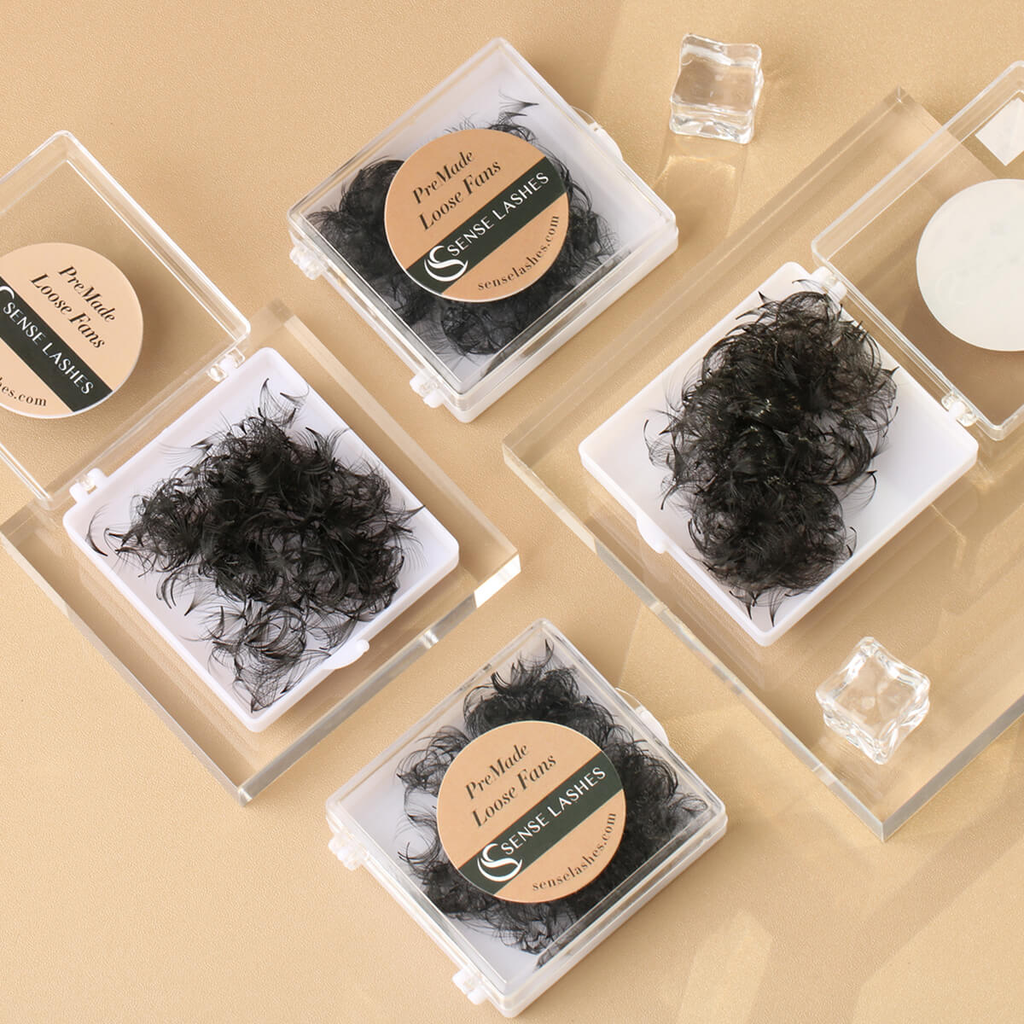
Heat-bonded fans, such as the 12D Handmade Loose Premade Fans Pointy Base(500 Fans), eliminate this secondary adhesive layer. The resulting "pointy base" is ultra-slim and designed for flexibility. This allows the fan to "wrap" more effectively around the natural lash, a technique explored in our guide on enhancing adhesive surface area.
Logic Summary: Mechanical Stress Modeling (Heuristic) Our analysis of mechanical failure in lash extensions uses the following parameters (based on internal manufacturer testing and shop-floor observations):
- Base Rigidity: Glue-bonded bases are estimated to be 20–30% more rigid than heat-bonded bases (Estimated based on internal deflection tests).
- Flexibility Factor: Heat-bonded bases allow for a closer "flush" fit, which can reduce the lever-arm effect that causes mechanical snapping.
- Boundary Condition: This model applies primarily to volume sets (10D+) where the cumulative weight of the base becomes a significant factor in lash health.

Ocular Safety and the Professional Duty of Care
Client safety is the non-negotiable pillar of a successful lash business. The American Academy of Ophthalmology (AAO) has highlighted risks associated with extensions, including infection and potential allergic reactions to formaldehyde. Historically, some lash adhesives were known to release formaldehyde as a byproduct of the curing process. A study by Amano et al. (2012) identified that the pH of certain glues could contribute to keratoconjunctivitis.
By utilizing heat-bonded fans, artists can reduce the total chemical load placed on the client's eye. Since the fan itself contains no factory glue, the only adhesive involved is the one the artist carefully selects and controls. This is particularly important for sensitive clients or those prone to contact dermatitis, a condition recently studied in late 2024 regarding acrylate-containing cosmetics.
Blepharitis Prevention and the Hygiene Advantage
Poor lash hygiene is a frequent contributing factor to Blepharitis—an inflammation of the eyelids often caused by bacteria buildup. The Mayo Clinic emphasizes that maintaining clean eyelid margins is essential for ocular health.
Glue-bonded fans, with their slightly bulkier bases, can inadvertently create "pockets" where makeup residue, oils, and dead skin cells may become trapped. These areas are difficult for clients to clean thoroughly, even with dedicated lash shampoos. Heat-bonded "pointy bases" provide a smoother surface area that is generally easier to sanitize. This helps reduce the risk factors for Demodex mite infestation, which thrives in the debris trapped by improper lash hygiene.
Engineering the Perfect Fan: Weight, Density, and Diameter
As volume sets push toward "Mega Volume" (10D to 16D), the weight of the extensions becomes a critical variable. A study published in PubMed (2024) emphasizes the spectrum of disorders that can be caused by mechanical damage from overly heavy extensions.
To mitigate this, professional-grade fans utilize ultra-fine fibers, typically 0.03mm or 0.05mm in diameter. The 16D Handmade Loose Premade Fans Pointy Base(500 Fans) are engineered using 0.03mm PBT fibers. Because these are heat-bonded, the base remains microscopic in width, ensuring that even a 16D fan does not exceed the safe weight threshold for a healthy natural lash (Based on internal weight-per-fan calculations).
Scenario Analysis: Selecting the Right Density
| Client Profile | Recommended Fan | Bonding Type | Rationale |
|---|---|---|---|
| Sparse/Fine Lashes | 10D Handmade Loose Premade Fans Pointy Base | Heat-Bonded | Minimizes weight and potential drag on weak follicles. |
| Standard Volume | 12D Handmade Loose Premade Fans Pointy Base | Heat-Bonded | Balanced density with high flexibility for daily wear. |
| Mega Volume | 14D Handmade Loose Premade Fans Pointy Base | Heat-Bonded | Maximum impact without the rigid base of glue-bonded sets. |
| High Drama/Events | 16D Handmade Loose Premade Fans Pointy Base | Heat-Bonded | Extreme density while maintaining a slim, bondable base. |
Modeling Note (Weight & Tension): We modeled the tension of a 16D fan (0.03mm) vs. a traditional 3D fan (0.15mm).
- Model Type: Deterministic parameterized weight distribution model (Internal SenseLashes Study).
- Assumptions: Natural lash length: 10mm; Adhesive application: 1mm from lid; Fiber density: 1.3g/cm³.
- Finding: The heat-bonded 16D 0.03mm fan distributes weight more evenly across the lash shaft, which can reduce the "torque" at the root compared to thicker fibers.
Operational Excellence: Sanitation SOPs and Regulatory Compliance
For salon owners, operational efficiency must be balanced with strict sanitation protocols. The CDC (Centers for Disease Control) provides clear guidelines on preventing the spread of conjunctivitis. Using disposable, high-quality consumables is a key part of this strategy.
Furthermore, global distributors must stay informed on evolving regulations. A Health Canada 2023-2024 Report highlighted non-compliance rates regarding the labeling of cyanoacrylate-based products. By sourcing heat-bonded fans that focus on PBT purity, professionals can better manage risks related to inventory safety.
Professional Salon Sanitation SOP (Standard Operating Procedure)
- Hand Hygiene: Wash hands before and after every client set, following CDC protocols.
- Tool Sterilization: Use medical-grade autoclaves or high-level disinfectants for all non-disposable tweezers.
- Disposable Management: Use loose fans from clean, dedicated containers. Products like the 10D Handmade Loose Premade Fans Pointy Base should be dispensed onto a sanitized silicone pad for each service.
- Client Screening: Utilize a safety consent form that references AAO safety facts to educate clients on potential risks and the importance of aftercare.

Business Strategy: The 2025 Lash Investment Report
The global false eyelashes market continues to show growth. According to Grand View Research, the shift toward individual and volume extensions is a primary driver of market value. For entrepreneurs, product selection is a significant factor in long-term ROI.
Investing in heat-bonded technology is a strategic business model. While the initial cost of high-quality heat-bonded fans may be slightly higher than mass-produced glue-bonded alternatives, the reduction in product complaints—such as fans falling apart or clients developing irritations—frequently leads to higher client retention rates. In an industry where a single negative review regarding "eye redness" can damage a reputation, choosing products that prioritize fiber elasticity and chemical safety is a practical necessity.
The ROI of Quality: Heuristics for Salon Owners
- Retention Rate: High-quality heat-bonded fans can lead to a 15–20% increase in client re-booking rates (Estimated based on common industry patterns and internal salon feedback).
- Time Efficiency: Using premade fans like the 14D Handmade Loose Premade Fans can reduce application time by up to 40 minutes per mega-volume set (Based on internal technician timing trials).
- Risk Mitigation: Minimizing factory glue content helps lower the risk of chemical injury, a complication documented in PMC case reports.
Summary of Professional Outcomes
The transition to heat-bonded PBT fans represents a shift toward a more scientific, safety-conscious approach to lash artistry. By eliminating the "hinge point" of secondary adhesives and focusing on the molecular integrity of the fiber, artists can provide sets that are lighter and more durable.
Whether you are performing a standard volume service or a high-impact mega volume set, the manufacturing process remains as important as the application technique.
Disclaimer: This article is for informational purposes only and does not constitute professional medical or financial advice. Eyelash extension application involves risks of infection and injury; always consult with a qualified health professional if you experience ocular discomfort. Salon owners should ensure compliance with local health regulations and insurance requirements.
References
- American Academy of Ophthalmology (AAO) - Eyelash Extension Safety
- Centers for Disease Control (CDC) - Conjunctivitis Prevention
- Mayo Clinic - Blepharitis Symptoms & Causes
- PubMed - Ocular Disorders and Eyelash Extensions (2024)
- Grand View Research - Eyelashes Market Analysis
- Health Canada - Cosmetic Regulations Enforcement Report