


Home Eyelash Extension Supplies Guide
Iris Saturation Theory: Matching Lash Vibrancy to Eye Depth

Iris Saturation Theory: Matching Lash Vibrancy to Eye Depth
In the professional lash industry, we often prioritize mapping, curl selection, and retention. However, the most nuanced element of a truly bespoke set—the interaction between iris saturation and lash vibrancy—is frequently overlooked. As artists, we have all encountered the "flat" look: a set that is technically perfect but appears heavy or dull on the client. Often, this isn't a failure of technique, but a failure of color harmony.
Iris Saturation Theory moves beyond the binary of "black or brown" lashes. It is a technical framework for evaluating the depth and pigment intensity of the client's iris to select a lash finish that creates visual balance. By understanding how light interacts with ocular pigments, we can prevent sets from overwhelming deep-toned eyes or washing out lighter ones.
The Science of Ocular Saturation vs. Lash Vibrancy
To master this theory, we must first distinguish between color (hue) and saturation (intensity). Saturation refers to the purity or depth of a color. A deep espresso iris has high saturation; a pale, "glassy" blue iris has low saturation.
A common industry mistake is equating dark irises with the need for high-vibrancy black lashes. In our professional observations, we have found that a very dark brown eye with high pigment saturation can actually be overwhelmed by an intensely black, matte lash. This creates a harsh, flat effect where the lash and the iris compete for dominance, rather than complementing each other. Conversely, low-saturation eyes, such as pale gray or light blue, often lack the natural contrast to stand up to standard black lashes without appearing "ghostly" or washed out.
Logic Summary: Our saturation assessment model assumes that visual harmony is achieved when the lash vibrancy is slightly higher than the iris saturation, creating a "frame" effect without visual competition. This is based on standard color theory principles of contrast and depth perception.
| Parameter | Low Saturation (Level 1-3) | Medium Saturation (Level 4-7) | High Saturation (Level 8-10) |
|---|---|---|---|
| Example Eye Color | Pale Blue, Light Gray, Soft Green | Hazel, Warm Brown, Steel Blue | Deep Espresso, Midnight Brown, Dark Amber |
| Iris Depth | Low (Translucent) | Moderate (Multi-tonal) | High (Opaque) |
| Lash Strategy | High Vibrancy / Rich Pigment | Balanced / Standard Black | Muted / "Dusty" Black or Brown |
| Recommended Finish | Royal Sable / High Shine | Cashmere / Semi-Matte | Cashmere Brown / Matte "Dusty" |
The "1-2 Level" Vibrancy Heuristic
The core of this theory is a simple but effective heuristic: Select a lash vibrancy that is 1 to 2 levels higher than the client's iris saturation.
Scenario A: The Low-Saturation Client (The "Pop" Strategy)
For clients with pale blue or gray eyes, the goal is to provide the definition they naturally lack. Using a standard, muted lash can make the eye look tired. Instead, we recommend a rich, high-pigment black. This creates a sharp boundary that makes the iris color appear more vivid. In these cases, even a subtle use of 0.07MM Wispy Glitter Eyelash Extensions as an accent can catch the light and enhance the "glassy" quality of the iris without overwhelming it.
Scenario B: The High-Saturation Client (The "Dimension" Strategy)
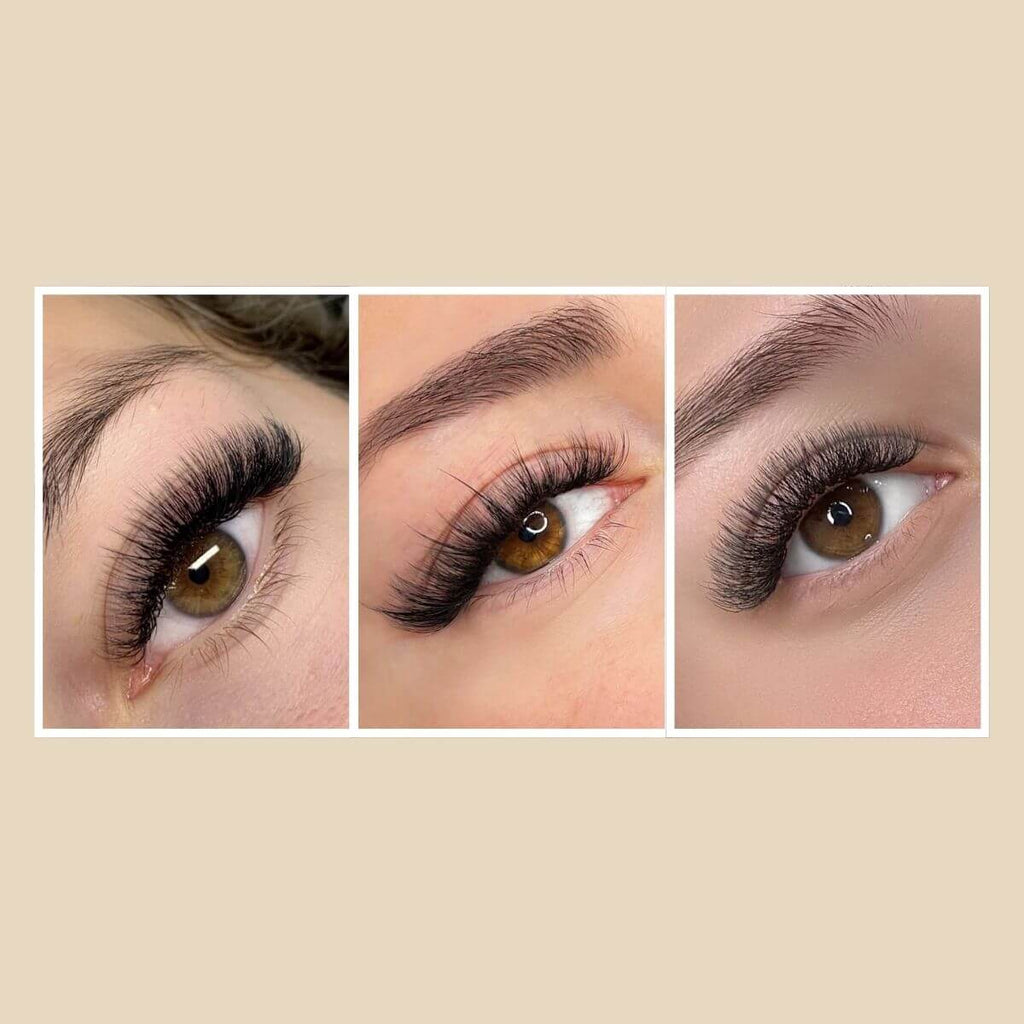
For a client with a deep espresso iris, an ultra-black, solid lash line can look like a heavy "block" of color. Experienced artists often opt for a softer, "dusty" black or a dark brown lash, such as 0.05MM Cashmere Premium Mega Volume Eyelash Extensions in a brown or off-black tone. This adds dimension and allows the natural highlights of the dark iris to remain visible.

Technical Assessment: Evaluating Under Natural Light
Accurate saturation assessment cannot happen under the artificial, often cool-toned LEDs of a lash lamp. These lights flatten the iris's natural depth and can lead to incorrect product selection.
- Natural Light Check: Before the client lies down, evaluate their eyes near a window. Look for the "limbal ring" (the dark circle around the iris) and the presence of any secondary colors (gold flecks in hazel eyes, or white bursts in blue eyes).
- Saturation Level Assignment: Use the 1-10 scale. A 1 is almost translucent; a 10 is so dark the pupil is barely distinguishable from the iris.
- Product Swatching: Hold a strip of lashes against the client’s cheek. Does the lash look "inky" (high vibrancy) or "soft" (low vibrancy)?
Methodology Note: This assessment protocol is a professional heuristic derived from pattern recognition in high-end artistry (not a controlled lab study). Results may vary based on the client's skin undertone and the specific lighting environment of the salon.
Ocular Health: The Foundation of Artistry
While aesthetics drive the "Iris Saturation Theory," professional credibility is built on safety. High-vibrancy lashes often require denser pigment loads or specific fiber coatings that can impact the weight of the extension.
According to the American Academy of Ophthalmology (AAO), risks associated with extensions include infection and allergic reactions to adhesives. As we push for higher vibrancy or more complex sets, we must ensure the ocular surface is protected.
Blepharitis and Hygiene
High-vibrancy sets, particularly mega-volume sets using 0.03MM Cashmere Premium Mega Volume Eyelash Extensions, create a dense lash line that can easily trap debris. The Mayo Clinic identifies poor eyelid hygiene as a primary cause of Blepharitis (eyelid inflammation). We must educate clients that "water is not enough." A dedicated lash shampoo is essential for maintaining the health of the meibomian glands, especially when wearing high-density sets designed for saturation balance.
Chemical Sensitivity and Irritation
The pursuit of the "perfect black" sometimes leads artists to use adhesives with high cyanoacrylate concentrations. A 2023-2024 Health Canada Report highlighted non-compliance rates regarding chemical safety in lash adhesives. Furthermore, a 2012 study by Amano et al. found that some adhesives release formaldehyde and have pH levels that can cause keratoconjunctivitis. At SenseLashes, we prioritize pH-balanced formulas to mitigate these risks, ensuring that the "vibrancy" of the lash doesn't come at the cost of the client's corneal health.

Advanced Mapping: Texture and the Ocular Microbiome
When matching vibrancy to eye depth, texture plays a critical role. A flat, uniform lash line rarely looks natural. We recommend using 0.07mm Cashmere Volume Wispy Eyelash Extensions to create "spikes" or "peaks." This breaks up the saturation and mimics the natural growth pattern of lashes.
However, long-term wear of heavy or textured extensions can alter the ocular surface microbiome. A 2024 study in PMC investigated how extensions impact tear stability. To counter this, we advocate for the use of lash primers and sealants that restore the lash's natural pH and seal the cuticle, protecting the delicate balance of the eye's surface.
The "Weight-to-Vibrancy" Ratio
A common pitfall is using heavy 0.15mm lashes to achieve high vibrancy. This often leads to mechanical damage. Recent research published in PubMed (2024) emphasizes the spectrum of disorders caused by mechanical trauma from heavy extensions. By utilizing ultra-light fibers like our 0.03mm or 0.05mm Cashmere range, you can achieve the desired vibrancy through density (volume) rather than individual lash weight, which is significantly safer for the natural lash cycle.
Implementation: The Salon Sanitation SOP
To truly embody E-E-A-T principles, your artistry must be backed by a rigorous Sanitation Standard Operating Procedure (SOP). Following CDC guidelines on preventing conjunctivitis, every set—regardless of how perfectly the saturation is matched—must be applied using sterile tools and disposable consumables.
Professional Checklist for New Clients:
- Initial Consultation: Evaluate iris saturation under natural light.
- Patch Test Protocol: Conduct a patch test 48 hours prior to the full set. As noted in PubMed (2024), contact dermatitis from acrylates can be delayed.
- Weight Assessment: Ensure the chosen diameter (e.g., 0.03mm vs 0.07mm) is appropriate for the client's natural lash health to prevent traction alopecia.
- Aftercare Education: Provide a clear guide on blepharitis prevention and the importance of daily cleansing.
Troubleshooting: When "Perfect" Doesn't Feel Right
If a client complains of a "heavy" or "unnatural" look despite a technically sound application, re-evaluate the saturation.
- If the eye looks "washed out": You likely chose a lash vibrancy that was too low (matching the iris rather than exceeding it). Increase the pigment density in the next fill.
- If the eye looks "harsh" or "smaller": The vibrancy was too high or the finish was too matte. Switch to a "dusty" black or incorporate dark brown fans to soften the look.
- If the client experiences burning: This may not be an allergy. According to WebMD, dry eye syndrome can be exacerbated by lash fumes. Ensure you are using a nano-mister to cure the adhesive instantly and protect the tear film, as suggested in PMC research.
The Future of Customized Artistry
The lash industry is moving away from "one-size-fits-all" beauty. As the market grows—a trend validated by Grand View Research—the most successful artists will be those who can explain the why behind their design choices.
Iris Saturation Theory is more than a styling tip; it is a commitment to technical excellence and client-specific customization. By harmonizing the vibrancy of our products with the natural depth of the human eye, we create sets that aren't just seen, but felt as a natural enhancement of the client's unique beauty.
For further reading on harmonizing lash sets with client features, explore our guides on Matching Lash Finishing to Client Skin Tones and Ages and Correcting Ocular Asymmetry with Mixed Curl Mapping.
Disclaimer: This article is for informational purposes only and does not constitute professional medical or legal advice. Eyelash extension application involves chemicals and proximity to the eye; always follow local regulations, maintain proper certification, and consult with a medical professional regarding ocular health concerns.
References
- CDC - Conjunctivitis Prevention and Hygiene
- Mayo Clinic - Blepharitis Symptoms and Causes
- American Academy of Ophthalmology - Eyelash Extension Safety
- Health Canada - Cosmetic Regulations Enforcement Report 2023-2024
- PubMed - Ocular Disorders and Eyelash Extensions (2024)
- PMC - Ocular Surface Microbiome and Extension Wear (2024)
- PubMed - Formaldehyde and pH in Lash Adhesives (Amano et al., 2012)
- Grand View Research - False Eyelashes Market Analysis