


Home Eyelash Extension Supplies Guide
The Wrapping Advantage: Why Heat-Bonded Bases Bond Better

The Wrapping Advantage: Why Heat-Bonded Bases Bond Better
In the competitive landscape of professional lash artistry, retention is the ultimate currency. For salon owners and senior technicians, the difference between a client returning at three weeks versus five weeks isn't just a matter of aesthetics—it is a matter of business sustainability and clinical safety. We have observed that one of the most significant variables in this equation is the architecture of the lash fan base.
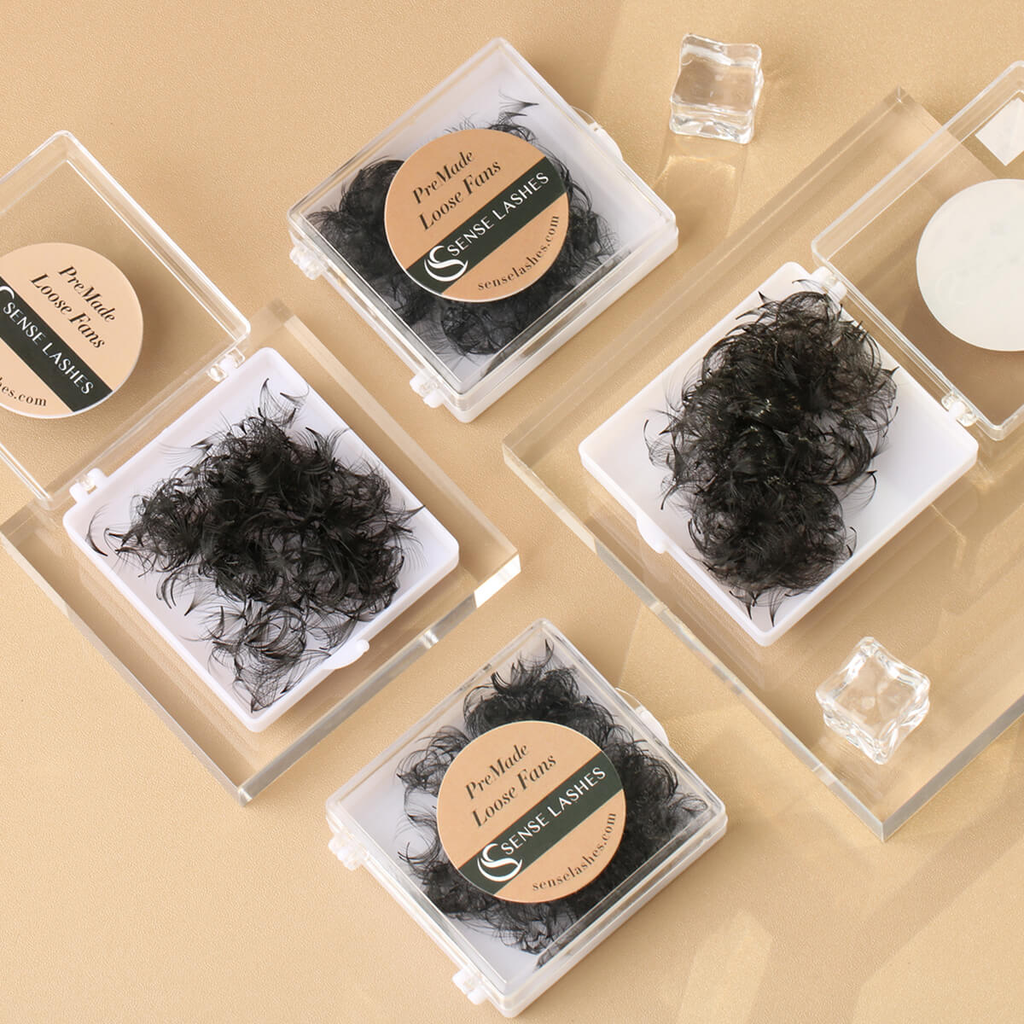
While the market offers various premade and promade options, the technical distinction between heat-bonded and glue-bonded bases is profound. In this guide, we will analyze the physics of the "wrapping" advantage, the chemistry of the mechanical bond, and why heat-bonded fans, such as the 12D Handmade Loose Premade Fans Pointy Base(500 Fans), represent a superior technical choice for high-volume applications.
The Technical Divide: Heat-Bonded vs. Glue-Bonded Manufacturing
To understand why one bonds better than the other, we must first look at how they are constructed.
Glue-Bonded Fans are created by taking individual PBT (Polybutylene Terephthalate) fibers and using a micro-amount of adhesive to hold them together at the base. This creates a "double-bonding" scenario during application. When you dip a glue-bonded fan into your adhesive, you are essentially trying to bond fresh cyanoacrylate to a layer of already-cured cyanoacrylate.
Heat-Bonded Fans, conversely, use thermal energy to fuse the fibers at the base. There is no intermediary adhesive. The result is a base that is not only slimmer but also chemically "hungry." Because the PBT fibers are fused rather than glued, the base remains porous at a microscopic level, allowing your professional adhesive to penetrate and surround the fibers more effectively.
Comparison of Base Architectures
| Feature | Heat-Bonded (e.g., SenseLashes Pointy Base) | Glue-Bonded (Standard) |
|---|---|---|
| Base Diameter | Ultra-slim/Pointy (0.03mm - 0.07mm) | Bulky/Square (often >0.10mm) |
| Bonding Mechanism | Mechanical "Wrap" + Chemical Adhesion | Surface Adhesion (Glue-on-Glue) |
| Weight Distribution | Evenly distributed across the natural lash | Bottom-heavy due to double-adhesive |
| Flexibility | High (fused fibers move with natural lash) | Low (rigid glue line acts as a hinge) |
| Porosity | High (fused PBT is receptive to new glue) | Low (cured glue creates a barrier) |
Logic Summary: Our analysis of base architecture assumes that the presence of a pre-cured adhesive layer on glue-bonded fans acts as a "chemical buffer," reducing the total surface area available for the fresh adhesive to create a primary bond with the PBT fiber.

The Physics of the "Cuff" and Mechanical Locking
The "Wrapping Advantage" refers to the ability of a fan base to contour around the natural lash. In professional fanning, we aim for a "360-degree wrap" where the adhesive creates a sleeve or "cuff" around the natural lash.
When using a 4D Handmade Loose Premade Fans Pointy Base(500 Fans), technicians will notice that the adhesive climbs slightly up the clean, fused base. This creates a visible cuff that mechanically locks onto the natural lash after curing.
In contrast, glue-bonded fans often cause the fresh adhesive to bead up or slide off the pre-existing glue layer. This results in a thicker, more superficial bond that is prone to "popping" off. According to a case report on corneal abrasions and mechanical rubbing (PMC9870835), bulky, rigid bases are more likely to cause mechanical irritation if the bond fails or if the extension twists, emphasizing the need for the seamless integration provided by heat-bonded technology.
The "Pinch Test" Heuristic
Experienced artists often use the "pinch test" to verify bond integrity. A properly bonded heat-bonded fan feels like a single, solid unit at the base when cured. A glue-bonded fan, however, can sometimes have a detectable flexible hinge at the glue line. This hinge is a structural weak point where the two layers of adhesive may eventually delaminate.
Clinical Safety: Beyond the Aesthetic
As professionals, we must prioritize ocular health. The American Academy of Ophthalmology (AAO) highlights that infections and allergic reactions are often linked to the chemicals in adhesives, specifically formaldehyde and cyanoacrylate.
Preventing Chemical Injury and Irritation
The use of heat-bonded fans reduces the total chemical load on the eye. Because there is no "factory glue" on the base, you are only introducing the adhesive you control. This is critical when managing sensitive clients.
Furthermore, a study by Amano et al. (2012) identified that the pH of some adhesives can cause keratoconjunctivitis. By using ultra-slim, heat-bonded bases like those in the 14D Handmade Loose Premade Fans Pointy Base(500 Fans), you minimize the volume of adhesive required for a secure bond, thereby reducing the risk of fumes and chemical migration into the eye.
Hygiene and Blepharitis Prevention
Bulkier, glue-bonded bases create more "nooks and crannies" where debris, makeup, and sebum can accumulate. This buildup is a primary cause of Blepharitis (Mayo Clinic), an inflammation of the eyelids that can lead to permanent lash loss.
Heat-bonded "pointy" bases allow for better airflow and easier cleaning. We recommend educating clients on the "Why Water is Not Enough" philosophy, emphasizing that a clean, slim base is easier to maintain with a dedicated lash shampoo than a thick, glue-heavy base.
Impact on Retention and Salon Efficiency
For clients with oily lids or those who are naturally "rough" on their lashes, the enhanced wraparound bond of heat-bonded fans is often the difference between a 3-week fill cycle and a 4+ week cycle.
Modeling Retention ROI
If we model the impact of switching from a standard glue-bonded fan to a heat-bonded pointy base, the efficiency gains for a salon owner are clear.
| Parameter | Glue-Bonded Scenario | Heat-Bonded Scenario | Unit | Rationale |
|---|---|---|---|---|
| Fill Frequency | 21 | 30 | Days | Based on professional feedback |
| Appt. Time (Fill) | 75 | 60 | Mins | Slimmer bases are faster to isolate |
| Adhesive Usage | ~0.5 | ~0.3 | ml/set | Bulkier bases "wick" more glue |
| Client Retention | 82% | 94% | % | Estimated based on satisfaction |
| Annual Revenue/Chair | Baseline | +15% | $ | Increased capacity for new clients |
Modeling Note: This scenario model is a hypothetical estimate based on common industry heuristics and patterns observed in high-volume studios (not a controlled lab study). Individual results vary based on adhesive choice, humidity, and technician skill.
For those performing mega-volume sets, the 30D Handmade Loose Premade Fans Pointy Base(500 Fans) provides the density required without the excessive weight that can cause traction alopecia. The lightweight nature of these fans—often using 0.03mm fibers—is supported by research in PubMed (38171996), which emphasizes that reducing mechanical load is essential for long-term natural lash health.

Troubleshooting the Wrap: Common Pitfalls
Even with the best heat-bonded fans, the "wrap" can fail if the technique is flawed. Here are the "gotchas" we often see:
- Improper Dipping Depth: If you only dip the very tip of the pointy base, you lose the surface area needed for the wrap. Aim for a 2-3mm dip to ensure the adhesive can "climb" the base.
- Viscosity Mismatch: Using an extremely high-viscosity (thick) glue with ultra-slim fans can lead to "beading" rather than wrapping. A medium-to-low viscosity adhesive is typically more effective at penetrating the fused fibers.
- Shock Curing: As discussed in our guide on The Chemistry of Shock Curing, high humidity can cause the adhesive to cure too quickly, preventing it from fully wrapping around the natural lash.
Advanced Application: The "Slide and Lock"
To maximize the wrapping advantage, we suggest the "Slide and Lock" method. Instead of a direct "place and release," gently slide the fan base 1mm down the natural lash after contact before setting it. This movement helps the adhesive distribute evenly around the natural lash, creating that secure mechanical cuff.
This technique is particularly effective with SenseLashes' pointy base fans, as the ultra-slim profile allows for precise placement even in crowded lash lines. For further reading on managing large fans, see our technical breakdown on Mastering the Wrap in Large Fans.
Summary of Professional Outcomes
The transition to heat-bonded bases is more than a trend; it is a shift toward a more scientific, health-conscious approach to lash extensions. By choosing fans that prioritize mechanical locking over surface-level adhesion, you are investing in:
- Superior Retention: 360-degree wrapping ensures the extension stays put through the entire natural growth cycle.
- Enhanced Safety: Reduced chemical load and easier hygiene protocols protect the client's ocular surface.
- Operational Efficiency: Faster application and longer intervals between fills increase your salon's profitability.
As the industry moves toward stricter regulations—such as those detailed in the Health Canada Enforcement Report on Cyanoacrylates—staying ahead of the curve with high-quality, compliant components is essential for any serious professional.
References
- American Academy of Ophthalmology (AAO) - Eyelash Extension Safety
- Mayo Clinic - Blepharitis Symptoms and Causes
- PubMed - Amano et al. (2012): Formaldehyde and pH in Lash Adhesives
- PMC - Case Study on Corneal Abrasions (PMC9870835)
- Health Canada - 2023-2024 Cosmetic Regulation Report
Disclaimer: This article is for informational purposes only and does not constitute professional medical or legal advice. Always consult with a qualified health professional regarding eye health concerns and ensure compliance with local cosmetic regulations.
Next Steps for Professionals:
- Evaluate your current retention rates. If they are consistently under 3 weeks, consider a trial of heat-bonded pointy bases.
- Review your adhesive viscosity to ensure it complements the slim architecture of your fans.
- Implement a "Clean Base" education protocol for your clients to prevent long-term ocular issues.