


Home Eyelash Extension Supplies Guide
The Contact Zone: Maximizing Base Surface Area for Retention

The Contact Zone: The Physics of Retention in Professional Lash Artistry
For the professional lash artist, the difference between a client returning in three weeks with a full set and a client calling after five days with significant fallout often boils down to a single, microscopic variable: the contact zone. While much of the industry focuses on the "look" of the fan—its fluffiness, symmetry, or curl—the technical durability of an extension set is dictated by the physical science of the bond where the extension base meets the natural lash.
Maximizing the base surface area is not merely a matter of using more adhesive. In fact, excessive adhesive can lead to chemical irritation or mechanical stress. Instead, achieving long-term retention requires a precise understanding of lash morphology, base geometry, and the fluid dynamics of the adhesive meniscus.
The Elliptical Reality: Understanding Natural Lash Morphology
A common oversight in professional training is treating the natural lash as a perfect cylinder. In reality, human natural lashes often exhibit an elliptical cross-section. A natural lash with a 0.15mm diameter is typically wider and flatter than it is tall. This anatomical nuance fundamentally changes how an extension base should be seated.
When an artist applies a pointy-based premade fan to a wide, elliptical natural lash, the result is often a "tangent bond"—where the fan only touches the highest point of the natural lash. This creates a weak hinge point prone to twisting. We estimate that this mismatch can result in as little as 40-50% surface contact, leaving the extension vulnerable to mechanical friction from sleeping or cleansing.
To counteract this, the goal is to achieve a "wrap" or a "hug" where the extension base follows the contour of the natural lash. By matching the fan's base geometry to the natural lash's shape, an artist can increase the contact zone to 70-80%, dramatically improving the bond's resistance to lateral forces.
Logic Summary: This "Surface Area Heuristic" is based on mechanical leverage principles. A larger contact zone distributes the weight of the fan across a greater area of the natural lash cuticle, reducing the "peeling" force exerted when the extension is brushed or moved.
Premade Fan Base Geometry: Pointy vs. Flat Bases
The selection of the fan base is the most critical decision in the "Contact Zone" strategy. Modern manufacturing has evolved to provide specialized bases for different natural lash profiles.
Pointy Base Fans
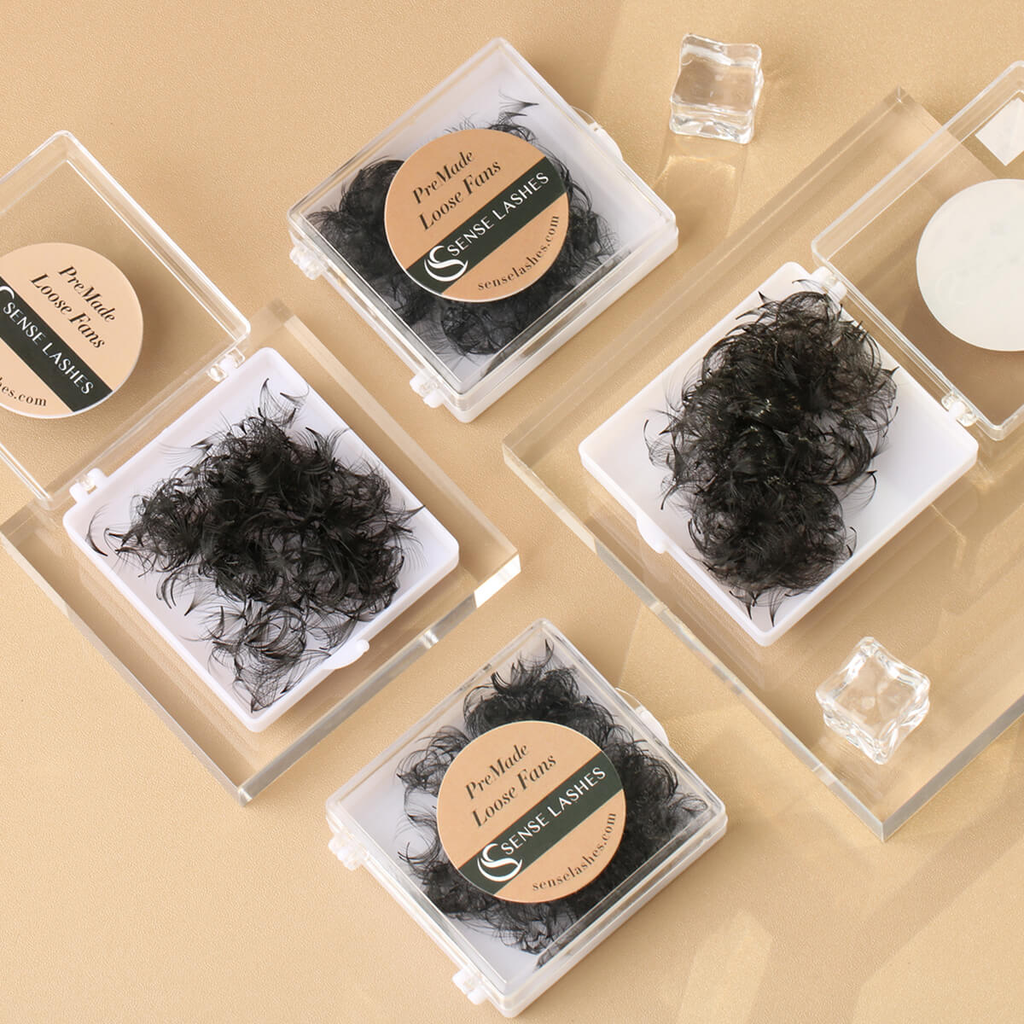
Pointy base fans, such as the 6D Handmade Loose Premade Fans Pointy Base(500 Fans), are heat-bonded to create an ultra-slim, needle-like attachment point. These are highly effective for:
- Fine Natural Lashes: Where a wide base would over-encumber the lash.
- Circular Cross-Sections: Where the base can sit deeply into the adhesive.
- Deep Attachment: Allowing the artist to "tuck" the base closer to the lash line without touching the skin.
Matching Bases to Growth Direction
The direction of the natural lash growth also dictates base selection. For lashes that grow downward, a pointy base provides a smaller "footprint," allowing the artist to redirect the fan upward more easily. Conversely, for healthy, thick natural lashes, a slightly wider base can achieve a more robust "wrap."

The Chemistry of the Bond: pH Balance and Adhesion
The "Contact Zone" is not just about physical touch; it is about the chemical environment. According to a landmark study by Amano et al. (2012), the pH of lash glues and the release of formaldehyde were historical concerns for ocular health. Modern professional-grade adhesives have moved toward pH-neutral formulas to minimize keratoconjunctivitis risks, but the artist must still manage the "meniscus"—the curve of the liquid adhesive at the junction of the extension and the lash.
The Meniscus Effect
A perfect bond should show a clean, uniform meniscus around the entire junction. If the adhesive beads into a ball, the contact zone is compromised. This is often caused by:
- Low Humidity: Causing the adhesive to "skin over" before it touches the lash.
- Dirty Lashes: Residual oils preventing the adhesive from wetting the surface.
In humid conditions (>65%), the natural lash can slightly swell. If the contact zone is marginal (only 40%), this swelling can actually "pop" the bond. Maximizing the surface area with high-quality PBT fibers, like those found in 10D Handmade Loose Premade Fans Pointy Base(500 Fans), ensures the bond is resilient enough to handle these micro-fluctuations in the lash structure.
Technical Specifications for Retention Modeling
To help salons standardize their application, we have modeled the relationship between fan weight and base contact.
| Fan Dimension | Base Type | Natural Lash Diameter | Target Contact Zone | Retention Estimate |
|---|---|---|---|---|
| 6D (0.07mm) | Pointy | 0.12mm - 0.15mm | 70% | 4-5 Weeks |
| 8D (0.05mm) | Pointy | 0.10mm - 0.12mm | 65% | 4 Weeks |
| 10D (0.03mm) | Pointy | 0.07mm - 0.10mm | 60% | 3-4 Weeks |
| 40D (0.03mm) | Pointy | 0.15mm+ (Healthy) | 75% | 3 Weeks |
Method & Assumptions: This model assumes a deterministic application environment (50% RH, 22°C) using medical-grade ethyl cyanoacrylate. Boundary conditions include: (1) Natural lashes must be in the catagen or early telogen phase; (2) Pre-treatment with a pH-balanced primer is required.
Eye Health and Retention: The "Blepharitis Prevention" Argument
Retention is often viewed as a purely aesthetic goal, but it is deeply linked to ocular hygiene. Poorly applied lashes with inadequate contact zones often lead to "poking" or "scratching," which causes the client to rub their eyes. This mechanical trauma is a leading cause of corneal abrasions, as noted in reports by PMC (Corneal Abrasion Case).
Furthermore, a "messy" bond with gaps in the contact zone provides a breeding ground for bacteria and Demodex mites. The Mayo Clinic identifies poor eyelid hygiene as a primary cause of Blepharitis (eyelid inflammation). As a professional, your role is to explain to clients that a seamless, high-surface-area bond isn't just for looks—it's for health.
When the base "hugs" the lash perfectly, there are no microscopic pockets for debris to hide. This makes daily cleansing with a professional lash shampoo significantly more effective. Using products like 8D Handmade Loose Premade Fans Pointy Base(500 Fans) ensures the base remains slim and easy to clean, preventing the bacterial buildup that leads to inflammation.
Troubleshooting: Why "Water is Not Enough"
Many clients believe that avoiding water will "save" their retention. However, research from the University of Waterloo suggests that the buildup of cosmetic residue and natural oils can actually degrade the adhesive bond over time.
If a client complains of burning or "dry eyes," it may not be a product allergy. The WebMD guide on Dry Eyes explains how eyelid inflammation can disrupt the tear film. If the contact zone is compromised, the extension may be mechanically irritating the meibomian glands, leading to "false" allergic symptoms.
Professional Troubleshooting Steps:
- Check the Base: Is it lifting? Even a 0.5mm lift at the base reduces the contact zone and creates a "hook" that catches on lint.
- Verify Humidity: Is your adhesive curing too fast? If so, the "Contact Zone" becomes a "Contact Point," which will fail.
- Audit the "Wrap": Ensure you are using the Master the Wrap technique to maximize the meniscus.

Salon Sanitation and Safety Standards
To maintain a high-performance salon, your sanitation protocol must be as precise as your application. The CDC (Centers for Disease Control) provides clear guidelines on preventing conjunctivitis. For lash artists, this means:
- Disposable Consumables: Always use fresh wands and patches for every client.
- Sterilization: High-level disinfection for tweezers that come into contact with the "Contact Zone."
- Adhesive Management: Following Health Canada's 2023-2024 compliance reports regarding cyanoacrylate labeling and chemical safety.
Using factory-direct products like 40D Handmade Loose Premade Fans Pointy Base(500 Fans) allows you to maintain consistency in your inventory, ensuring that every fan meets the same technical specifications for base width and PBT quality.
Summary of Next Steps for the Professional
To master the "Contact Zone" and elevate your client retention, implement these three technical shifts:
- Assess Lash Cross-Sections: Before choosing your fan, look at the natural lash head-on. If it appears wide/elliptical, prioritize a base that can "hug" the width. If it is fine/circular, use a pointy base for a deeper bond.
- Optimize the Meniscus: Ensure your adhesive is fresh and your humidity is controlled. The adhesive should "wick" slightly up the extension and natural lash, creating a smooth transition.
- Educate on Hygiene: Use the Mayo Clinic's Blepharitis research to explain why a clean contact zone is a healthy contact zone.
By focusing on the physical science of attachment, you move beyond the "art" of lashes and into the "engineering" of beauty. This technical authority not only improves your work but builds the deep trust required to sustain a premier lash business.
Disclaimer: This article is for informational purposes only and does not constitute professional medical, legal, or financial advice. Eyelash extension application involves chemicals and proximity to the eye; always follow local licensing regulations and consult with a medical professional regarding ocular health issues.
References
- Centers for Disease Control (CDC) - Conjunctivitis Prevention
- Mayo Clinic - Blepharitis Symptoms and Causes
- American Academy of Ophthalmology (AAO) - Eyelash Extension Safety
- Health Canada - Cyanoacrylate Compliance Report 2023-2024
- PubMed - Amano et al. (2012) Study on Glue Toxicity
- PMC - Corneal Abrasion Case Report