


Seamless Transitions: Blending C and D Curls Effectively
Mastering Seamless Transitions: The Technical Logic of Blending C and D Curls
Achieving a flawless, gradient lash line is the hallmark of an advanced lash artist. One of the most common challenges in technical mapping is the transition between different curl profiles—specifically the shift from a C curl to a D curl. When executed poorly, this transition results in a visible "step" or "shelf" in the lash set, where the lift angle changes too abruptly for the eye to perceive it as a single, cohesive unit.
In professional artistry, the difference between a C and D curl is not merely aesthetic; it is geometric. A standard C curl typically offers a soft, natural lift, while a D curl provides a more dramatic, vertical "flick." In practice, the lift angle difference between these two curls is approximately 15 to 20 degrees. Bridging this gap requires a sophisticated understanding of lash placement, adhesive behavior, and eye anatomy.
The Geometry of the "Step" Effect
The "step" occurs because the apex of a D curl sits significantly higher and further back than that of a C curl. If an artist simply switches from a row of C curls to a row of D curls at a specific mapping mark, the visual jump is jarring.
To solve this, we must view the transition not as a line, but as a "Transition Zone." This zone usually spans 3 to 4 natural lashes. Within this space, we apply a mathematical approach to blending, rather than a binary choice of one curl or the other.
Logic Summary: The 15-Degree Variance Our analysis of curl geometry assumes a standard PBT fiber manufacturing process. The 15-20 degree variance is a heuristic based on the curvature radius of industry-standard mandrels used for C and D curls. This model assumes the natural lash exit angle is constant across the transition zone.
Mapping Strategies: The 3:1 and 4:1 Transition Ratios
The most effective way to eliminate gaps is to use a staggered ratio. Instead of a hard stop, you introduce the stronger curl gradually.
For a standard Cat Eye or Squirrel map where you transition from C (inner/middle) to D (outer), follow this sequence over the transition zone:
- Zone 1 (Pure C): 100% C curl.
- Zone 2 (The Blend): Use a 3:1 ratio. For every three C curls applied, apply one D curl.
- Zone 3 (The Equalizer): Use a 1:1 ratio. Alternate C and D curls across the natural lashes.
- Zone 4 (The Lead): Use a 1:3 ratio. For every one C curl, apply three D curls.
- Zone 5 (Pure D): 100% D curl.
When using high-performance fibers like 0.07MM Premium Volume Eyelash Extensions, this staggered approach ensures that the "fanning" of the volume lashes fills the geometric voids created by the differing lift angles.
Heuristic for Visual Density
Seasoned artists note that D curls, due to their tighter curvature, can appear visually more compact than C curls of the same length. To compensate, always fan your volume lashes slightly wider when using D curls in a blend. This prevents a dense, isolated "black spot" from appearing where the D curls begin.
Adhesive Behavior and Curl Retention
The physical shape of the lash base affects how adhesive interacts with the natural lash. Because a D curl has a more aggressive curve, the "base" or the straight portion of the extension is often shorter than that of a C curl.
- Wicking Speed: C curls, with their more open base, tend to wick adhesive faster along the natural lash.
- Bonding Requirements: D curls often require a slightly thicker adhesive bead or a 1-2 second longer drying time to ensure the tighter base fully encapsulates the natural lash.
For advanced artists working in environments with 50-70% humidity, using an extremely fast-acting adhesive like 0.5-1 Second Diamond Eyelash Extension Glue is critical. Its thin viscosity allows for a clean bond even on the shorter bases of D curls, preventing "stickies" during the complex transition phase. For those still mastering their speed, the 1-2 Second Gold Eyelash Extension Glue provides a more forgiving window to ensure the alignment is perfect before the bond sets.

Ocular Health: Why Transitions Matter Beyond Aesthetics
A seamless transition isn't just about beauty; it's about mechanical safety. Abrupt changes in curl and length can create uneven weight distribution on the natural lashes. According to a 2024 study published in PubMed regarding ocular disorders, mechanical damage to the lash follicle is a primary risk factor in long-term extension wear. By blending curls effectively, you distribute the "leverage" of the extension more naturally, reducing the risk of traction alopecia.
Furthermore, the "step" effect can trap debris. A jagged lash line makes it harder for the client to effectively cleanse the eyelid margin. Poor hygiene in these gaps can lead to Blepharitis, an inflammatory condition of the eyelids. The Mayo Clinic identifies bacteria buildup as a leading cause of this inflammation. As a professional, educating your clients on why water is not enough and recommending a dedicated lash shampoo is essential for preventing these complications.
Troubleshooting: Monolids and Deep-Set Eyes
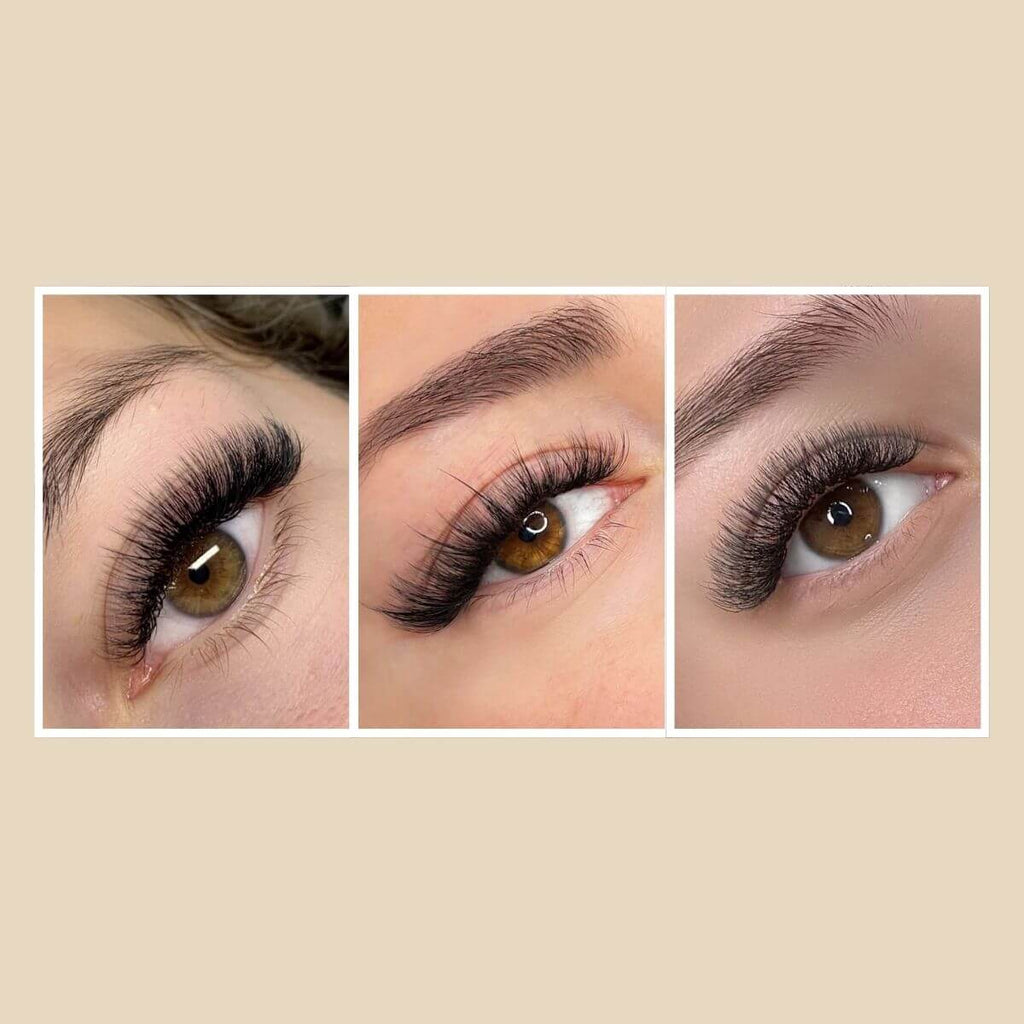
The C-to-D transition is particularly vital for clients with monolids or deep-set eyes. In these cases, a full set of D curls can often look "startled" or hit the brow bone. A strategic blend—starting with C in the inner corners and transitioning to D only in the outer third—mimics the eye's natural shadow gradient.
For these delicate sets, 0.07MM Cashmere Premium Mega Volume Eyelash Extensions are highly recommended. Their matte finish and extreme softness allow the transition to look like natural hair rather than synthetic plastic.
| Parameter | C Curl Characteristic | D Curl Characteristic | Impact on Blend |
|---|---|---|---|
| Lift Angle | ~30-45° | ~60-75° | Requires 15-20° transition management |
| Base Length | Longer | Shorter | D curls require more precise adhesive placement |
| Visual Density | Airy / Open | Compact / Dense | D curls need wider fanning for balance |
| Ideal Eye Type | Hooded, Deep-set | Downward-pointing, Monolid | Blend them to customize for hybrid eye shapes |
Salon Sanitation and Professional Standards
Maintaining a high standard of sanitation is non-negotiable for the modern professional. The CDC (Centers for Disease Control) provides clear guidelines on preventing the spread of conjunctivitis, which can easily occur in a salon environment if disposable consumables are not used correctly.
We recommend developing a "Salon Sanitation SOP" that includes:
- Use of sterilized PBT fibers.
- Fresh adhesive drops every 20 minutes.
- Strict use of disposable wands and patches.
This commitment to safety bridges the "compliance signaling gap." When clients see you prioritizing their eye health over just the aesthetic outcome, you build long-term trust. This is especially important given the American Academy of Ophthalmology's (AAO) advisory on the risks of infections and allergic reactions to formaldehyde.
While modern, high-quality adhesives like those from SenseLashes are formulated to be pH-balanced and low-fume, older or substandard glues often released significant amounts of formaldehyde. A landmark study by Amano et al. (2012) highlighted these risks. Ensuring you use 2025-compliant formulas protects both your client and your professional liability.
Business Mastery: Import Compliance and Client Safety
For salon owners and distributors, technical mastery must be paired with business acumen. Global regulatory bodies are increasingly scrutinizing lash products. For instance, Health Canada's 2023-2024 Enforcement Report specifically targeted cyanoacrylate-based adhesives for labeling and chemical safety non-compliance.
By sourcing from a "Pro-Grade Partner" that prioritizes import compliance, you safeguard your inventory against customs seizures and ensure that the pigments in your colored lashes are FDA-compliant, rather than using industrial-grade dyes that can cause severe dermatitis.

Managing Allergic Reactions and Irritation
Even with the best technique and products, sensitivities can occur. It is vital to distinguish between irritation (caused by fumes) and a true allergic response. A study on Allergic Contact Dermatitis caused by ethyl cyanoacrylate notes that reactions are often delayed.
Implement a "Patch Test Protocol" for all new clients. Explain that while a negative patch test is a good sign, it does not 100% guarantee that a reaction won't develop over time as the immune system is exposed to acrylates. This transparency, backed by recent 2024 research on dermatitis patterns, manages client expectations and protects your salon's reputation.
Protecting the Ocular Microbiome
Recent investigations into Ocular Surface Disease (2024) suggest that long-term extension wear can alter the eye's microbiome and tear film stability. To mitigate this, professionals should use primers and sealants that restore the lash pH balance immediately after application.
By sealing the cuticle and neutralizing the adhesive's pH, you protect the delicate balance of the eye's surface. This technical step is what separates a "lash technician" from a "lash specialist." Understanding the science of synthetic fiber curl memory also helps in selecting the right fibers that won't lose their shape and irritate the eye by drooping.
Summary of Best Practices for C to D Blending
To achieve a seamless, professional result, keep these key takeaways in your workflow:
- Respect the 15° Gap: Acknowledge that C and D curls are geometrically different and require a transition zone.
- Use the 3:1 Staggered Ratio: Gradually increase the proportion of D curls over 4 natural lashes.
- Widen Your Fans: Compensate for the visual compactness of D curls by fanning them slightly wider.
- Adjust Adhesive Application: Be mindful that the tighter curve of a D curl may require a more precise adhesive bead to ensure a long-lasting bond.
- Prioritize Hygiene: Use the technical necessity of smooth transitions to educate clients on Blepharitis prevention and daily cleansing.
- Stay Compliant: Only use products that meet international safety standards (FDA, Health Canada) to protect your business and your clients.
Mastering multi-curl transitions is a journey of precision. By combining the right mapping logic with high-performance products like the 0.07MM Premium Volume Eyelash Extensions, you can offer your clients sophisticated, natural-looking results that stand up to both aesthetic and medical scrutiny.
Disclaimer: This article is for informational purposes only and does not constitute professional medical, legal, or financial advice. Eyelash extension application involves chemicals and proximity to the eye; always follow local regulations and consult with health professionals regarding specific eye conditions or allergic reactions.
References
- Centers for Disease Control (CDC) - Conjunctivitis Prevention
- Mayo Clinic - Blepharitis Symptoms and Causes
- American Academy of Ophthalmology (AAO) - Eyelash Extension Safety
- Health Canada - Cosmetic Regulations Enforcement Report
- Amano et al. (2012) - Formaldehyde and pH in Eyelash Glues
- PubMed - Spectrum of Ocular Disorders from Eyelash Extensions (2024)
- PMC - Ocular Surface Microbiome and Extension Wear (2024)