


Premade Fans vs. Handmade Fans: Which Is Better for Your Lash Business?

Premade fans and handmade fans differ in speed, customization, retention, and business value. This article explains how each method works, how application time affects revenue, and why fan weight and base shape matter for natural lash safety.
Premade fans typically increase your hourly rate and daily client capacity compared to handmade fans. They cut application time by roughly half, while modern pointy-base designs deliver retention that satisfies most clients. The core trade-off is speed versus full customization. Your decision should factor in client volume, pricing structure, retention goals, and the natural lash conditions you work with most often.
How Do Premade Fans and Handmade Fans Differ in Practice?
Both fan types serve volume and mega volume services, but they follow different workflows and produce different levels of control.
What Are Handmade Fans and Premade Fans?
Here is how each method is defined and where promade fans fit in.
| Handmade Fans | Premade Fans* | |
|---|---|---|
| How they’re made | Built by the lash artist during the appointment using individual extensions | Factory or worker-made in advance; includes both tray premade and handmade promade styles |
| Fanning step at appointment | Yes | No |
| Base construction | No pre-bonded base | Heat-bonded or glue-bonded pointy base |
| Customization | Full control over dimension and weight per natural lash | Pre-set per tray; variety achieved by mixing trays |
| Technique used to apply | Wiggle, pinch, or rolling method to form fan; then place | Pick up, dip base in adhesive, attach to isolated lash |
*Within the premade category, promade fans are handmade by workers rather than machine-produced. Both types skip the fanning step at your appointment.
Handmade fans give you real-time control over every fan. Premade and promade fans eliminate the fanning step entirely and differ mainly in how the fans were originally assembled.
What About Easy Fanning Lashes?
Easy fanning lashes (also called self-fanning or blooming lashes) sit between handmade and premade fans. They have a lightly adhesive base that lets individual lashes spread into a fan shape when you pick them up. You still control the fan width and dimension, but the fanning motion is faster than building a traditional handmade fan from scratch.
Easy fanning lashes are a strong option if you want more customization than premade fans offer but less fanning time than fully handmade technique requires.
Key Differences at a Glance
| Factor | Handmade Fans | Premade Fans |
|---|---|---|
| Application time per full set | Typically 2.5 to 3.5 hours | Typically 1.5 to 2 hours |
| Customization per natural lash | Full control over dimension and weight | Limited per individual fan; variety achieved by mixing multiple trays |
| Wrapping technique | Possible (extensions wrap around the natural lash) | Not possible (base is pre-bonded) |
| Skill requirement | Advanced fanning technique needed | Isolation and placement skills sufficient |
| Material cost per set | Lower (individual lash trays) | Higher (pre-manufactured fans) |
| Physical strain over a full day | Higher (repetitive fanning motion) | Lower (no fanning step) |
Handmade fans offer the highest degree of creative control. Premade fans offer the fastest path to a finished volume set. Most experienced lash artists keep both options available and choose based on the client and the appointment.
How Does Application Time Affect Your Revenue With Premade Fans vs. Handmade Fans?
Time per set directly controls how many clients you can serve in a workday. Switching to premade fans can free up enough time to fit one additional appointment into your daily schedule.
The Time and Revenue Calculation
A handmade volume set typically takes 2.5 to 3.5 hours. A premade volume set typically takes 1.5 to 2 hours. In an 8-hour workday, that difference can mean completing 4 sets instead of 2 or 3.
If your volume set is priced at $150 to $200, one additional daily client adds $600 to $800 per week in potential revenue, depending on your local market. Material costs for premade fans run higher per set (roughly $15 to $25 more than individual lash trays, varying by supplier and fan dimension), but the net gain from serving more clients typically outweighs the added supply cost.

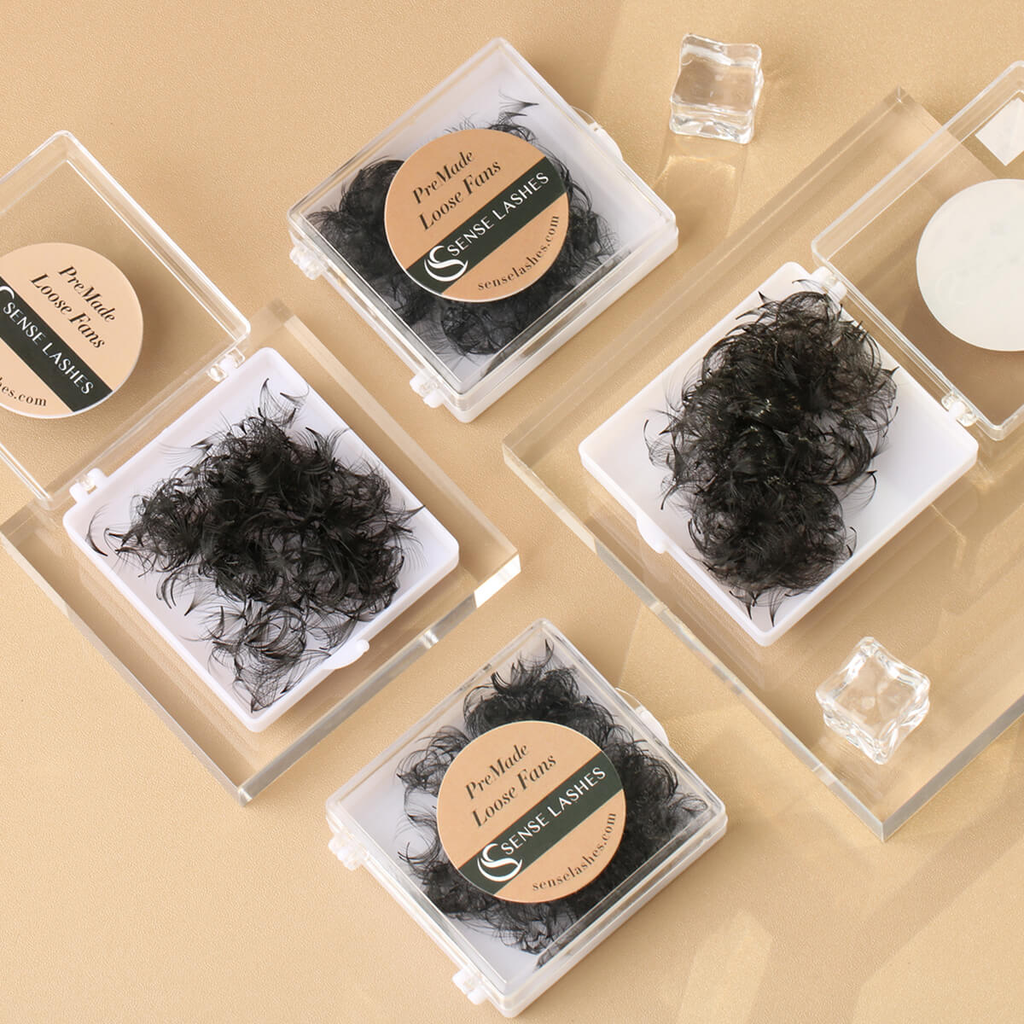
0.07 5D Pre-Made Volume Fans Lashes (base tape)
Curl: C
Length: 8MM
Beyond Revenue: Fatigue and Consistency
Fewer fanning repetitions per day reduce strain on your hands and wrists. Lash artists who report chronic hand fatigue from high-volume handmade sets often find that premade fans let them maintain consistent quality across the final appointments of a long day.
The revenue calculation is not universal. If you charge a premium for fully custom handmade sets and your schedule is already full, switching to premade fans may not increase your income. Evaluate your own pricing, client volume, and retention rates before changing your workflow.
Are Premade Fans Bad for Natural Lashes?
No. Premade fans are not inherently bad for natural lashes. Natural lash safety depends on total fan weight, not on whether the fan was made by hand or by machine.
How Fan Weight Determines Lash Safety
Every natural lash can safely support a limited amount of extension weight. A widely used general guideline in professional lash training sets the limit at roughly 50% of the natural lash’s own weight. Exceeding this threshold increases the risk of traction stress, premature shedding, and long-term follicle damage.
Fan weight is determined by two variables: the diameter of the individual lashes and the number of lashes in the fan (the dimension).
Industry estimates suggest a 10D fan made from 0.03 mm lashes weighs approximately the same as a single 0.10 mm classic extension. If you match the fan weight to the natural lash strength, premade fans are as safe as handmade fans.
Heat-Bonded vs. Glue-Bonded Premade Fans
Not all premade fans carry the same weight.
- Glue-bonded fans use adhesive to hold the individual lashes together at the base. This adhesive adds extra bulk and weight that is not always visible but can increase the total load on the natural lash.
- Heat-bonded fans fuse the lash fibers together without additional adhesive. The result is a cleaner, lighter base. For high-dimension sets (10D and above), heat-bonded construction is strongly recommended to keep total weight within safe limits.
Check the base construction before purchasing premade fans. A narrow, pointed, heat-bonded base is the current industry standard for safe volume application.
Why Does Fan Base Shape Matter for Lash Retention?
Retention is the metric clients care about most. Base geometry plays a larger role in retention than many lash artists realize, and it is where premade fans have improved the most in recent years.
The Problem With Flat-Base Premade Fans
Older premade fan designs had wide, flat bases. When applied to a natural lash, this created a “double base” effect: the bonded fan base sat on top of the natural lash with minimal surface contact. The adhesive could not grip effectively, and the fans were prone to twisting, lifting, or falling off within the first two weeks.
This history is the origin of the widespread belief that premade fans have poor retention. It was accurate for earlier designs and is less true for current pointy-base models.
How Pointy-Base Fans Improved Retention
Modern pointy-base premade fans taper to a narrow tip at the base. This creates more surface area for adhesive contact and allows the fan to sit closer to the natural lash. When you dip the base 2 to 3 mm into adhesive, the adhesive forms a thin sleeve around the connection point.
Pointy-base premade fans deliver retention that satisfies most clients on a typical fill cycle. The gap between premade and handmade retention has narrowed considerably with modern base designs, though handmade wrapping still holds an advantage for clients who go longer between fills.
The Wrapping Advantage of Handmade Fans
Handmade fans allow the wrapping technique, where the extensions are positioned around the natural lash rather than sitting flat on top. This mechanical wrap means the adhesive bonds to the natural lash from multiple sides, not just from the top.
Wrapping typically produces a stronger bond and longer retention than flat placement. If you have clients who need 4 to 6 weeks between fills, or clients with oily skin where adhesive breaks down faster, handmade wrapped fans remain the stronger choice.
When Should You Use Premade Fans or Handmade Fans?
The best approach for most lash businesses is not choosing one method permanently. It is matching the method to the situation.
Situations Where Premade Fans Work Best
Premade fans are the right choice when speed matters without sacrificing a professional result.
- Express volume services priced for shorter appointment slots deliver strong revenue per hour and attract time-conscious clients.
- Clients who prefer a consistent, uniform fan look benefit from the symmetry of factory-made fans.
- Late-arriving clients or appointments with limited remaining time can still receive a full set with premade fans.
- Lash artists who have mastered isolation and placement but are still developing fanning speed can deliver volume sets confidently with premade fans.
Situations Where Handmade Fans Work Best
Handmade fans remain the better option when customization and maximum retention are priorities:
- Clients with fragile, fine, or sparse natural lashes need lighter fans on weaker lashes and fuller fans on stronger lashes within the same set.
- Wispy, textured, or mixed-length styles require varied fan dimensions that premade trays cannot easily replicate.
- Clients on longer fill cycles (4 weeks or more) benefit from the stronger mechanical bond of the wrapping technique.
- High-end pricing models where clients pay a premium for a fully bespoke set justify the additional time investment.
A Hybrid Approach
Many experienced lash artists use premade fans as the base layer across the lash line, then add handmade fans in specific areas for texture, density variation, or accent spikes. This hybrid method reduces total application time while preserving the custom feel clients value.
What Should Beginners Know About Premade Fans vs. Handmade Fans?
Both fan types have a place in your development. The sequence in which you build each skill affects how quickly you can offer volume services to paying clients.
Start With Premade Fans for Speed and Confidence
Premade fans let you focus on the two foundational skills of volume lashing: isolation and placement. You do not need to split your attention between creating the fan and applying it. This focused practice builds muscle memory faster.
Once your isolation is clean and your placement is consistent, you can begin offering volume services sooner. Premade fans lower the barrier to adding volume sets to your service menu.
Learn Handmade Fans to Expand Your Skill Set
Handmade fanning requires in-person training and sustained practice. Most lash educators recommend completing a hands-on volume course before attempting handmade fans on clients. Practice on training strips or mannequin heads until you can create symmetrical fans at a steady pace. Speed comes with repetition. Expect your handmade sets to take longer than premade sets for several months while your fanning technique develops.
Keep Both in Your Toolkit
The most versatile lash artists are comfortable with both methods. Premade fans support your business efficiency. Handmade fans support your artistry and problem-solving ability when a client presents with challenging natural lashes. Training in both gives you the flexibility to adapt to any appointment.
Choose the Right Fan Method to Grow Your Lash Business
Premade fans reduce application time, lower physical strain, and support higher daily revenue for most volume practices. Handmade fans provide maximum customization, stronger retention through the wrapping technique, and full creative control for complex sets. Evaluate your client volume, pricing model, and the lash conditions you see across your client base. Test premade fans on your next ten clients and track retention, service time, and client satisfaction before adjusting your full inventory. Using both methods where each fits best gives your business the most flexibility.
FAQs About Premade Fans vs. Handmade Fans
Q1: How Do Premade Fans Affect My Lash Extension Application Time?
Premade fans cut volume set time from roughly 2.5 to 3.5 hours to around 1.5 hours. You can complete two additional clients in an 8-hour day. This raises your effective hourly rate even after higher material costs are subtracted.
Q2: What Is the Cost-Benefit Analysis for Lash Artists Using Premade Fans?
Higher tray cost is offset by the extra services you perform daily. Many artists report net gains within the first few weeks, depending on their pricing and client volume. Calculate your own menu price, material spend, and average retention rate to verify the benefit for your studio.
Q3: Why Do My Premade Fans Keep Popping Off After One Week?
Poor retention with premade fans usually traces back to three factors. First, check your room humidity and temperature, as adhesive cures differently outside optimal ranges. Second, confirm your adhesive is fresh and stored correctly. Third, evaluate your fan base type: flat-base fans have less contact surface and lose grip faster than pointy-base, heat-bonded alternatives.
Q4: How Do I Calculate Safe Fan Weight for a Client With Thin Natural Lashes?
Match the total fan weight to roughly 50% or less of the natural lash’s weight. For fine natural lashes, use thinner diameters (0.03 mm or 0.05 mm) and lower dimensions (3D to 5D). Based on standard industry weight conversion approximations, a 5D fan in 0.05 mm weighs roughly the same as a single 0.10 mm classic extension. Always assess each natural lash individually before applying.
Q5: When Should a Beginner Lash Artist Switch From Handmade to Premade Fans?
Switch after you master isolation and placement on classic sets. Premade fans let you focus on even mapping and adhesive control without splitting attention between fanning and placement. Continue practicing handmade fans on training strips to keep advanced customization skills sharp.
Leave a comment