


Protruding Eyes: Selecting Curls to Recede the Profile
The Technical Challenge of Protruding Eyes
In the professional lash industry, "one-size-fits-all" mapping is the quickest route to a dissatisfied client. Among the various ocular structures we encounter, protruding eyes—often characterized by a prominent eyeball that sits forward in the orbital socket—present a unique aesthetic and mechanical challenge. While many clients initially request high-lift curls like D or DD to "open" the eyes, applying these to a protruding profile often results in an exaggerated, startled appearance that emphasizes the very feature the client may wish to soften.
The objective for this eye shape is visual recession. By strategically selecting flatter curls and managing lash density, we can create a silhouette that appears to sit further back into the orbital plane. This requires a deep understanding of lash dynamics, fiber weight, and the chemical interactions between adhesives and the ocular surface.
Anatomy and Lash Dynamics: Why the "Bulge" Matters
Protruding eyes, sometimes referred to as "prominent" or "proptotic," often feature a natural lash line that grows at a downward angle. This occurs because the forward projection of the eyeball pushes the eyelid tissue outward, altering the exit point of the natural lash follicle.
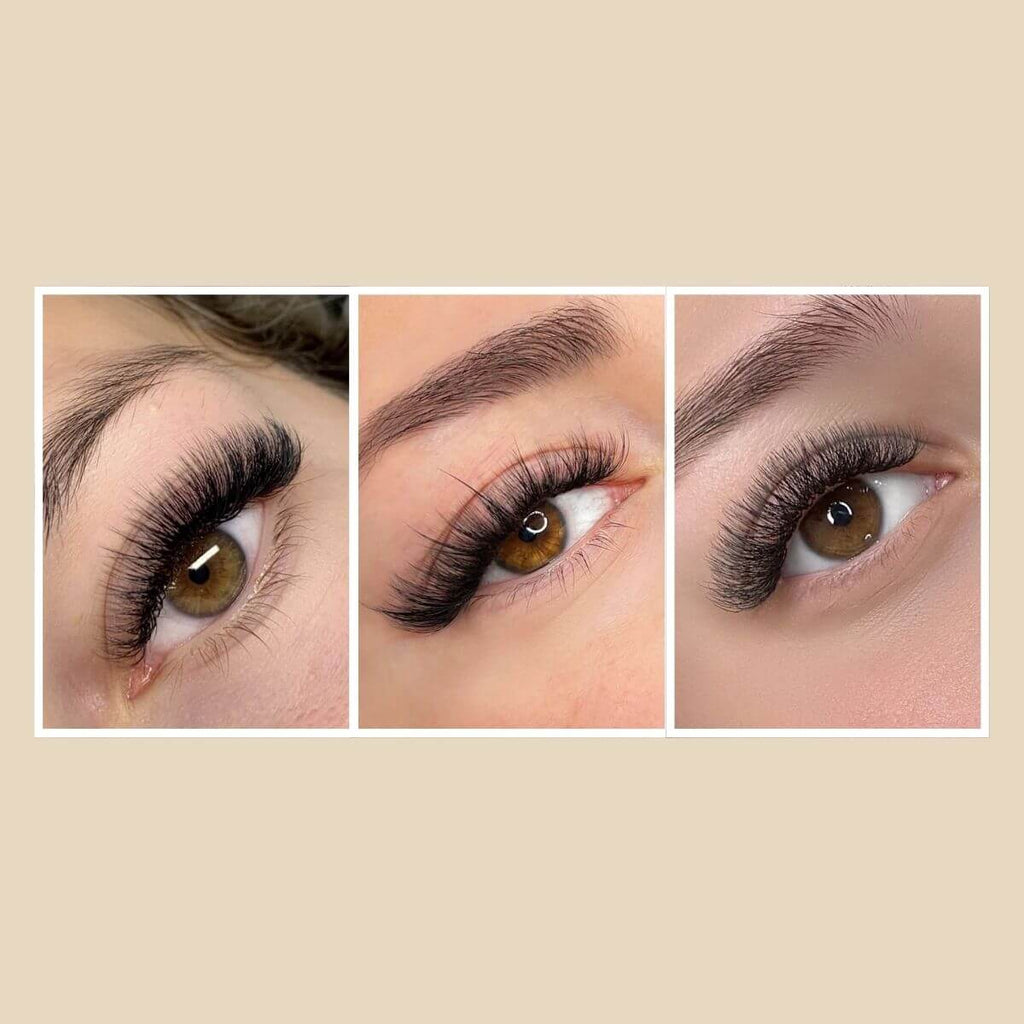
When we apply extensions to these downward-pointing natural lashes, the attachment angle becomes critical. A high curl (like a D-curl) attached to a downward lash creates a "shelf" effect, where the extension juts out before curling up, often making the eye look even more prominent. Conversely, low-lift curls like B and J align more naturally with this downward growth, allowing the extension to extend the lash line outward rather than upward, which provides a receding visual effect.
Logic Summary: Our approach to protruding eyes is based on the "Recession Heuristic." By minimizing vertical lift and maximizing horizontal extension, we shift the focal point from the apex of the eyeball back toward the lash line. This is a common pattern observed in advanced styling and corrective mapping (not a controlled lab study).
The Role of PBT Fiber Memory
The success of these sets relies heavily on the quality of the synthetic fiber. Most professional extensions are made from Polybutylene Terephthalate (PBT). Understanding PBT curl memory is essential because flatter curls like B and J must maintain their specific arc without "relaxing" over time. If a B-curl loses its shape, it can droop further, potentially obstructing the client's vision or causing mechanical irritation.
Selecting the Right Curls: The B and J Strategy
For protruding eyes, the B-curl is the professional's primary tool. It provides just enough lift to be visible but remains flat enough to recede the profile. In our experience with diverse client bases, we have found that a specific ratio of curls often yields the most balanced results.
The 60/40 Mixed Set Heuristic
A common approach for a sophisticated, receding look is a mixed set:
- 60% B-Curl: Used across the majority of the eye to provide a consistent, subtle lift.
- 40% J-Curl: Strategically placed on the most prominent areas of the eyeball (usually the center or slightly toward the inner-middle) to flatten the profile where the protrusion is most evident.

For technicians looking for a reliable base, the 0.12MM Premium Classic Eyelash Extensions in B-curl provide an ideal balance. The 0.12mm diameter is thin enough to avoid straining the natural lash follicle—which is often under more tension in protruding eyes—while still providing enough "darkness" to define the lash line.
Why Diameter and Weight Matter
Clients with protruding eyes often experience increased mechanical friction from blinking and environmental exposure. Using heavy lashes (0.18mm or 0.20mm round lashes) can lead to premature shedding or "drooping" of the set. If a bolder look is required, we recommend the 0.20MM Ellipse Flat Classic Eyelash Extensions. Because flat lashes have a flattened base, they provide the visual impact of a 0.20mm lash with the weight of a 0.10mm lash, significantly reducing the strain on the natural lash.
Mapping for Visual Recession: Avoiding the Outer Corner Trap
A frequent mistake in styling protruding eyes is applying dense, long lashes to the outer corners. While a "Cat Eye" is popular, on a prominent eye, long outer lashes can act as a pointer, emphasizing the forward projection.
The Reverse Taper Technique
Instead of increasing length toward the outer corner, consider a short tapering profile. By keeping the outer corner lashes slightly shorter and using J-curls, you "anchor" the eye, preventing it from looking "heavy" or "bulging."
Recommended Mapping Sequence:
- Inner Corners: 7mm-8mm B-curl.
- Middle (Apex): 9mm-10mm J-curl (to flatten the most prominent part).
- Outer-Middle: 10mm-11mm B-curl.
- Outer Corners: 9mm-8mm J-curl.
This mapping creates a "Soft Wing" that draws the eye horizontally rather than highlighting the vertical protrusion.
Adhesive Chemistry and Ocular Safety
Protruding eyes often have a larger surface area of the conjunctiva exposed, which can lead to increased sensitivity. According to WebMD, dry eye syndrome can be exacerbated by environmental factors, and in the lash studio, this includes adhesive fumes.
Formaldehyde and pH Balance
Research by Amano et al. (2012) identified that many lash adhesives release trace amounts of formaldehyde during the curing process and can have pH levels that cause keratoconjunctivitis. For clients with protruding eyes, the "gap rule" is non-negotiable. Ensuring a 0.5mm to 1.0mm gap between the extension and the eyelid prevents the adhesive from coming into contact with the skin or the sensitive ocular surface.
Managing Fumes and Irritation
Because these clients may not be able to close their eyes as "tightly" as those with deep-set eyes, they are at a higher risk for chemical burns or irritation from cyanoacrylate fumes. We suggest:
- Using a low-fume, high-purity adhesive.
- Employing a nano-mister to flash-cure the adhesive, reducing the "off-gassing" period.
- Ensuring proper salon ventilation as per AAO safety guidelines.
| Parameter | Value/Range | Unit | Rationale |
|---|---|---|---|
| Attachment Gap | 0.5 - 1.0 | mm | Prevent contact dermatitis/irritation |
| Adhesive Cure Time | 1 - 2 | sec | Minimize fume exposure duration |
| Room Humidity | 45 - 55 | % | Optimal for cyanoacrylate polymerization |
| Lash Diameter | 0.07 - 0.12 | mm | Reduce follicle strain on downward lashes |
| Curl Choice | J, B | N/A | Visual recession vs. protrusion |
Modeling Note: This table represents a "Safe Application Model" for sensitive ocular structures. It assumes a standard professional environment and compliant products. Boundaries include clients with active eye infections or severe pre-existing dry eye.
Retention Challenges and Aftercare
Technicians often report that retention on protruding eyes is roughly 10-15% shorter than average. We attribute this to two primary factors:
- Environmental Exposure: The forward position of the lashes makes them more susceptible to wind, dust, and physical contact.
- Friction: The eyelid travels a greater distance over the eyeball during a blink, increasing mechanical friction on the lash base.
The Importance of Hygiene
To combat these issues, a rigorous aftercare routine is essential. Poor hygiene leads to bacteria buildup, which can cause Blepharitis. For protruding eyes, where the eyelid margins are more exposed, the risk of inflammation is higher.
Educating clients on "Why Water is Not Enough" is a key professional responsibility. We recommend a dedicated lash foam cleanser used daily. This not only prevents infection but also removes oils that can break down the adhesive bond, helping to mitigate the "retention gap" seen with this eye shape.

For volume sets that require a delicate touch, the 0.07MM Premium Volume Eyelash Extensions allow for the creation of lightweight fans that won't weigh down the downward-growing natural lashes. If you are new to these techniques, 0.10MM Premium Classic Eyelash Extensions are an excellent entry point for practicing the B-curl recession technique.
Professional Sanitation and Compliance
As a professional, your choice of supplies reflects your commitment to client safety. The CDC guidelines on conjunctivitis prevention emphasize the need for sterile environments. For lash artists, this means using disposable consumables—such as eye patches and wands—for every client.
Furthermore, ensure your adhesives are compliant with local regulations. For instance, Health Canada's 2023-2024 report highlights the importance of correct labeling and chemical safety in cyanoacrylate products. Using factory-direct, compliant supplies ensures you are protected from both liability and customs issues.
Summary of the Recession Strategy
Mastering the protruding eye shape is a hallmark of an expert lash artist. By shifting your mindset from "lifting" to "receding," you can provide life-changing results for your clients.
- Prioritize B and J Curls: Avoid the vertical "pop" of D-curls; opt for the horizontal extension of flatter curls.
- Manage Weight: Use 0.12mm classics or 0.20mm flat lashes to reduce mechanical strain.
- Strategic Mapping: Use the 60/40 mixed set rule and avoid heavy outer corners.
- Safety First: Maintain the gap rule, use low-fume adhesives, and prioritize lash hygiene to prevent Blepharitis and irritation.
By following these technical guidelines and using high-quality, professional-grade materials, you can ensure consistent, beautiful, and safe outcomes for every client, regardless of their ocular anatomy.
Medical Disclaimer: This article is for informational purposes only and does not constitute professional medical advice, diagnosis, or treatment. Always seek the advice of a physician or other qualified health provider with any questions regarding a medical condition. Eyelash extensions should only be applied by certified professionals in a sanitary environment.
References
- American Academy of Ophthalmology (AAO) - Eyelash Extension Safety
- Centers for Disease Control and Prevention (CDC) - Conjunctivitis Prevention
- Mayo Clinic - Blepharitis Symptoms and Causes
- Health Canada - Cosmetic Regulations Enforcement Report
- PubMed - Amano et al. (2012): Formaldehyde and pH in Eyelash Adhesives
- WebMD - Dry Eye Syndrome Overview