


Inicio Eyelash Extension Supplies Guide
The Pitfalls of Symmetrical Mapping on Asymmetrical Planes

The Pitfalls of Symmetrical Mapping on Asymmetrical Planes
In the pursuit of the "perfect" lash set, many artists fall into the trap of mathematical symmetry. We are taught to mirror the left eye to the right, using identical lengths, curls, and diameters. However, the human face is rarely a perfectly symmetrical canvas. When we apply a rigid, symmetrical map to asymmetrical ocular planes—such as varying orbital depths or unilateral ptosis—we do not create balance; we emphasize the discrepancy.
For the advanced lash professional, the shift from basic application to "eye-sculpting" requires a departure from mirroring. True artistry lies in compensatory mapping. This article breaks down the technical reasons why standard symmetrical maps fail and provides a high-level framework for correcting ocular asymmetry through strategic length manipulation and weight management.
The Biomechanics of Ocular Asymmetry
Before we can correct a problem, we must understand its structural origin. In a professional studio environment, we frequently encounter two primary forms of asymmetry: orbital depth variance and lid laxity (ptosis).
Orbital Depth and the "Receding" Eye
Orbital depth refers to how far the eyeball sits within the socket. It is common for one eye to be slightly more prominent (exophthalmic) while the other sits deeper (enophthalmic). When you apply the same 12mm extension to both eyes, the extension on the deeper-set eye has "further to travel" to reach the same visual plane as the prominent eye. The result? One eye looks open and dramatic, while the other looks shadowed and recessed.
Unilateral Ptosis and Lid Margin Discrepancy
Ptosis, or drooping of the upper eyelid, can be caused by various factors, including muscle weakness or skin laxity. According to the American Academy of Ophthalmology (AAO), mechanical trauma or even the weight of poorly applied extensions can exacerbate lid issues. When one eyelid sits lower than the other, a symmetrical map will cover more of the iris on the drooping side, making the eye appear significantly smaller and "heavier."
Logic Summary: Our mapping recommendations are based on a "Visual Plane Alignment" model. This heuristic assumes that the goal of lash extensions is to bring both lash lines to a perceived horizontal equilibrium, regardless of the underlying skeletal or muscular differences.
Why Symmetrical Mapping Highlights Flaws
A common mistake observed in professional settings is applying a perfectly symmetrical map to a client with significant orbital depth difference. Because the human brain is wired to look for patterns, the identical lash lengths act as a "ruler," making the 2-3mm difference in eye depth immediately obvious to the observer.
Furthermore, the mechanical weight of the extensions plays a critical role. A study published in PubMed regarding ocular disorders emphasizes that mechanical damage can occur when the weight of extensions is not properly calibrated to the natural lash's load-bearing capacity. If you apply heavy volume fans to an eye already struggling with ptosis, you are physically pulling the eyelid further down, worsening the asymmetry you intended to hide.

The Technical Solution: The 1-2mm Compensation Rule
To achieve visual balance, we must move toward a compensatory approach. The most effective heuristic for advanced artists is the 1-2mm Compensation Rule.
Implementing the Rule
- Neutral Assessment: Assess the client in a neutral, seated position with eyes open and looking straight ahead. Differences in brow elevation or head tilt often mask true asymmetry when the client is lying flat.
- Length Adjustment: For a noticeably deeper-set eye, increase the extension lengths by 1-2mm compared to the more prominent eye. This "pushes" the lashes forward visually, bringing them into the same plane as the other eye.
- Curl Manipulation: Sometimes, length isn't enough. You may need to use a stronger curl (e.g., D curl) on the deeper eye and a softer curl (e.g., C curl) on the prominent eye to achieve a matching "lift" from the front view. For more on this, see our guide on Correcting Ocular Asymmetry with Mixed Curl Mapping.
Weight Management with Ultra-Lightweight Fibers
When correcting for ptosis, weight is your enemy. Adding heavy extensions to a drooping lid will only increase the "heaviness" of the look. Advanced artists prioritize ultra-fine diameters for the compensatory eye. Using 0.03MM Easy Fanning Eyelash Extensions allows you to build the necessary density for a cohesive look without adding the gravitational pull that exacerbates a droop.
| Parameter | Prominent Eye (Standard) | Deeper/Ptotic Eye (Compensatory) | Rationale |
|---|---|---|---|
| Length | Base Length (e.g., 10mm) | Base + 1-2mm (e.g., 11-12mm) | Compensates for orbital recession. |
| Diameter | 0.05mm or 0.07mm | 0.03mm | Reduces mechanical load on the lid. |
| Curl | C or CC Curl | CC or D Curl | Provides necessary vertical lift. |
| Fan Density | Standard Volume | Mega Volume (fine fibers) | Maintains visual impact without weight. |
| Texture | Slight Sheen | Matte | Matte absorbs light, reducing recession. |
The Science of Light, Texture, and Ocular Surface Health
Corrective mapping isn't just about length; it’s about how the lashes interact with light and the health of the ocular environment.
Light Manipulation
The finish of the lash fiber (matte vs. sheen) can alter the perceived depth of the eye. A slight sheen reflects more light, which can help a recessed eye appear more forward-facing. Conversely, matte lashes are excellent for disguising hooded lids by absorbing light and creating a soft, blurred effect. When working with complex lids, referring to our Lash Extension L and M Curl Hooded Eyelid Guide can provide further technical nuances.
Protecting the Ocular Microbiome
Advanced design must never come at the cost of safety. Research in PMC (2024) indicates that long-term extension wear can alter the ocular surface microbiome and tear film stability. When we use longer lengths or higher densities for correction, we must be even more vigilant about hygiene.
Poorly mapped sets that are too heavy or sit too close to the lid margin can trap bacteria, leading to conditions like Blepharitis. As noted by the Mayo Clinic, eyelid inflammation is often caused by bacteria buildup. We recommend a strict "Lash Shampoo" protocol for all clients, especially those with compensatory sets that might have higher lash density.
Advanced Application Techniques for Asymmetry
To execute these corrections successfully, the choice of material and adhesive is paramount. Consistency in your fans ensures that the visual weight is distributed evenly.
Precision with Easy Fanning and Premade Options
For artists still perfecting their hand-made volume technique, 0.05MM Easy Fanning Eyelash Extensions are a vital tool. They allow for the creation of wide, symmetrical fans that provide the "coverage" needed to hide lid gaps in ptotic eyes.
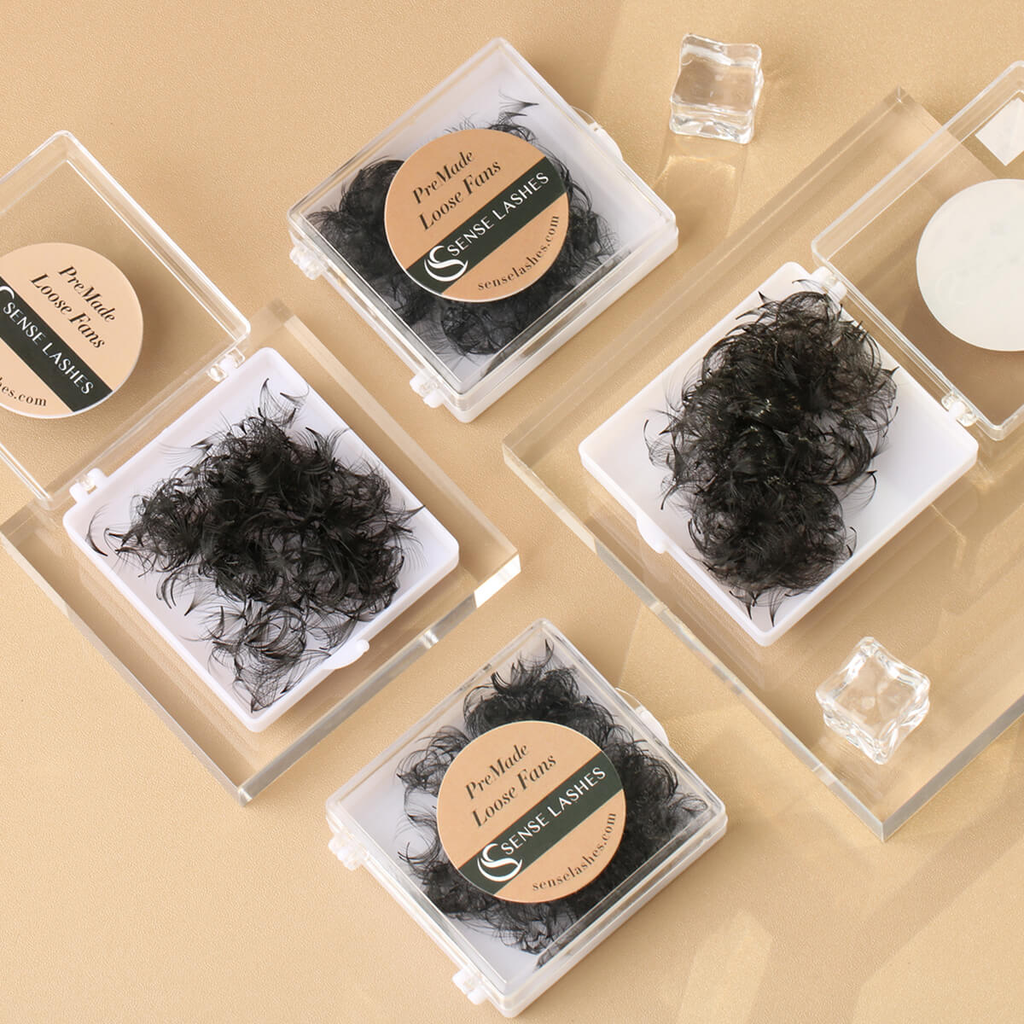
If speed and perfect consistency are the priority, utilizing 16D Handmade Loose Premade Fans Pointy Base ensures that the bases remain narrow. A narrow base is critical for preventing mechanical irritation of the lid margin, which PubMed studies have identified as a source of formaldehyde-related sensitivity and pH-induced keratoconjunctivitis.

The Role of Cyanoacrylate and Compliance
When applying longer, compensatory lengths, the bond must be secure but safe. Health Canada's 2023-2024 reports highlight the importance of using adhesives that comply with strict chemical safety regulations. Using high-purity Ethyl Cyanoacrylate reduces the risk of allergic contact dermatitis, a condition explored in detail by recent dermatology studies.
Professional Workflow: Assessment and Calibration
The difference between a basic artist and an advanced technician is the "Live Calibration" step.
- The First Eye Rule: Complete the mapping and application for the more "difficult" eye (the one requiring more correction) first.
- Side-by-Side Comparison: Have the client open their eyes while seated. Compare the visual plane of the extensions. If the deeper-set eye still looks recessed, you have the opportunity to add a few "spike" layers of 0.07MM Easy Fanning Eyelash Extensions to add depth and dimension before finishing the second eye.
- Documentation: Note the exact lengths and curls used for each eye in the client's file. Asymmetry can change over time due to aging or lifestyle factors, and having a technical baseline is essential for long-term retention and satisfaction.
Salon Sanitation and Safety SOP
To maintain the highest level of professional trust, your technical skill must be matched by clinical-grade hygiene. Following CDC guidelines on conjunctivitis prevention, your station should always include:
- Disposable wands and micro-brushes for every client.
- Hospital-grade sterilization for tweezers between every set.
- A clear "Client Safety Consent Form" that explains the risks of extensions and the importance of aftercare.
Summary of Advanced Mapping Logic
Moving away from symmetrical mapping is a hallmark of professional maturity. By acknowledging the unique planes of each client's face, you move from being a "lash applier" to an "eye architect."
- Acknowledge Asymmetry: Use the seated, neutral assessment to identify orbital depth and ptosis.
- Compensate Strategically: Apply the 1-2mm rule to bring recessed eyes forward.
- Prioritize Health: Use ultra-lightweight 0.03mm fibers to protect lid integrity and prevent mechanical drooping.
- Maintain Compliance: Use only regulated, high-purity adhesives to minimize the risk of dermatitis and chemical injury.
By mastering these technical nuances, you provide results that are not just beautiful, but tailored, safe, and professional.
Disclaimer: This article is for informational and educational purposes only and does not constitute medical advice. Eyelash extension application involves chemicals and proximity to the eye that carry inherent risks. Always consult with a qualified health professional regarding ocular health issues, and ensure you are operating within the legal scope of practice in your jurisdiction.
References
- American Academy of Ophthalmology - Eyelash Extension Safety
- Centers for Disease Control and Prevention (CDC) - Hygiene and Conjunctivitis
- Mayo Clinic - Blepharitis Symptoms and Causes
- Health Canada - Cosmetic Regulations and Cyanoacrylate Compliance
- PubMed - Mechanical and Chemical Risks of Eyelash Extensions (2024)
- PubMed - Allergic Contact Dermatitis from Acrylates