


Startseite Eyelash Extension Supplies Guide
Fixing the Staircase Effect in Multi-Curl Lash Mapping

Achieving Seamless Transitions: The Technical Guide to Multi-Curl Mapping
In the realm of advanced lash artistry, the "staircase effect" remains one of the most persistent technical hurdles. This phenomenon—characterized by abrupt, jagged transitions between different curl types—can compromise the professional finish of a set, turning a custom multi-curl map into a series of visible "steps." For the professional artist, technical mastery over these transitions is not merely an aesthetic choice; it is a hallmark of authoritativeness and consistency that builds client trust.
Achieving a seamless visual slope requires a deep understanding of lash geometry, fiber physics, and the strategic application of length and diameter. This guide explores the mechanisms behind the staircase effect and provides a professional-grade framework for blending curls with precision.
The Geometry of the Staircase: Why Abrupt Transitions Occur
The staircase effect is rarely the fault of the lash fiber itself. Instead, it is typically a result of a mismatch between the visual height of different curls. When an artist switches from a C-curl to a D-curl without adjusting the length, the tighter curvature of the D-curl causes the tip of the extension to sit higher and more upright than the C-curl. This creates a vertical "jump" in the lash line.
According to a comprehensive review on lash extension methods and safety, aesthetic outcomes are heavily dependent on the artist's ability to manage these spatial relationships.
The Physics of Curl vs. Length
A common misconception is that a 12mm C-curl and a 12mm D-curl will appear to have the same length on the eye. In reality, because the D-curl has a smaller radius of curvature, its vertical projection is greater. To the observer, the D-curl looks "taller" despite having the same physical measurement from base to tip.
Logic Summary: Our mapping model assumes that vertical height variance is the primary driver of the staircase effect. This is a geometric constant: as the curl angle increases (from C to D to CC), the perceived height increases if the physical length remains static.

The "1-2mm Rule" for Seamless Blending
To counteract this geometric jump, seasoned artists employ a specific heuristic: the length-drop transition. When moving from a softer curl to a stronger curl (e.g., C to D), you must decrease the length of the stronger curl to maintain a consistent visual line.
Implementing the Transition Zone
In a professional map, the transition should occur over a "blending zone" rather than a single point. If your map transitions from C-curl at 11mm to D-curl, the standard protocol is:
- Zone A (C-Curl): 11mm
- Transition Zone (D-Curl): 10mm (a 1mm drop)
- Zone B (D-Curl): 11mm (returning to the target length once the curl change is established)
This 1mm adjustment effectively "tucks" the D-curl under the profile of the C-curl, preventing a harsh line. For more dramatic transitions, such as moving from a B-curl to a CC-curl, a 2mm drop may be required.
| Transition Type | Recommended Length Adjustment | Rationale |
|---|---|---|
| C to CC/D | Decrease length by 1mm | Offsets the increased vertical lift of the tighter curl. |
| B to D | Decrease length by 2mm | Compensates for the significant change in curvature radius. |
| D to C (Reverse) | Increase length by 1mm | Prevents the softer curl from appearing "lost" or too short. |
Note: These are professional heuristics and may require minor adjustments based on the client's natural lash angle.
Layer Blending and Micro-Texturing
Beyond length adjustments, advanced artists use "layer blending" to diffuse the boundary between curls. The human eye is highly sensitive to patterns; a single line of transition is easy to spot. By mixing diameters and curls across the natural lash layers, you can create a "soft focus" effect that masks the transition.
Mixing Diameters for Texture
Using ultra-fine fibers like 0.05MM Cashmere Premium Mega Volume Eyelash Extensions allows for the creation of dense yet lightweight fans. A key insight for blending is to mix diameters—for instance, using 0.05mm and 0.07mm fans within the same transition zone. The variation in fiber thickness adds a micro-texture that naturally diffuses the transition boundary.
The 0.05MM Cashmere Premium Mega Volume Eyelash Extensions are particularly effective here because their "fan like butter" texture allows for precise placement in the middle and top layers of the natural lashes. When you place a slightly shorter, tighter curl on the top layer and a longer, softer curl on the bottom layer, the two curls "sandwich" the transition, creating a seamless gradient.

Adhesive Influence on Transition Precision
The choice of adhesive is a critical, yet often overlooked, factor in fixing the staircase effect. In transition zones, the artist needs a split-second of flexibility to perfect the fan angle.
Viscosity and Setting Time
While an ultra-fast glue like the 0.5-1 Second Diamond Eyelash Extension Glue is excellent for high-speed application, it may set too quickly for the micro-adjustments required in complex multi-curl mapping.
For transition areas, many advanced technicians prefer a slightly more forgiving adhesive. The 1-2 Second Gold Eyelash Extension Glue provides a 1-2 second drying window. This extra second allows the artist to ensure the fan is perfectly wrapped around the natural lash, ensuring the curl direction is exactly aligned with the map's trajectory.
Methodology Note: We categorize adhesive selection based on room conditions and artist speed. The 1-2 second window is a "safety buffer" for complex mapping where fan geometry is more critical than raw speed.
E-E-A-T: Prioritizing Ocular Health in Multi-Curl Artistry
Technical mastery is inseparable from client safety. Abrupt transitions or poor mapping can lead to more than just aesthetic failure; they can cause mechanical irritation. According to PubMed (2024) research on ocular disorders, mechanical damage and chemical toxicity are the primary risks associated with extensions.
Preventing Mechanical Trauma
A "stepped" lash line often means that some extensions are sitting at awkward angles, potentially rubbing against the eyelid or the ocular surface. This mechanical friction can lead to conditions like Blepharitis (eyelid inflammation), which is often exacerbated by poor hygiene and bacteria buildup.
To mitigate these risks, professionals must:
- Ensure Proper Isolation: Use high-quality tools to prevent "stickies," which cause tension on the follicle.
- Validate Chemical Safety: Only use adhesives that comply with safety standards. Health Canada's enforcement reports highlight the importance of using properly labeled, professional-grade cyanoacrylate products.
- Maintain Hygiene: Educate clients on the necessity of daily cleaning to prevent Conjunctivitis and Demodex mite infestation.
The Role of Fiber Weight
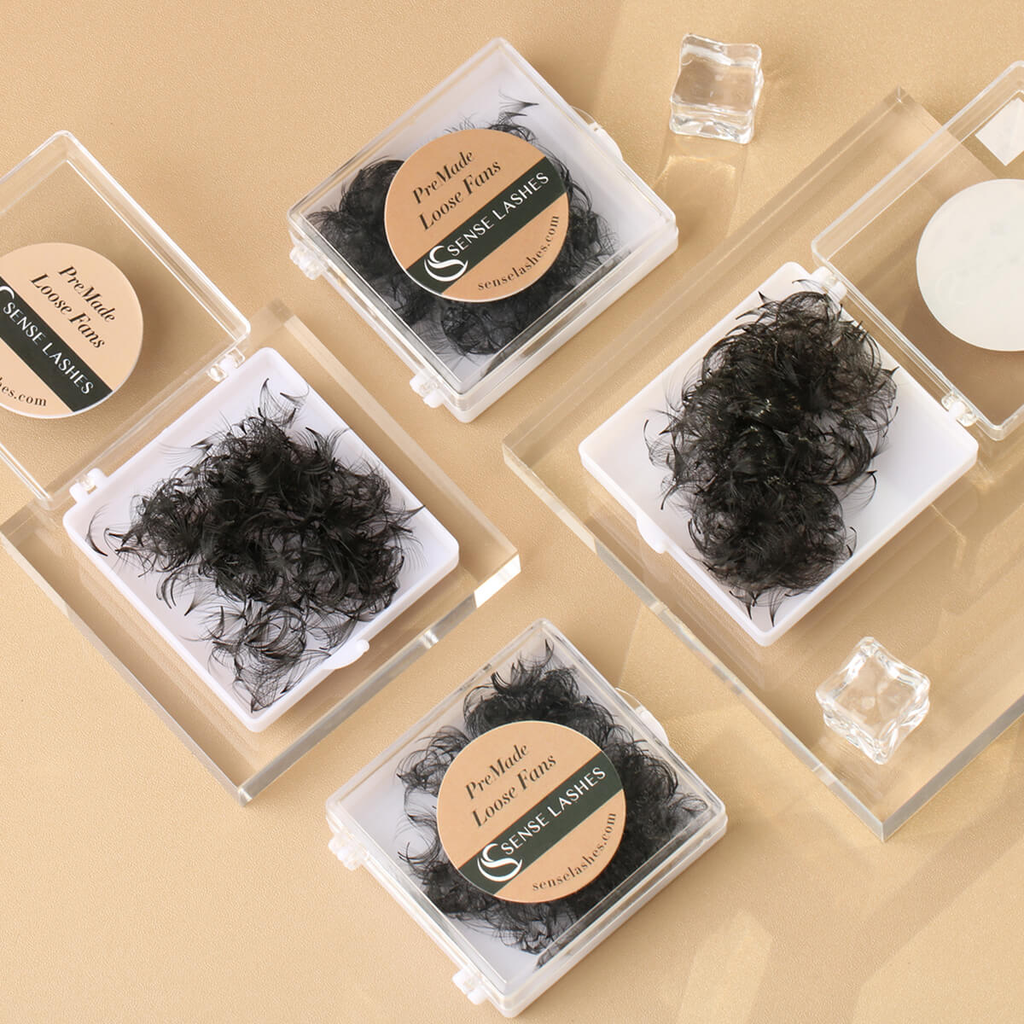
Using lightweight options like 12D Handmade Loose Premade Fans Pointy Base(500 Fans) helps maintain the health of the natural lash. Because these fans are heat-bonded with an ultra-slim base, they provide the "Blackout Look" without the excessive weight that can cause traction alopecia or alter the ocular surface microbiome.
Troubleshooting Common Mapping Failures
If you still notice a staircase effect despite following the 1-2mm rule, consider these three "gotchas":
- Natural Lash Direction: If the client's natural lashes grow downward in one section and straight in another, a uniform map will create a staircase. You must adjust your curl choice based on the natural lash's "starting" angle.
- Inner Corner "Jump": The inner corners often require a much softer curl (e.g., B or C) even if the rest of the set is D-curl. Switching too late or too abruptly in the inner corner is a common beginner mistake.
- Adhesive Blobs: Excessive adhesive at the base can "tilt" the extension upward, effectively changing its curl. Using a thin-viscosity glue like the 0.5-1 Second Diamond Eyelash Extension Glue helps maintain the intended geometry.
The 2025 Industry Perspective
The lash industry is moving toward "Health-First Artistry." As noted by Grand View Research, the demand for professional-grade, reliable supplies is surging as the market matures. Clients are no longer just looking for "long lashes"; they are looking for technical perfection that doesn't compromise their eye health.
| Feature | Impact on Transition | Recommended Tool |
|---|---|---|
| Fiber Softness | Allows for natural blending between layers | 0.05MM Cashmere Lashes |
| Base Thickness | Thinner bases prevent "bulk" at transition points | 12D Pointy Base Premade Fans |
| Glue Flex | Allows for minor fan adjustments during placement | 1-2 Second Gold Glue |
Professional Outcomes and Next Steps
Fixing the staircase effect is a journey of precision. By implementing the 1-2mm length-drop rule and utilizing multi-layer blending techniques, you elevate your work from a standard service to a high-performance cosmetic procedure.
For further reading on maintaining the integrity of your fibers and understanding the chemistry behind your tools, refer to our guides on PBT Curl Memory and Navigating Curl Inconsistency.
Key Takeaways for the Professional:
- Adjust Length for Curl: Always drop 1mm when moving to a tighter curl.
- Layer Intentionally: Mix curls across the horizontal layers of the natural lashes.
- Prioritize Safety: Use medical-grade adhesives and educate clients on Blepharitis prevention.
- Consistency is Key: Use factory-direct supplies to ensure that your "C" and "D" curls are consistent from batch to batch.
YMYL Disclaimer: This article is for informational purposes only and does not constitute professional medical advice. Eyelash extension application involves risks of infection and chemical injury. Always consult with a licensed professional and refer to American Academy of Ophthalmology (AAO) guidelines for eye safety.