


Home Eyelash Extension Supplies Guide
Matching Diameters: Blending Colored Fibers with Black Bases

The Technical Challenge of Fiber Uniformity in Color Artistry
In the pursuit of the "perfect" gradient, professional lash artists often encounter a frustrating phenomenon: the visible ridge. You have mapped the set meticulously, transitions are mathematically sound, and yet, where the black lashes meet the colored accents, the texture looks "off." This is rarely a failure of fanning technique; rather, it is a failure of diameter synchronization.
In professional lash artistry, "nominal diameter"—the number printed on the box—is often an approximation that ignores the physical reality of fiber coatings. When we transition from a standard black PBT (Polybutylene Terephthalate) fiber to a colored or glitter-coated fiber, we are not just changing the pigment; we are changing the physical architecture of the extension. Achieving technical mastery requires us to look beyond the label and understand the micrometer-level differences that impact visual smoothness, weight distribution, and long-term ocular health.
The Physics of Fiber Coating: Nominal vs. Effective Diameter
The most significant "gotcha" in color blending is the thickness added by pigments and specialized coatings. Based on our internal pattern recognition from professional feedback and quality control assessments, a nominally 0.03mm black cashmere lash and a nominally 0.03mm colored glitter lash are rarely identical in thickness.
The glitter or metallic coating typically adds between 0.005mm and 0.01mm to the effective diameter. While this sounds negligible, in a mega-volume fan of 10D or 15D, that cumulative difference creates a fan that is physically wider and visually denser than its black counterpart. This creates a "shadow gap" or a visible step-down in the transition zone.
The Calibration Heuristic: The Silicone Pad Test
To mitigate this, we recommend a "Calibration Protocol" before starting a premium color set.
- Place a silicone lash pad under a high-intensity ring light.
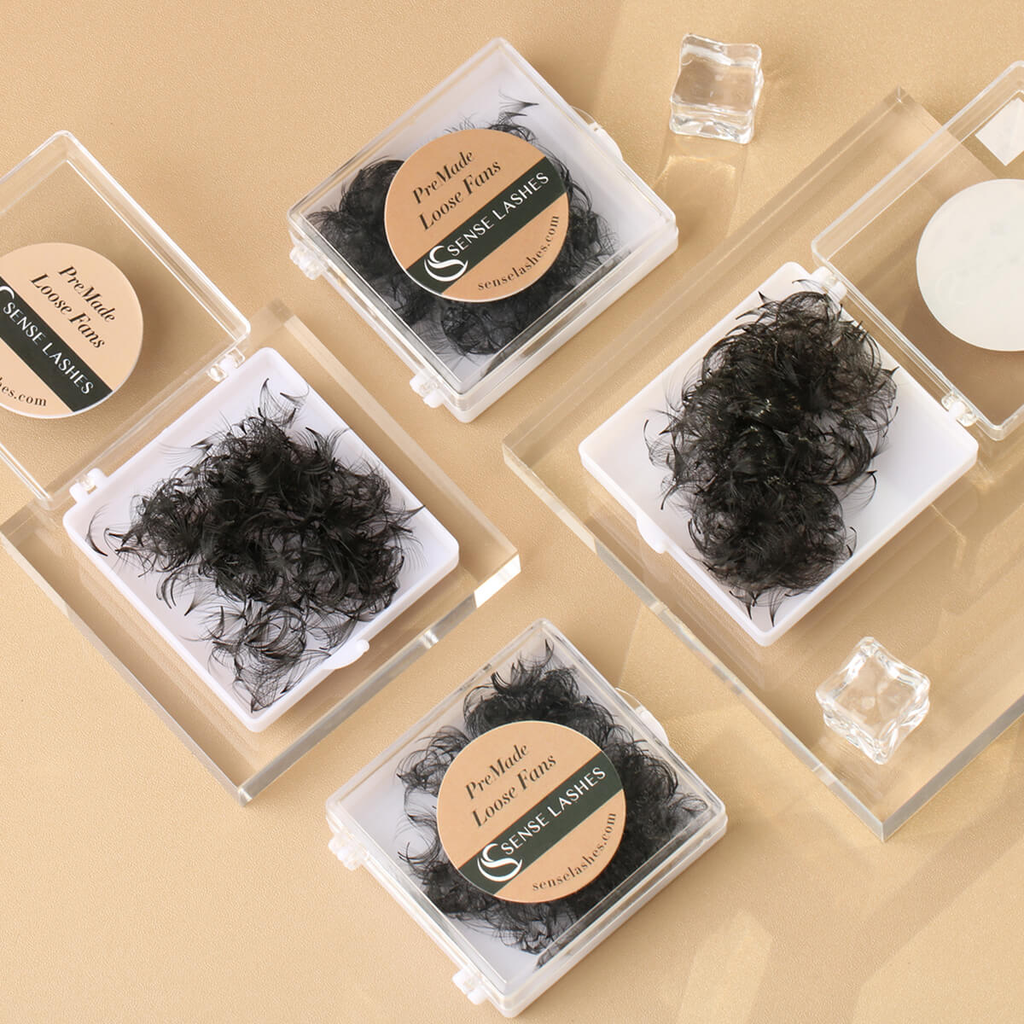
- Create 5-10 fans of your primary black fiber (e.g., 10D Handmade Loose Premade Fans Pointy Base(500 Fans)).
- Create 5-10 fans of your colored/glitter fiber of the same nominal diameter side-by-side.
- Observation: If the colored fans cast a noticeably thicker shadow or appear denser at the base, you must adjust your mapping.
Logic Summary: This calibration assumes that fiber manufacturing tolerances vary by pigment density. We use this heuristic to identify "effective diameter" rather than relying on packaging labels, which helps prevent the "ridge effect" in horizontal blending.

Strategic Blending: Counteracting the "Ridge Effect"
When the effective diameter of your colored lash is thicker than your black base, you have two professional paths to maintain a seamless flow:
1. The Sparse Mid-Transition Technique
Instead of a hard line where black ends and color begins, use the thicker colored fibers sparsely within the final 2mm of the black section. This "interleaving" breaks up the visual ridge, allowing the eye to perceive a smooth gradient rather than a structural change.
2. Diameter Up-Scaling for the Base
If you are using a 0.03mm glitter lash that measures closer to 0.04mm in practice, consider pairing it with a 0.05mm black base, such as the 0.05MM Easy Fanning Eyelash Extensions. By slightly increasing the diameter of the black lashes, you minimize the contrast in fiber density, resulting in a more uniform texture across the entire lid.
For a deeper look at how weight impacts your choice, refer to our guide on Choosing Diameters to Counteract Length-Induced Weight Gaps.
Weight Distribution and Ocular Health
As technical professionals, our primary responsibility is the preservation of the natural lash cycle. A 2024 study published in PubMed (38171996) emphasizes that eyelash extensions can cause a spectrum of disorders, including mechanical damage and chemical toxicity, when weight and application are not precisely managed.
When we blend fibers of different diameters, we are also blending different weights. A 0.07mm fiber is significantly heavier than a 0.03mm fiber, but even the subtle 0.01mm addition from a glitter coating can increase the torque on the natural lash follicle. According to the American Academy of Ophthalmology (AAO), excessive weight can lead to traction alopecia—permanent loss of the natural lash.
Modeling Weight Impact
| Fiber Type | Nominal Diameter | Est. Coating Thickness | Effective Weight Factor | Risk Level |
|---|---|---|---|---|
| Matte Black | 0.03mm | 0.00mm | 1.0x | Low |
| Deep Pigment Color | 0.03mm | ~0.003mm | 1.1x | Low |
| Glitter/Metallic | 0.03mm | ~0.008mm | 1.3x | Moderate |
| Standard Black | 0.07mm | 0.00mm | 5.4x | High (in fans) |
Methodology Note: This table uses a deterministic model based on the volume of a cylinder (V = πr²h). We assume PBT density is constant and calculate the weight increase based on the radius expansion caused by coatings. This is a scenario model for education, not a lab measurement.
When using heavier fibers like 0.07MM Cashmere Premium Mega Volume Eyelash Extensions, it is critical to reduce the number of lashes per fan (D-count) to ensure the total weight remains within the safe threshold for the client's natural lash health.
The Role of Curl and Base Architecture
Diameter matching is only half the battle; curl and base bonding are the other critical variables. A mismatched curl will exaggerate any diameter difference. For instance, a "D" curl in a 0.03mm black lash may have a slightly different radius than a "D" curl in a 0.07mm colored lash due to the way different pigments react to the heat-setting process.
Base Bonding Points
For artists using premade options like the Brown 10D PreMade Loose Fans - 0.07 - 500 Fans, the base architecture is paramount. A heat-bonded, pointy base will nestle seamlessly against handmade fans. However, if the colored premade fan has a thicker, adhesive-bonded base, it will not "sit" at the same level on the natural lash as a slim, handmade black fan.
The Fix: When working with thicker-based colored fans, use a lower-viscosity adhesive. This allows the adhesive to wrap around the thicker base without creating a bulky "bead" that could irritate the eyelid or trap debris.

Risk Mitigation: Hygiene and Chemical Safety
Technical mastery includes protecting the client from the "invisible" risks of lash artistry. Poorly blended sets—especially those with "ridges" or bulky adhesive points—create microscopic "pockets" where bacteria and debris can accumulate.
Preventing Blepharitis and Infection
According to the Mayo Clinic, Blepharitis (eyelid inflammation) is often caused by bacteria or clogged oil glands. When we use thicker fibers or more adhesive to "force" a blend, we increase the surface area for biofilm formation.
We must educate clients that "water is not enough" for aftercare. Daily cleansing with a professional-grade foam cleanser is non-negotiable, especially for complex color sets. This is supported by research in PMC (10361280) regarding Demodex mite infestation and its link to poor ocular hygiene.
Managing Allergic Reactions
A common pitfall is confusing irritation with a true allergy. A study in PubMed (35674514) details allergic contact dermatitis caused by Ethyl Cyanoacrylate. When working with colored lashes, ensure your pigments are FDA-compliant to avoid industrial dyes that may trigger sensitivities.
Furthermore, always adhere to a strict sanitation protocol. Following CDC guidelines on preventing conjunctivitis is the baseline for professional practice. This includes using disposable consumables—like wands and eye patches—for every client to prevent cross-contamination.
Salon Sanitation SOP (Standard Operating Procedure)
To maintain a high-trust environment and ensure the longevity of your color work, implement the following checklist:
- Pre-Application: Perform a thorough lash bath to remove oils. This ensures the adhesive bonds to the fiber, not the debris.
- Adhesive Management: Use fresh adhesive drops every 15-20 minutes to maintain optimal viscosity and reduce fume emission, which WebMD notes can exacerbate dry eye symptoms.
- Isolation Integrity: Use high-quality gel patches to prevent chemical burns from adhesive fumes entering the eye, a risk highlighted in PMC (12415672).
- Post-Application: Use a nano-mister or sealant to balance the pH of the lash environment. Recent studies in PMC (11397841) suggest that restoring the ocular surface microbiome is key to long-term wearability.
Summary of Professional Outcomes
Mastering the blend between black and colored fibers is what separates a "service provider" from a "lash artist." By understanding that nominal diameters are just a starting point, you can calibrate your sets for maximum visual impact and client safety.
Key Takeaways for the Professional:
- Always Calibrate: Test your colored fans against your black fans on a silicone pad to identify effective diameter differences.
- Bridge the Gap: Use a slightly thicker black fiber (e.g., 0.05mm) to blend with "heavy" 0.03mm glitters or colors.
- Prioritize Health: Follow AAO and CDC guidelines to mitigate the risks of weight-related damage and infection.
- Focus on Bases: Ensure your premade fans have pointy, heat-bonded bases for the most seamless integration with handmade fans.
By applying these technical principles, you ensure that every color set you produce is not only a work of art but a benchmark in professional safety and reliability.
Disclaimer: This article is for informational purposes only and does not constitute professional medical or legal advice. Always consult with a qualified health professional regarding eye conditions or allergic reactions.